Shrub · Hydrangeaceae
Slender Deutzia
Deutzia gracilis
A low-maintenance Hydrangeaceae shrub that flowers on old wood and rates non-toxic to pets.
Full sun
Every 5–10 days
USDA 5–8
2–5 ft · 0.6–1.5 m
Overview
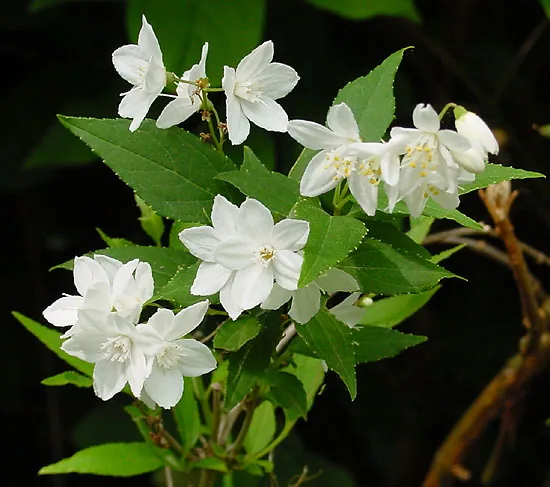
Deutzia gracilis is a low, arching shrub native to Japan and placed in the Hydrangeaceae, the hydrangea family. Its garden value rests on the dense flush of small white flowers it carries each spring along last year's stems. Mature dimensions stay modest at 2 to 5 feet (61 to 152 cm) in both height and spread, which suits it to the front of a border or a path edge where a larger shrub would overwhelm the scale.
Its reputation rests on a wide tolerance for site conditions. The species withstands cold to -20°F (-29°C), performs across clay, loam, and sand, and adapts to soils from acidic to alkaline. Because it asks only for sun and adequate drainage rather than any specific soil chemistry, it earns an easy rating, and that adaptability is the practical reason behind it.
Flowering is concentrated, running about 10 to 14 days in mid to late spring before the shrub returns to a plain green mound for the balance of the season. Selected cultivars extend the interest with burgundy fall color or bright lime foliage held through summer. The plant therefore delivers a defined seasonal display rather than continuous color, a point worth weighing when siting it.
Care
The short version: site it in full sun to part shade in any well-drained soil, water it through dry spells to keep the root zone from drying, and confine pruning to the period right after flowering, since the buds form on old wood and earlier cuts remove them.
Light
Flower production peaks in full sun, since stronger light drives heavier budding, yet the species tolerates partial sun and partial shade with only a reduction in bloom. In hot-summer regions, afternoon shade limits the chlorophyll bleaching that intense heat causes in exposed leaves, so some shelter is the sounder choice where summers are severe.
Water
Hold the soil consistently moist but well drained, watering through establishment and dry spells because a shrub that has not yet rooted out cannot draw on deeper moisture. Allow the surface to dry slightly between waterings, since saturated ground excludes the air roots need. After establishment, an interval of 5 to 10 days in dry weather is usually sufficient.
Soil
The species accepts clay, loam, or sand, so texture is rarely the limiting factor. The genuine requirement is moist, well-drained ground, and its broad tolerance spans a pH of 6.0 to 8.0, meaning chemistry from acidic to alkaline does not constrain placement.
Temperature
Cold hardiness extends through USDA zones 5 to 8, with survival to about -20°F (-29°C). Heat tolerance reaches near 100°F (38°C), though foliage holds condition better under afternoon shade in hot climates, where direct exposure accelerates bleaching.
Humidity
Ambient outdoor humidity meets its needs, so no target figure applies. The more relevant variable is air movement, because still, damp conditions around crowded foliage favor the leaf spot fungi the shrub is otherwise rarely troubled by.
Feeding
Nutrient demand is low. A balanced slow-release shrub fertilizer or compost applied in early spring supplies the season's requirement in a single application. Restrict nitrogen in particular, since excess drives soft, succulent growth that aphids preferentially colonize.
Pruning
Pruning timing follows directly from the flowering habit, because deutzia blooms on old wood, meaning the buds for next spring form on the current stems. Cut immediately after flowering and thin up to one-third of the oldest stems to maintain an open, graceful framework. Late-summer or fall cuts remove the developing buds and forfeit the following season's bloom.
Repotting
Deutzia rarely requires repotting and performs best planted out in the ground. Where it is container-grown, pot up only when roots circle the pot or emerge from the drainage holes, or when water passes straight through with little absorption, all signs the root mass has outgrown its volume.
Size & spacing
Plan for a mounding habit of 2 to 5 feet (61 to 152 cm) in height and a comparable spread. Allow roughly that distance between plants so the arching stems develop their natural form and air circulates through the canopy, which limits foliar disease.
When to plant
Plant deutzia in spring or fall, when mild conditions let the root system extend before the stress of summer heat or hard frost. Flowering is brief, occurring in mid to late spring across roughly March to May, so position it where the display will be seen. Pruning is the one operation tied to a fixed window, and it must follow flowering rather than precede it.
Northern hemisphere
Southern hemisphere
Typical months for a temperate climate: start earlier in warm zones, later where spring frosts linger.
- Plant: Spring or fall
- Harvest: Mid-to-late spring (March to May), blooming for about 10 to 14 days
Hardiness
USDA hardiness zones: 5–8
Temperature: down to -29°C
Troubleshooting
Deutzia is close to trouble-free, and the disorders it does present are almost all cosmetic rather than structurally damaging. A small number of pests colonize the soft spring growth, and intense sun can pale exposed foliage during heat. Identify the symptom below to judge whether intervention is warranted or whether the shrub will recover unaided.
New shoot tips coated in honeydew and small sap feeders
Clustered, soft-bodied insects on the freshest growth are aphids, which concentrate on the new spring shoots where sap sugars are highest. Their feeding excretes sticky honeydew and distorts the expanding leaves. Dislodge the colonies with a strong jet of water, and conserve the lady beetles and lacewings that prey on them to suppress the remainder.
Fix:
- Spray colonies off with a strong jet of water
- Apply insecticidal soap or horticultural oil to affected growth if populations are heavy
- Encourage natural predators such as lady beetles and lacewings
Meandering pale galleries within the leaf tissue
Serpentine pale trails are the feeding mines of leaf miner larvae, which tunnel between the upper and lower leaf surfaces where contact sprays cannot reach them. Remove and destroy the most heavily mined leaves to reduce the population. The injury is essentially superficial on a vigorous deutzia and seldom justifies further treatment.
Fix:
- Remove and destroy mined leaves to reduce the population
- Tolerate light damage, which is mostly cosmetic on an otherwise vigorous shrub
Exposed foliage losing color during high heat
Exposed leaves that fade to pale or near-white during hot, bright weather show foliage bleaching, the breakdown of chlorophyll under high heat and light. The condition is cosmetic and the shrub recovers. In hot-summer regions, an afternoon-shaded position and evenly moist soil reduce the heat load that drives it.
Fix:
- Provide afternoon shade in hot-summer climates
- Keep soil evenly moist to reduce heat stress
Discrete dark lesions developing across the foliage
Discrete dark lesions appearing in damp weather indicate leaf spot disease, a fungal complaint that rarely becomes significant on this shrub. Remove the affected leaves and thin congested stems to raise air circulation through the canopy. Watering at the base rather than overhead keeps the foliage dry, and the problem typically resolves without further action.
Fix:
- Remove and dispose of affected leaves
- Improve air circulation by thinning crowded stems
- Avoid overhead watering
Toxicity
For households with pets or small children, the safety record is unambiguous: slender deutzia is non-toxic across every species checked. The ASPCA reports it safe for dogs, cats, and horses, and NC State Extension records no toxicity. No part of the plant carries a hazard that would restrict where it can be planted.
Safe for
People · Cats · Dogs · Horses · Rabbits · Livestock · Birds
Cats None
The ASPCA classifies slender deutzia as non-toxic, so a cat that samples a leaf is exposed to no toxin.
Dogs None
Dogs are equally unaffected. The foliage will not poison them, though ingesting a large quantity of any plant can still produce a mild, self-limiting digestive upset.
Horses None
No toxicity is documented in horses, so a deutzia sited near a paddock presents no risk.
Rabbits Safe
Rabbits may browse the shrub without harm, as none of its tissues contain a toxic compound.
Livestock Safe
Cattle, goats, and sheep can graze near it safely, since the plant holds no toxic principle.
Birds Safe
The shrub presents no poisoning risk to birds that perch in it or feed on its foliage and spent flowers.
People Safe
Slender deutzia is non-toxic to people and is therefore a sound choice for gardens used by children. It is cultivated for ornament rather than food, so no part of it is intended for consumption.
No special handling precautions are needed; the plant is non-toxic.
Varieties
Several named cultivars depart from the species in foliage color or habit, selected for traits the plain form lacks. The following are the selections most often offered.
Nikko
A dwarf, dense mound of only 1 to 2 feet that functions as a groundcover, its green leaves deepening to burgundy in autumn.
Chardonnay Pearls
A compact selection grown for its lime-yellow foliage and pearl-like buds that open to white flowers.
Pink Minor
A compact form on which pink buds open into white flowers brushed with a blush of pink.
How to propagate
Deutzia propagates readily by two vegetative methods, either rooting a summer softwood cutting or rooting a low stem in place by layering.
Stem cuttingsEasy
Summer · Several weeks to root; transplantable the following season
Softwood cuttings taken in summer root with little difficulty and offer the most reliable route to new plants. Allow several weeks for root initiation, then hold the rooted cuttings undisturbed until the following season, when they are ready to transplant to a permanent position.
LayeringEasy
Spring to summer · One growing season or more
Layering exploits the shrub's low, arching stems. From spring through summer, peg a stem to the soil at a point of contact, where it forms roots. Allow a full growing season or more before the layer has rooted sufficiently to be severed from the parent and lifted.
Myths
The shrub contains compounds harmful to cats and dogs, making it unsafe for pet households.
The published record contradicts this: the ASPCA lists slender deutzia as non-toxic to dogs, cats, and horses, and NC State Extension concurs. The shrub can be planted freely around pets and children, since no part of it carries a documented toxin.
Pruning timing is irrelevant for deutzia, which can be sheared in any season.
Because the flower buds form on old wood, any cut made in late summer, fall, or immediately before bloom removes the next season's flowers along with the stems. Pruning belongs to the window just after the flowers fade, which preserves the developing buds and sustains the display year on year.