Shrub · Hydrangeaceae
Climbing Hydrangea
Hydrangea anomala subsp. petiolaris
A slow rooter that earns its keep with fragrant white lacecaps for decades.
Partial shade
Every 5–10 days
USDA 4–8
30–60 ft · 9.1–18.3 m
Overview
Climbing hydrangea is a deciduous woody vine that climbs by aerial rootlets, holdfasts that adhere to brick, stone, and tree bark without external support. Its origin in the woodlands of Japan and Korea explains the shade tolerance: it performs in part shade and even full shade because it evolved beneath a forest canopy. With maturity it reaches 30 to 60 feet (9 to 18 m), clothing its support in broad green leaves.
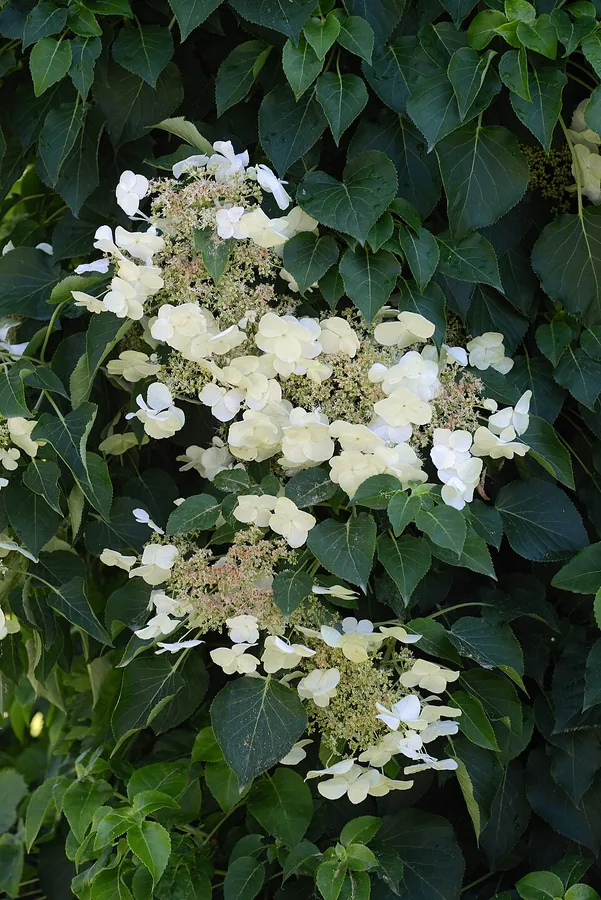
Flowering is the reason most gardeners grow it. In late spring to early summer the vine produces flat, fragrant white lacecap clusters, a ring of showy sterile florets surrounding the small fertile ones at the center. After leaf drop, the peeling cinnamon bark provides structural winter interest.
The defining trait is its pace. A young plant directs its early energy into root development before it extends or flowers, which is why it appears static for the first few years. Site it as a long-term planting, supply rich soil and consistent moisture, and the root investment pays off in vigorous later growth and bloom.
Care
The short version: part shade and rich, evenly moist soil, a strong masonry or freestanding support, and a multi-year establishment period before reliable bloom, all of which follow from its woodland origin and root-first habit.
Light
Part shade gives the best balance. The vine tolerates full shade and grows in full sun, but sun is only viable where soil moisture is reliable, because exposure raises transpiration the roots must keep pace with, and deep shade reduces flowering since the plant has less energy to set buds. An east- or north-facing wall with some light approximates its native exposure.
Water
Maintain soil that is consistently moist but not waterlogged, since the species is intolerant of standing water and the resulting root suffocation. Water deeply during dry spells, roughly every 5 to 10 days by weather, and prioritize this while the vine establishes, when root volume is still small. Plants in sun need more because higher light drives faster water loss.
Soil
Provide rich, humus-heavy loam with free drainage, matching the woodland soils it evolved in. It is adaptable across a pH from 5.5 to 7.5, so soil texture and moisture-holding capacity matter more than the exact reaction.
Temperature
Cold hardiness extends through USDA zones 4 to 8, with the vine surviving minima near -29°F (-34°C). At the upper limit, around 86°F (30°C), heat increases water demand, which is why moist soil and some shade become more important as temperatures climb.
Humidity
Average outdoor humidity meets its needs, so there is no target to maintain. Air movement is the operative factor, because stagnant, humid air around dense foliage favors the powdery mildew and leaf spot fungi.
Feeding
The species is not a heavy feeder. Work a balanced or slow-release granular fertilizer into the soil at the base in spring, since excess nitrogen drives soft, succulent growth that aphids exploit rather than improving bloom.
Pruning
Keep pruning minimal because the vine flowers on old wood. Prune only in late winter or directly after flowering, and only to manage size or remove dead, damaged, or misplaced stems, since hard cuts remove the previous season's wood carrying next year's flower buds.
Repotting
Container culture is rare and repotting almost never required. If a potted specimen shows roots circling the base, water passing straight through, or arrested growth, pot up one size or plant it in the ground, where its eventual scale is better matched.
Size & spacing
Account for its mature dimensions when siting. It climbs 30 to 60 feet (9 to 18 m) and spreads 5 to 6 feet (152 to 183 cm), so the support must bear that weight and the plant must have room to develop over years.
When to plant
Planting time matters because root establishment drives everything that follows. Set the vine out in spring or early fall so the roots develop in cool, moist soil, then anticipate the first flush of bloom from late spring into early summer once the plant is well established.
Northern hemisphere
Southern hemisphere
Typical months for a temperate climate: start earlier in warm zones, later where spring frosts linger.
- Plant: Spring or early fall
- Harvest: Late spring to early summer (May to July)
Hardiness
USDA hardiness zones: 4–8
Temperature: down to -34°C
Troubleshooting
Nearly every complaint about climbing hydrangea traces to its biology or its placement rather than to pathogens. Slow early growth reflects the root-first habit and is expected. Identify the cause below, since the correct response is usually patience or a change of support, not a spray.
Clinging rootlets damaging siding, paint, or mortar
The vine attaches by self-clinging aerial rootlets that penetrate cracks, loose joints, and the spaces behind trim. On wood or stucco these holdfasts strip material and degrade paint, and a mature vine imposes considerable weight on its support. Direct it onto brick, stone, or a freestanding arbor, and where a trellis is used, set it 4 to 6 inches off the wall so air circulates and the vine can be drawn back.
Fix:
- Keep the vine off wood-sided houses; grow it on brick, stone, or sturdy masonry, or on a freestanding arbor, trellis, fence, or large tree
- Mount a trellis 4-6 inches off the wall to allow air circulation and easier removal
- Prune regularly to limit weight and keep growth away from gutters, windows, and trim
Minimal growth and no bloom in the first years
This reflects normal establishment rather than disease. Climbing hydrangea sleeps, then creeps, then leaps, allocating early resources to a deep root system before extension or flowering. Allow 2 to 5 years, maintain moist, mulched soil, and avoid heavy pruning, which removes the old wood that carries flower buds.
Fix:
- Be patient; allow 2-5 years to establish before expecting vigorous growth and bloom
- Keep soil consistently moist and mulched while establishing
- Site in part shade with at least some light to encourage flowering
- Avoid heavy pruning that removes old-wood flower buds
Leaf spots or a white powdery coating
Two fungi account for these symptoms. Cercospora leaf spot produces tan centers with purple margins, while powdery mildew forms a white surface film under humid, still conditions. Remove affected and fallen foliage, water at the base early so leaves dry, and thin the canopy to speed drying.
Fix:
- Remove and dispose of affected and fallen leaves
- Improve air circulation and avoid wetting foliage; use drip irrigation or water early in the day
- Apply a labeled fungicide (such as horticultural oil for powdery mildew) per directions if needed
Sticky leaves, clustered insects, or fixed stem bumps
Tender new growth attracts aphids, which congregate on shoot tips and excrete sticky honeydew. The fixed, immovable bumps on stems and leaf undersides are scale insects such as cottony camellia scale. Dislodge aphids with a strong water jet or insecticidal soap, treat scale with horticultural oil, and limit nitrogen, which produces the soft growth these pests prefer.
Fix:
- Knock aphids off with a strong water spray or treat with insecticidal soap or horticultural oil
- Treat scale with horticultural oil, following label directions
- Encourage natural predators and avoid over-fertilizing with nitrogen
Toxicity
Regard the entire plant as inedible. The leaves, buds, and flowers contain cyanogenic glycosides, compounds that release cyanide on chewing and irritate the digestive tract of pets and people. Serious poisoning is uncommon because a large quantity must be consumed, but since no part qualifies as food, keep pets, grazing animals, and small children from ingesting it.
Toxic to
Cats · Dogs · Horses · Rabbits · Livestock · Birds · People
Cats Mild
A cat that ingests the leaves or flowers typically develops vomiting, diarrhea, and a dull, lethargic demeanor. Serious cyanide poisoning is unusual because it requires a large quantity, but the gastrointestinal upset alone justifies keeping cats away from the plant.
Dogs Mild
Dogs respond comparably, with vomiting, loose stools, and reduced energy after consuming foliage or blooms. The hazard scales with the amount eaten, so a single nibble is far less concerning than a chewed branch.
Horses Mild
The ASPCA records vomiting, depression, and diarrhea in horses that browse the plant. Most cases remain mild, though a horse stripping a large vine represents a greater dose and greater risk.
Rabbits Caution
The cyanogenic glycosides are present in every leaf, bud, and flower, so the plant is not safe browse for a rabbit. Keep it beyond reach and out of the hutch.
Livestock Caution
Grazing animals can absorb the cyanide-releasing compounds when they consume the foliage, which is most likely when better forage is scarce. Exclude cattle, goats, and sheep with fencing as a precaution.
Birds Caution
No record documents birds feeding on it, but the toxin is distributed throughout the plant, so treat it as unsafe and keep pet birds from the leaves and flowers.
People Caution
No part of this plant is food. The leaves, buds, and flowers all contain cyanogenic glycosides, so prevent small children from chewing them, even though a serious dose would require a large amount.
Keep pets and small children from chewing leaves and flowers; no special skin-handling precautions are typically needed.
Helpline numbers

United States
ASPCA Animal Poison Control: (888) 426-4435 (fee applies)
Poison Control: (800) 222-1222



Canada
Poison Centres: 1-844-764-7669
Varieties
The species suffices in most gardens, but a few named selections are worth knowing where variegated foliage or larger inflorescences are the goal.
Firefly
Firefly is a variegated selection whose leaves carry bright yellow margins, delivering foliage color well before the flowers open.
Miranda
Miranda is a second variegated form, with leaves edged in soft lime-green that brightens a shaded position.
Skylands Giant
Skylands Giant is selected for its notably larger flower clusters, which appear once the vine has established.
Japanese hydrangea vine (Schizophragma hydrangeoides)
Japanese hydrangea vine (Schizophragma hydrangeoides) is not a true hydrangea but a closely allied clinging genus, equally slow to establish, occasionally taking up to 7 years to flower, and bearing showy lacecap-style blooms.
How to propagate
Climbing hydrangea propagates by several methods, each constrained by the same slow establishment that governs the parent plant. Layering is the most reliable, and seed the slowest to reach flowering size.
Stem cuttingsModerate
Early to mid summer (softwood or semi-hardwood) · Several weeks to root; multiple years to establish and bloom
Collect softwood or semi-hardwood cuttings from the current season's growth in early to mid summer and hold them moist and humid until they root over several weeks. The constraint is the same slow establishment the species shows, so even a rooted cutting needs years to settle and flower.
LayeringEasy
Spring or summer · One or more seasons to root before separating
Layering in spring or summer is the most dependable method. Pin a low, pliable stem onto moist soil, where it roots readily at the contact point, then wait a season or more before severing the rooted section from the parent.
SeedModerate
Fall or spring · Slow; seedlings take years to reach flowering size
Seed sown in fall or spring is workable but slow. Seedlings develop gradually and require years to reach flowering size, which is why cuttings or layering are the usual choice.
Myths
Climbing hydrangea covers a wall or fence quickly.
In practice it is among the slowest vines to establish, adding little over the first 2 to 3 years while it builds roots. The gardener's shorthand, sleep, creep, then leap, captures the sequence, and rapid climbing comes only after that final stage. Choose it for sites where a multi-season wait is acceptable, not where fast cover is required.