Ornamental · Apiaceae
Masterwort
Astrantia major
Given moist soil and dappled shade, masterwort holds its starry bracts through the cool of summer.
Partial shade
Every 2–5 days
USDA 4–7
2–3 ft · 0.8–0.9 m
Overview
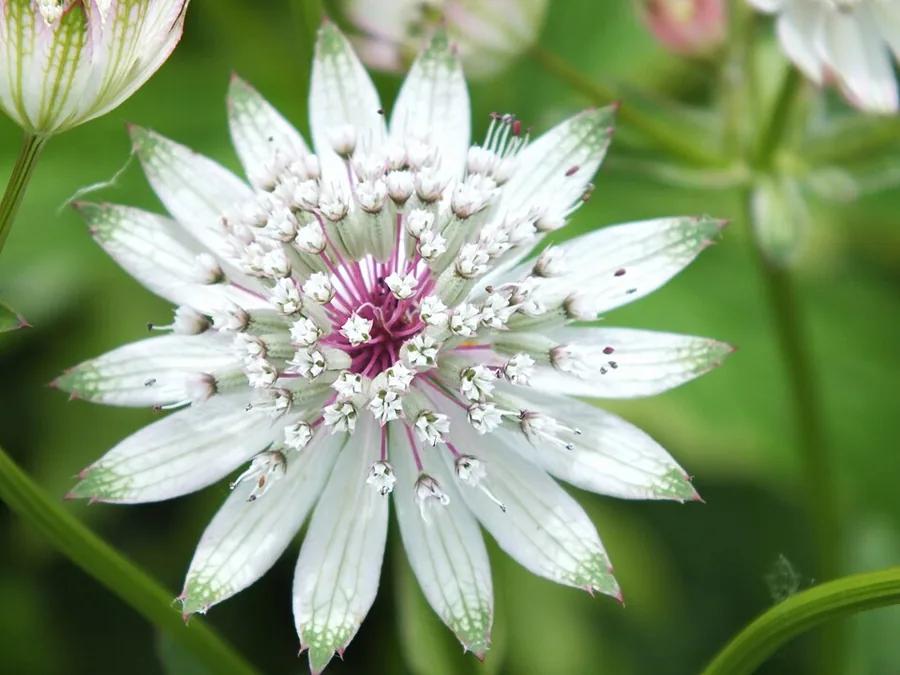
Masterwort is a clump-forming woodland perennial in the Apiaceae, the carrot family, and its inflorescence is textbook for the group: a domed umbel of tiny true flowers sitting within a ruff of papery, petal-like bracts that reads as a single pincushion bloom. It evolved in the cool meadows and mountain woods of Europe, and that provenance dictates the whole of its cultivation.
Because of that origin, masterwort excels in the shaded, moisture-retentive situation that defeats sun-adapted plants. It requires soil kept damp and organically rich, partial shade with perhaps a little morning sun, and the cool regime of a temperate climate. Prolonged hot, dry summers exceed its tolerance, which is why it performs best in northern gardens.
The persistence of the bracts is the horticultural payoff. They keep their color and structure long after the true flowers senesce, so a clump remains ornamental for weeks and dries well for cut work. Interplanted with hostas, ferns, and astilbe, it reads as connective texture that ties a shaded border together rather than dominating it.
Care
The short version: part shade with a little morning sun, soil held evenly moist and never allowed to dry, rich ground amended with organic matter, and the cool conditions that its woodland origin requires.
Light
Masterwort performs best in partial shade, ideally receiving a few hours of gentle morning sun with dappled light thereafter. It tolerates deeper shade, but flowering diminishes as light falls, because the plant cannot fund a full bloom on a reduced light budget. Withhold harsh afternoon sun, which scorches the foliage and accelerates soil drying.
Water
Hold the soil uniformly moist at all times, since the species has no drought tolerance and must be irrigated whenever rainfall is insufficient. Its wetland affinity means it tolerates some standing water and even the margin of a bog garden, so on this plant the safer error is damp rather than dry.
Soil
Establish it in organically rich soil that retains moisture yet still drains, replicating the medium-to-wet woodland ground of its native range. Incorporating generous compost or leaf mold before planting supplies nutrition and raises the water-holding capacity the roots rely on.
Temperature
Masterwort is decidedly cool-adapted, cold-hardy to roughly -29°F (-34°C) and comfortable to about 75°F (24°C). It succeeds across zones 4 through 7 and declines where summers are protracted and hot, which is the physiological limit behind its northern preference.
Humidity
Ambient outdoor humidity is adequate, so no target percentage applies. The operative variable is root-zone moisture, since the combination of dry air and dry soil, not air humidity alone, is what stresses the plant.
Feeding
Apply a light feed in spring, either incorporating organic matter or a balanced fertilizer as growth resumes. Rich soil supplies most of the demand, so heavy feeding is unnecessary and counterproductive: excess nitrogen forces soft growth that recruits aphids.
Pruning
Deadhead the spent umbels after bloom to suppress self-seeding, a cut that frequently redirects the plant into a second flush. The old foliage may be removed in fall or retained for winter structure and cleared in spring.
Repotting
Masterwort builds a slowly enlarging clump, so lift and divide it every few years as it crowds. Reduced flowering, a congested habit, or a dead or sparse center are the clump's own indicators that division is due.
Size & spacing
Mature plants stand about 2.5 to 3 feet (76 to 91 cm) tall and form a clump roughly 12 to 18 inches (30 to 46 cm) wide, so allot each that footprint to let it develop without competing with its neighbors.
When to plant
Masterwort runs on the phenology of a cool-season perennial. Sow seed in late winter after a sustained chill, transplant young stock outdoors in spring once frost has passed or again in fall, and expect the bracted umbels to open from late spring through midsummer.
Northern hemisphere
Southern hemisphere
Typical months for a temperate climate: start earlier in warm zones, later where spring frosts linger.
- Sow: Late winter to early spring; fresh seed needs cold stratification for 2-3 months
- Plant: Spring after frost, or fall
- Harvest: May to July
Hardiness
USDA hardiness zones: 4–7
Temperature: down to -34°C
Troubleshooting
Masterwort is largely trouble-free, with no serious pest or disease problems on record. The few issues that surface are slugs in the damp shade, aphids on succulent new growth, and reduced flowering where the site is too dark or too dry. Diagnose against the entries below and intervene early.
Diminished flowering and a generally poor stand
Sparse bloom in masterwort traces to excessive shade or soil that dries in heat, because this woodland species sets flowers poorly without adequate light and consistent root moisture. Repositioning it for a few hours of morning sun under dappled shade restores the light budget it needs, regular irrigation holds the even moisture its shallow feeding roots depend on, and a mulch layer both conserves that water and buffers root temperature through hot spells.
Fix:
- Move or site the plant where it gets a few hours of morning sun and dappled shade
- Keep soil continuously moist with regular irrigation
- Mulch to keep roots cool and conserve moisture
Irregular chewed holes across the leaf blades
The culprit is slugs, which thrive in exactly the damp, shaded microclimate masterwort wants, so the two go together. Hand-collecting at dusk or first light removes them while they feed, and clearing the debris and mulch near the crown takes away the cool refuge they retreat to by day. Where feeding runs heavy, traps or iron-phosphate bait reduce the population directly.
Fix:
- Hand-pick slugs in the evening or early morning
- Remove debris and mulch hiding places near the crown
- Use traps or iron-phosphate slug bait if damage is heavy
Deformed shoot tips colonized by soft-bodied insects
Clustered soft-bodied insects with sticky honeydew point to aphids, which feed on sap and distort the tender tips as they draw it. A strong jet of water dislodges the colony physically, insecticidal soap handles persistent numbers, and predators such as lady beetles keep populations down over time. Reducing nitrogen matters because the surge of soft, sappy growth it drives is precisely what attracts them.
Fix:
- Spray plants with a strong jet of water to dislodge aphids
- Apply insecticidal soap if populations are high
- Encourage beneficial predators such as lady beetles
Toxicity
For a pet-conscious garden, masterwort reads reassuringly: it is not documented as poisonous. No listing flags it as toxic to cats, dogs, horses, or other animals, and it is safe to cultivate where children and pets are present. As with any foliage, a large ingested quantity can provoke transient gastrointestinal upset, but the plant presents no real hazard.
Safe for
People · Cats · Dogs · Horses · Rabbits · Livestock · Birds
Cats None
No toxic constituents are documented in masterwort, so a cat that samples a leaf faces no chemical hazard. Any reaction to a large mouthful of foliage is mechanical, a little drooling or transient gastric upset that resolves without treatment.
Dogs None
The record flags no poisonous compound in the leaves, stems, or flowers, so masterwort is safe around dogs. A persistent chewer risks nothing worse than mild, self-limiting stomach upset.
Horses None
Masterwort contains nothing toxic to equines, so horses may graze in its vicinity without physiological risk.
Rabbits None
The foliage carries no toxins, so rabbits can browse it safely. Any single large intake of fresh greenery is still best offered in moderation on general dietary grounds.
Livestock None
Cattle, goats, and sheep are unaffected by masterwort, which lacks the compounds implicated in grazing-animal poisonings.
Birds None
Masterwort presents no poisoning risk to birds, so backyard species and poultry can peck at it without consequence.
People None
No listing identifies masterwort as toxic to humans, so incidental contact by a child is harmless. It is cultivated strictly as an ornamental and is not intended for consumption, so there is no reason to eat any part.
Keep pets from grazing ornamental plants as a general precaution; ingestion of any plant material can cause mild gastrointestinal upset.
Varieties
Several named selections are worth distinguishing, since each expresses a different variation on the astrantia bract and floret.
Rubra
A compact selection carrying silver-tinged claret-red florets over rose, papery bracts that retain their form and color well beyond the fading of the true flowers.
Roma
A patented, seed-sterile cultivar bearing rose-red florets and silver-pink bracts, flowering from late spring into midsummer, and, being sterile, producing no self-sown seedlings.
Shaggy
A form of subspecies involucrata distinguished by large white flowerheads subtended by long, deeply cut, green-tipped bracts that give the head its characteristic shaggy outline.
Companions
Masterwort shines beside the other plants of the moist, shaded border, the ones that share its taste for cool, rich, evenly damp ground.
Plant near
Hosta: The fine-textured astrantia foliage contrasts well with large-leaved hostas in shade.
Astilbe: Shares the same moist, part-shade conditions and pairs well in shade and woodland gardens.
Ferns: Thrives in the same moist, shaded woodland setting and provides textural contrast.
Ligularia: Enjoys the same rich, continuously moist soil in part shade.
How to propagate
Masterwort is increased either by dividing an established crown or by raising it from seed, and the two methods differ markedly in the time and stratification they require.
DivisionEasy
Early spring or fall · One growing season
Division in early spring or fall is the most dependable method and the only one that preserves a named cultivar, since the daughter plants are clonal. Lift a mature crown, split it into sections, and replant each; the divisions reestablish over a single growing season.
SeedModerate
Sow fresh seed in late winter to early spring · One to two seasons to flowering
Seed propagation is slower and demands cold stratification. Sow fresh seed in late winter or early spring following a chill of 2 to 3 months, which breaks the dormancy the embryo carries, and scarifying the coat improves emergence. Expect one to two seasons to first flowering, and note that cultivars seldom come true because seedlings segregate.
Myths
Masterwort is the same plant as the medicinal herb of the same name.
The masterwort of traditional herbal medicine is generally an Angelica or Peucedanum species, taxonomically distinct from this plant. Astrantia major is an ornamental grown for its bracted inflorescences, not the folk-medicine herb that merely shares the vernacular name.
Astrantia spreads aggressively and takes over the garden.
Under favorable conditions masterwort does extend by underground stolons and self-seeding to form colonies, so the observation has a basis. The spread is slow, however, and the plant reads as well-mannered rather than invasive. Deadheading after bloom removes the seed source and holds any self-sowing in check.