Ornamental · Asteraceae
Ligularia
Ligularia dentata
Sited in damp shade, the leopard plant answers with bold foliage and tall daisy spires.
Partial shade
Every 2–4 days
USDA 3–8
3–4 ft · 0.9–1.2 m
Overview
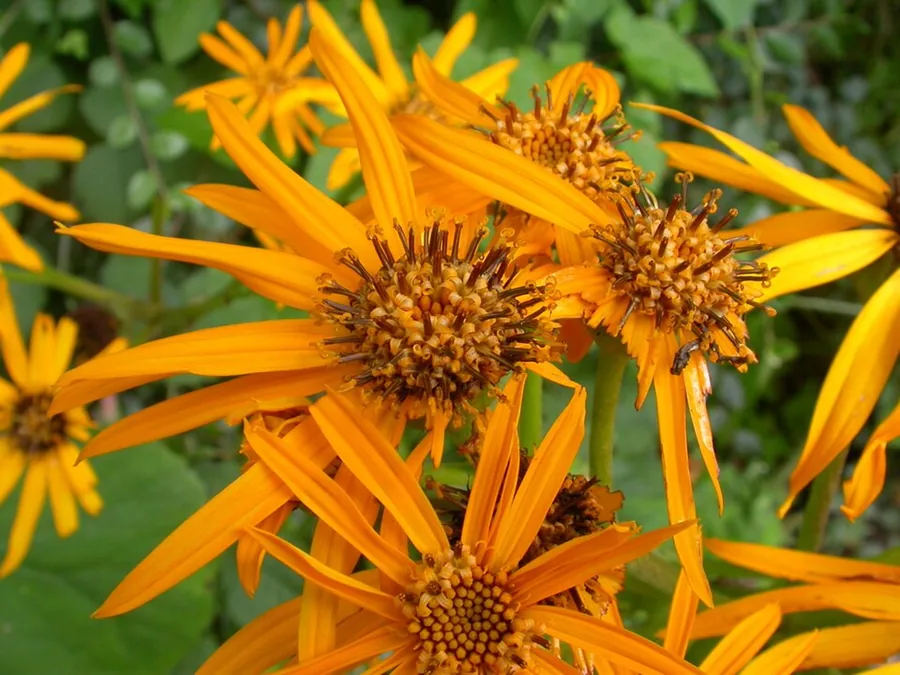
Ligularia, the leopard plant, is a coarse-textured perennial in the daisy family valued for presence at the shaded margin of a pond or bog. Against the usual restraint of shade planting, it produces large rounded blades and tall inflorescences of yellow and orange flowers. Its cold tolerance is considerable, carrying it through winters to zone 3.
Its two governing requirements are water and shade. The root zone must stay damp to wet and never dry, and the broad leaves scorch and lose turgor in full sun, a response sharpened in hot-summer regions. A cool, moist, sheltered position lets it settle into a durable, long-lived clump.
Cultivar selection turns on the display you want. Several hold purple-black foliage across the season, while others elevate their flowers on dark spires well above the leaf mound. Because all demand the same damp shade, the decision reduces to whether foliage or bloom should lead.
Care
The short version: part to full shade in rich soil held constantly moist to wet, relief from direct sun during hot afternoons, and a clean cutback once the foliage has faded.
Light
Site ligularia in part to full shade. It tolerates deep shade far better than open sun, and in hot-summer regions a position out of harsh afternoon light limits the leaf scorch and loss of turgor that follow high radiant and thermal load.
Water
The plant requires constantly moist to wet soil that never dries, met by deep watering every 2 to 4 days in warm weather. Because the large blades can transpire faster than the roots resupply, the foliage may still flag on hot afternoons over moist ground and recovers as the day cools.
Soil
Provide rich, humusy ground high in organic matter for its water-holding capacity. It accepts clay, loam, or sand provided the soil stays moist, and it tolerates a broad pH from 6.0 to 8.0.
Temperature
Ligularia is exceptionally cold-hardy, enduring -40°F (-40°C) and holding to roughly 86°F (30°C). Heat, not cold, sets the limit, so decline follows hot, dry summers rather than severe winters.
Humidity
Ambient outdoor air is sufficient, so no target figure applies. The operative factor is moisture at the roots, which governs how well the foliage sustains itself through summer heat.
Feeding
Supply a balanced fertilizer across the growing season, or top-dress the crown with compost in spring. Richer soil supports the demand of this large-leaved, heavy-transpiring plant.
Pruning
Remove the spent flower stalks after bloom and clear fading foliage as it declines. Cut the plant to the ground in late fall or early spring to reset it for the next flush of growth.
Size & spacing
A mature clump reaches 3 to 4 feet (91 to 122 cm) in height with a spread of 2 to 3 feet (61 to 91 cm). Allow that footprint so the broad blades expand fully without competition.
When to plant
Ligularia is a cool-season perennial that regrows from the crown each year. Seed is started in late winter, plants are set out in spring after the frost danger passes or in early fall, and flowering runs through June and July.
Northern hemisphere
Southern hemisphere
Typical months for a temperate climate: start earlier in warm zones, later where spring frosts linger.
- Sow: Late winter to early spring; seed germinates best with cool conditions
- Plant: Spring after frost danger passes, or early fall
- Harvest: Blooms June to July
Hardiness
USDA hardiness zones: 3–8
Temperature: down to -40°C
Troubleshooting
Nearly all ligularia problems resolve to one of two causes: slug feeding or excess heat and sun. The foliage itself usually indicates which. Identify the symptom below, then correct the underlying cause rather than the visible sign.
Chronic decline and scorch in a hot-summer climate
Ligularia is a cool-climate perennial whose performance falls off under heat, drought, and full sun. When decline coincides with the hottest, driest part of the season, the growing site rather than any pest is the limiting factor. Relocation to a shadier, cooler position that holds even moisture resolves it, and incorporating organic matter raises the soil's water-holding capacity so it stays charged between rains.
Fix:
- Relocate to a shadier, cooler, consistently moist site
- Add organic matter and maintain even soil moisture
Ragged feeding holes across the foliage
The soft, expansive leaf blades present an ideal target for slugs and snails, nocturnal feeders that betray themselves with drying slime trails. Hand removal after dark is the most direct control, supported by shallow traps or iron-phosphate bait staged close to the crown. Because these mollusks shelter under cool, moist cover during daylight, clearing damp mulch and debris removes the refuge that sustains the population.
Fix:
- Hand-pick slugs in the evening
- Set out shallow traps or iron-phosphate slug bait
- Reduce excess mulch and debris where they hide
Afternoon collapse of the foliage with overnight recovery
This is textbook heat stress, seen on hot afternoons even where soil moisture is fully adequate. The large blades transpire faster than the roots can resupply, so turgor drops and the leaves flag until evening temperatures ease the demand and they rehydrate. Afternoon shade lowers the transpiration load, deep watering keeps the root zone charged, and mulch buffers both soil temperature and moisture loss.
Fix:
- Provide afternoon shade or dappled shade
- Keep soil consistently moist with deep watering
- Mulch to conserve soil moisture and keep roots cool
Toxicity
Regard ligularia as strictly ornamental. The leaves contain pyrrolizidine alkaloids, the class of liver-toxic compounds also found in its ragwort relatives, making them mildly toxic to pets, livestock, and people in any quantity ingested. A single exploratory bite seldom exceeds gastrointestinal upset, yet no part of the plant is edible.
Toxic to
Cats · Dogs · Horses · Rabbits · Livestock · Birds · People
Cats Caution
A single taste typically produces no more than drooling or transient gastrointestinal upset. The material concern is the pyrrolizidine alkaloids held in the leaves, which impose a cumulative burden on the liver when a cat grazes repeatedly.
Dogs Caution
A dog that samples a leaf generally shows only drooling and loose stools. The hazard scales with dose, because the alkaloids are hepatotoxic and their effect accrues with sustained ingestion.
Horses Caution
Horses usually decline it, which limits exposure. In common with its ragwort relatives, ligularia carries pyrrolizidine alkaloids that accumulate in and damage the liver under continued grazing.
Rabbits Caution
It should never be offered as forage. The liver-toxic alkaloids that affect larger animals are present in the leaves, so confine rabbits to greens of known safety.
Livestock Caution
Cattle, sheep, and goats face the recognized ragwort hazard. Because the pyrrolizidine alkaloids accumulate in the liver, injury results from repeated grazing over time rather than from an isolated mouthful.
Birds Caution
Poultry and pet birds should be kept from the foliage. The alkaloids documented as toxic to mammals are prudently regarded as a hazard to birds as well, so shared access is inadvisable.
People Caution
No part of ligularia is edible. The leaves contain pyrrolizidine alkaloids that are hepatotoxic in any quantity, so children must be kept from tasting it and the plant treated as strictly ornamental.
Helpline numbers

United States
ASPCA Animal Poison Control: (888) 426-4435 (fee applies)
Poison Control: (800) 222-1222



Canada
Poison Centres: 1-844-764-7669
Varieties
The ligularias in general cultivation are few, and they divide cleanly into selections grown for dark foliage and those grown for their flower spires.
Desdemona
The large emerging leaves flush purplish-red and mature to brownish-green uppers over purple undersides, carried beneath sizable daisy flowers.
Britt Marie Crawford
Its glossy, leathery blades retain a pronounced purple-black through the whole season beneath bright orange-yellow daisies.
The Rocket (Ligularia stenocephala)
Properly the allied Ligularia stenocephala rather than L. dentata, it raises slender 4 to 5 foot spires densely set with small lemon-yellow flowers on purple-tinged stems above triangular, toothed foliage.
How to propagate
Ligularia increases slowly but reliably, either by division of an established crown or from seed.
DivisionModerate
Early spring or fall · One growing season
Division of an established clump is the most dependable method of increase. Lift and separate the crown in early spring or fall, hold the divisions under consistent moisture as they root, and they establish across a single growing season.
SeedModerate
Late winter to spring · Plants may take a year or more to reach flowering size
Seed sown from late winter to spring germinates most reliably under cool conditions that suit the species. The trade-off is time, since a seedling commonly requires a year or more to reach flowering size.
Myths
Ligularia needs full sun to flower well.
The requirement runs the other way. This is a shade-adapted species that performs best in part to full shade, and excess sun induces wilting and weakened growth, most acutely in hot-summer regions. Provide shade and consistent moisture and flowering follows.
Ligularia and Farfugium japonicum are the same plant.
The shared leopard plant name and Farfugium's former placement within Ligularia are the source of the confusion. Taxonomists reassigned Farfugium to its own genus years ago. True ligularias are distinct moisture-loving perennials, not the same plant.