Herb · Lamiaceae
Lemon Balm
Melissa officinalis
Disturb the foliage and the volatile oils release at once: lemon balm scents the whole garden lemon while demanding almost no input.
Full sun
Every 5–7 days
50–86°F · 10–30°C
70–90 days
Overview
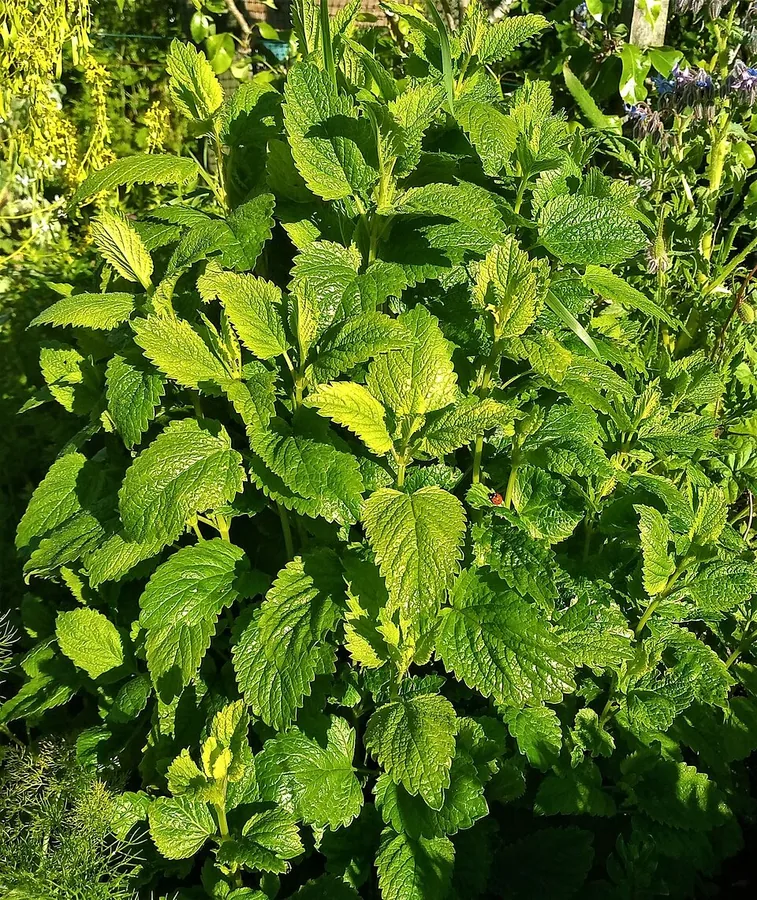
Melissa officinalis is a hardy herbaceous perennial in the mint family, cultivated for soft, crinkled leaves whose volatile oils carry a distinct lemon scent when the tissue is bruised. Native to the eastern Mediterranean and western Asia, it has served as a cottage garden staple for centuries and is valued equally by pollinating bees and by cooks. The small summer flowers are inconspicuous, so the foliage remains the principal ornamental and culinary feature.
Its tolerance is broad. The plant performs on poor, sandy, or rocky substrates, accepts full sun through partial shade, and recovers vigorously from hard pruning because it regenerates readily from the crown. The one trait that warrants management is its capacity to spread, both by prolific seed and by creeping rhizomes, which is the practical reason many growers confine it to a pot or a restricted bed.
For culinary quality, harvest the leaves before flowering, when essential oil content and lemon flavor peak. Once the plant blooms the foliage coarsens, so a hard shear after bloom removes the spent growth, triggers tender new shoots, and maintains a compact, well-foliated clump.
Care
The short version: grow it in full sun to part shade in average, well-drained soil, water steadily during establishment and sparingly thereafter as drought tolerance develops. Feed minimally, harvest before bloom, and shear hard after flowering to sustain vigor and restrain spread.
Light
Site it in full sun, which maximizes canopy density and essential oil concentration, so the foliage stays fragrant. It tolerates partial shade, a useful buffer in hot climates, though insufficient light produces thin, floppy growth.
Water
Maintain even moisture during establishment, then reduce as the plant develops drought tolerance and requires irrigation only about every 5 to 7 days in dry weather. Saturated soil is the principal risk, particularly over winter when low respiration makes waterlogging lethal, so ensure free drainage.
Soil
It grows on almost any substrate, from poor sand to clay to shallow rocky ground, provided drainage is adequate. Average, well-drained loam at a pH of 6.0 to 7.5 is optimal. High fertility is counterproductive, since it drives lush vegetative growth at the expense of essential oil and thus scent.
Temperature
The active growing range runs from 50°F to 86°F (10°C to 30°C). As a perennial hardy to USDA zone 3, the root system survives severe winters and resumes growth from the crown each spring.
Humidity
Ambient outdoor humidity of 40% to 60% is sufficient. Air movement is the more critical variable, because stagnant, crowded conditions raise the leaf-surface moisture that powdery mildew requires to establish.
Feeding
The plant needs little to no supplemental fertilizer. A single light balanced feed in spring suffices, and excess nitrogen produces soft, leafy growth with diminished lemon aroma.
Pruning
Shear the plant after flowering and clear the spent stalks to stimulate fresh, fragrant regrowth and suppress self-seeding. Frequent harvest before bloom functions as ongoing pruning and yields the highest-quality foliage.
Repotting
For container specimens, repot or divide every 1 to 2 years, preferably in spring. Roots circling the pot or emerging from drainage holes, together with slowed growth and rapid drying, indicate the plant has exhausted its root volume.
Size & spacing
A mature specimen attains 18 to 35 inches (45 to 90 cm) in height with a comparable spread. Allow each plant 18 to 35 inches (45 to 90 cm) so airflow through the canopy stays adequate and mildew pressure remains low.
When to plant
Lemon balm is hardy and its schedule is straightforward. Sow indoors in late winter, transplant outdoors in spring once frost risk has passed, and harvest through summer, completing the heaviest cutting before flowering sets in around June to August.
Northern hemisphere
Southern hemisphere
Typical months for a temperate climate: start earlier in warm zones, later where spring frosts linger.
- Sow: 6-8 weeks before the last spring frost
- Plant: Spring, after the last frost
- Harvest: Small white to pale-yellow flowers in summer (about June-August); harvest leaves before flowering for best flavor
Hardiness
USDA hardiness zones: 3–9
Temperature: down to -40°C
Troubleshooting
Serious problems are uncommon on lemon balm. Nearly every complaint traces to a specific cause, crowding, still air, or the plant's spreading habit, and each responds to a targeted correction. Identify the symptom below and address the underlying condition.
Volunteer seedlings and an expanding clump breaking past the bed
Lemon balm advances on two fronts, dropping abundant viable seed once flowers mature and extending laterally on rhizomes, so an isolated clump colonizes surrounding ground within a season or two. Interrupt the seed cycle by cutting the plant back before the flowers set, and remove volunteers while they are shallow-rooted and easy to lift. Confining it to a container blocks both routes of escape.
Fix:
- Deadhead and cut back before seed set
- Pull volunteer seedlings
- Grow in a container to contain spread
White fungal film developing over the upper leaf surface
That coating is powdery mildew, a foliar fungus favored by crowding and stagnant air around the canopy. Remove the most affected leaves, thin the stand to restore air movement through the clump, and keep irrigation off the foliage so leaf surfaces dry quickly. Because the pathogen struggles in bright, well-ventilated conditions, relocating the plant to full sun usually resolves it.
Fix:
- Remove and discard affected leaves
- Improve air circulation by thinning and spacing plants
- Avoid overhead watering
Post-bloom stems sprawling open with a bare, woody base
After flowering the plant redirects energy from vegetative growth, so the stems sprawl open and lignify at the base while foliage thins toward the tips. A hard shear removes that spent framework and stimulates dense new shoots from the crown within a few weeks. Repeating this cut each year after bloom keeps the clump compact and well foliated.
Fix:
- Cut plants back hard after flowering to force fresh compact growth
Toxicity
The verdict here is clear: lemon balm is non-toxic across the board. The ASPCA classifies it as safe for cats, dogs, and horses, and as a culinary herb it is consumed by people routinely. The only party it genuinely inconveniences is the gardener managing its spread.
Safe for
People · Cats · Dogs · Horses · Rabbits · Livestock · Birds
Cats None
Classified non-toxic, so a cat is safe near it. Ingesting the foliage may bring on a mild, transient gastric upset attributable to the concentrated essential oils, and nothing more serious.
Dogs None
No toxic principle affects dogs. Chewing the lemon-scented foliage carries no risk.
Horses None
Documented non-toxic to horses, which can graze the plant without adverse effect.
Rabbits None
Rabbits digest the leaves without incident, and many readily consume the aromatic foliage.
Livestock None
Cattle, goats, and sheep may browse it freely, with no toxicity on record.
Birds None
The foliage presents no hazard to backyard birds or poultry.
People None
A recognized culinary herb, infused as tea and used to flavor food. The leaves are safe for consumption by adults and children alike.
Non-toxic culinary herb; leaves are edible and commonly consumed.
Varieties
The plain green species predominates in cultivation, but a few selections are distinguished by foliage color or by scent chemistry. These are the named forms worth sourcing deliberately.
Aurea
Its foliage carries a gold and green variegation that reaches its strongest expression under cool temperatures and partial shade.
All Gold
It holds solid golden-yellow foliage that retains the best color in partial shade, which shields the leaves from scorch.
Lime
It was selected for an aroma that reads as sharp lime rather than the species' characteristic lemon.
How to propagate
Lemon balm ranks among the most easily propagated herbs. Division, cuttings, and seed all succeed, and the plant will seed itself around the garden without any intervention.
DivisionEasy
Spring or early fall · 4-6 weeks
Division is the most reliable method for preserving a named cultivar true to type, since it reproduces the parent clonally. Lift a mature plant in spring or early fall, separate the crown into sections, and replant them. Each section re-establishes and puts out roots within roughly 4 to 6 weeks.
Stem cuttingsEasy
Late spring to summer · 3-4 weeks
Softwood stem cuttings root with minimal effort because the tissue is still actively growing. Take them from late spring through summer and place them in a moist medium or plain water, where adventitious roots form in about 3 to 4 weeks.
SeedModerate
Spring; surface-sow as seed needs light · 2-3 weeks to germinate, several weeks more to establish
Seed is the slower option and will not hold a cultivar true, given how freely the plant self-sows. Surface-sow in spring rather than covering the seed, because germination is light-dependent and needs warmth. Emergence takes 2 to 3 weeks, with several additional weeks before the seedlings are established.
Myths
Lemon balm is a form of true mint.
It does belong to the mint family, Lamiaceae, together with the true mints, yet it stands in its own genus, Melissa, and is not a Mentha. The lemon-scented, softer foliage marks the distinction once the difference is understood.
Lemon balm stays contained and does not run like mint.
It disperses just as aggressively, only through a different mechanism. Allowed to flower, it self-seeds heavily and advances on rhizomes, moving beyond the bed unless the flowers are deadheaded or the plant is confined to a container.