Shrub · Actinidiaceae
Kiwi
Actinidia deliciosa
Give it full sun, a strong trellis, and a male partner, and a kiwi vine rewards the patience with fruit.
Full sun
Every 3–7 days
USDA 7–9
10–20 ft · 3–6 m
Overview
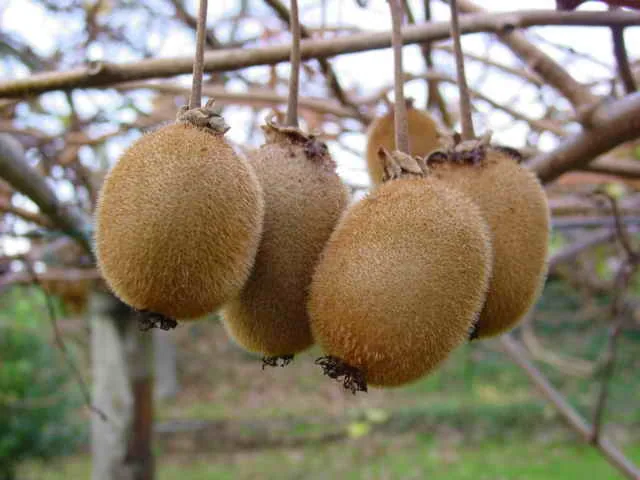
Kiwi is a large, fast-growing woody vine native to the hill country of southern China, where it was cultivated as the Chinese gooseberry long before New Zealand commercialized it for export. Its vigor is considerable: an unchecked vine climbs both hard and wide and will occupy a 200 square foot trellis with twisting cane and broad foliage. The familiar fuzzy brown fruit is borne only on female vines, and only after several years of establishment.
The reproductive biology is what most often defeats a new grower. Most kiwi are dioecious, carrying staminate and pistillate flowers on separate plants, so an isolated vine flowers without ever setting fruit. The remedy is to interplant a male among the females, at roughly one male to several females, and rely on bees to transfer pollen between them.
Fruiting is a matter of patience rather than speed. A young vine devotes its first 3 to 5 years to structural growth before it comes into bearing, and its mature mass requires a serious trellis to support the framework. Given full sun, consistent moisture, and annual pruning, a well-sited vine remains productive for decades.
Care
The short version: full sun, deep and fertile well-drained soil on the acidic side, consistent moisture over a shallow root system, a strong trellis to carry the framework, and both a male and female vine to obtain fruit.
Light
Kiwi crops most heavily in full sun, which drives fruit ripening and supports the vine's substantial vegetative demand. It tolerates partial sun or light shade, but shading reduces yield and produces softer, more elongated canes.
Water
Because the root system is shallow and draws from a limited soil volume, the vine requires steady, even moisture and stresses quickly under drought. Irrigate deeply through fruit development and hot weather, and mulch to conserve soil moisture, keeping the mulch pulled back from the trunk.
Soil
Site it in deep, fertile, well-drained loam high in organic matter. Kiwi favors mildly acidic conditions, a pH of 5.0 to 6.5, and it will not tolerate waterlogging or salty and alkaline soils.
Temperature
The vine withstands a broad thermal range, roughly 14°F to 95°F (-10°C to 35°C) across the season, but the unlignified spring shoots are its vulnerable point. A late frost after growth has begun can destroy the season's new wood in a single night.
Humidity
Ambient outdoor humidity, on the order of 40% to 70%, meets the vine's needs. There is no target to manage outdoors, so direct attention to irrigation and air movement instead.
Feeding
Apply a balanced or nitrogen-rich fertilizer around the root zone monthly through spring and midsummer, coinciding with active growth. Discontinue by late summer so the new growth firms and hardens off ahead of winter.
Pruning
Kiwi requires regular, decisive pruning to remain within bounds and to sustain cropping. Prune female vines hard in winter while fully dormant, renewing the fruiting wood annually, since fruit is borne on current-season shoots arising from one-year-old wood. Summer-prune the vigorous canes to admit light, prune males lightly after flowering, and train young vines to a single trunk on the trellis.
Repotting
Kiwi is grown in the ground rather than in containers, so repotting rarely applies. If a young vine is started in a pot, pot it on before the roots circle, then transfer it to its permanent trellised position.
Size & spacing
These vines attain large dimensions, reaching 10 to 20 feet (3 to 6 m) in height and spreading 7 to 13 feet (2 to 4 m) wide. Provide each with a strong, well-anchored trellis and ample space, because a mature plant can fill a 200 square foot frame and collapse insufficient support.
When to plant
Kiwi follows a long, deliberate seasonal cycle. Plant in spring once the last hard frost has passed, since the emerging shoots are markedly frost-tender, then allow several seasons of vegetative growth before the late-spring flowers give way to fruit harvested in mid to late fall.
Northern hemisphere
Southern hemisphere
Typical months for a temperate climate: start earlier in warm zones, later where spring frosts linger.
- Plant: Spring after the last hard frost; new shoots are very frost-tender.
- Harvest: Slightly fragrant greenish-white flowers in late spring; fuzzy brown fruit harvested mid to late fall (about October to November).
Hardiness
USDA hardiness zones: 7–9
Temperature: down to -18°C
Troubleshooting
Most kiwi failures reduce to three underlying factors: frost injury to tender new growth, the absence of a compatible male, or moisture stress on a shallow root system. Reading the early signs on shoots, flowers, and leaves usually lets you address the cause before the season is lost.
New spring shoots turning black and limp
The soft spring flush is the least cold-hardy tissue on the vine, so this is frost damage to frost-tender new growth. Because the young shoots have not yet lignified, a single cold night after budbreak collapses their cells while the older, harder wood remains sound. Once the vine resumes growth, prune the dead shoots back to living wood, and hold frost cloth in reserve to cover the canopy whenever a late frost threatens.
Fix:
- Prune out killed shoots back to healthy wood once growth resumes
- Cover vines with frost cloth when frost is forecast
Plenty of flowers but no fruit forming
The species is dioecious, so male and female flowers occur on separate plants, and a female with no pollen source in range flowers fully yet sets no fruit. A second cause is immaturity, because a vine commonly requires 3 to 5 years before it reaches fruiting age. Establish at least one male within the females' pollinating range and support strong bee activity through bloom to move pollen between the sexes.
Fix:
- Plant at least one male kiwi within pollinating range of the females
- Encourage bee activity at bloom time
Scorched leaf edges and wilting in the heat of the day
The vine's shallow root system draws from a limited soil volume, so transpiration outruns uptake during heat and the leaves show it as scorched leaf margins and midday wilting. Hot, dry wind raises the transpiration demand and deepens the effect. Irrigate deeply through any dry stretch and apply a thick organic mulch over the root zone, held clear of the trunk, to buffer soil moisture.
Fix:
- Water deeply and regularly during dry spells
- Apply organic mulch over the root zone
Toxicity
For households with pets, the assessment is straightforward: the kiwi vine is non-toxic throughout. The fruit is an ordinary food crop, and neither the foliage nor the stems poison cats, dogs, or livestock. Cats may show a marked attraction to the vine comparable to their response to catnip, which is a behavioral effect and not a toxic one.
Safe for
People · Cats · Dogs · Horses · Rabbits · Livestock · Birds
Cats None
Kiwi presents no toxic hazard to cats, though many respond strongly to the vine much as they do to catnip, since the genus Actinidia includes silver vine. That behavioral attraction carries no risk, so a cat rolling on the canes warrants no concern.
Dogs None
The vine and its fruit pose no danger to dogs. A dog that ingests a large quantity of fuzzy skin or unripe fruit may show transient gastrointestinal upset, which reflects overconsumption rather than any toxic principle.
Horses Safe
No part of the plant, whether leaf, stem, or fruit, is toxic to horses. Grazing in the vicinity of a kiwi vine carries no poisoning risk.
Rabbits Safe
Rabbits may browse the foliage without harm, and a small portion of ripe fruit serves as a suitable occasional treat. The plant contains no relevant toxin.
Livestock Safe
Cattle, goats, and sheep incur no poisoning from kiwi leaves or fruit. The plant is simply not toxic to grazing stock.
Birds Safe
Birds may feed on ripe kiwi without harm, and wild species readily take fallen fruit. No portion of the plant is toxic to them.
People Safe
Ripe kiwifruit is a wholesome, everyday food and safe to eat. The only qualification is that a subset of people are allergic to the fruit, which is distinct from any question of toxicity.
Fruit and foliage are harmless if nibbled. Note that cats are often strongly drawn to Actinidia vines because the genus includes silver vine (Actinidia polygama), a catnip-like attractant; this is attraction, not poisoning.
Varieties
Kiwi cultivars divide into fruit-bearing females and the males that pollinate them, so selection is a matter of pairing the two. The following are the cultivars worth knowing.
Hayward
This is the dominant commercial female cultivar, valued for large, well-flavored fruit with good storage life into winter.
Tomuri
A late-flowering male pollinizer selected because its bloom period coincides with Hayward's, although it sets no fruit of its own.
Blake
A more self-fertile female bearing smaller, earlier fruit, useful where space does not allow a dedicated male.
Companions
Kiwi keeps its own company more than most plants, since the one partner it truly needs is a male vine of its own kind to set fruit.
Plant near
Male kiwi (pollinizer cultivar such as Tomuri): Required near female vines for pollination; one male can pollinate several females.
How to propagate
Several propagation routes are available, but only the vegetative methods preserve both the cultivar and its sex true to type, which is essential when matching males to females.
GraftingDemanding
Late winter to early spring · 1 to 2 growing seasons
Nurseries propagate named cultivars by grafting or budding onto seedling rootstock in late winter to early spring, a method that fixes both the cultivar identity and the plant's sex. A grafted vine then needs one to two growing seasons to establish. This is the most demanding technique in kiwi propagation and the one commercial growers rely on.
Stem cuttingsModerate
Softwood/semi-hardwood in summer; hardwood in winter · Several weeks to a few months to root
Softwood or semi-hardwood cuttings taken in summer, or hardwood cuttings in winter, reproduce the parent faithfully. Held under mist or in a humid frame, they root with reasonable reliability over a period of a few weeks to a few months. This method sits at a moderate difficulty and offers a practical alternative to grafting.
LayeringEasy
Spring to summer · One season
Layering is the least demanding technique. Pinning a low cane against moist soil in spring or summer induces adventitious roots where the cane contacts the ground, forming a rooted layer over one season. After rooting, sever the layer from the parent and transplant the new vine.
SeedModerate
Spring after cold stratification · 3 to 5 years to first flowering
Seed propagation is viable but genetically unpredictable. Following cold stratification, spring-sown seed yields variable seedlings that do not come true to type, and their sex stays unknown until first flowering at 3 to 5 years. For a defined cultivar, grafting or cuttings are the appropriate route.
Myths
Kiwi vines are poisonous to cats.
The fruit and the entire plant are non-toxic. Cats gravitate to Actinidia vines because the genus includes silver vine, a catnip-like attractant, so the behavior that looks alarming is simply a cat responding to that stimulus. Attraction is not poisoning.
A single kiwi plant will fruit on its own.
Most kiwifruit are dioecious, so an isolated female can flower for years and still set no fruit without a male in range. A male and a female plant are both required for pollination and a crop.