Shrub · Actinidiaceae
Hardy Kiwi
Actinidia arguta
A cold-tolerant vine yielding smooth, grape-sized fruit consumed whole, with no need to peel.
Full sun
Every 5–7 days
USDA 3–8
25–30 ft · 7.6–9.1 m
Overview
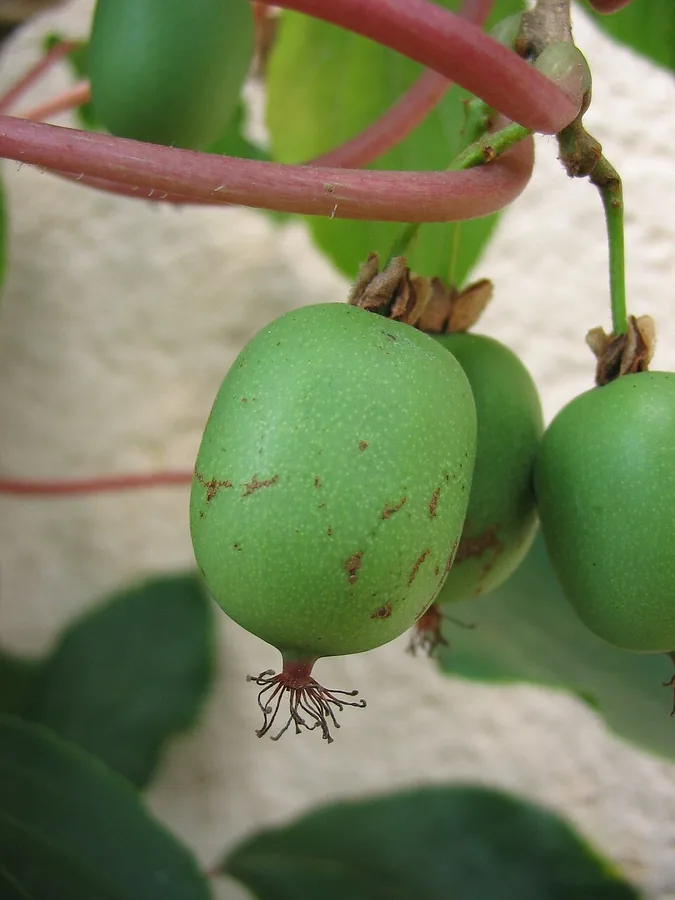
Hardy kiwi is the cold-tolerant, small-fruited relative of the fuzzy kiwi sold in stores. Its berries reach about grape size with smooth, hairless skin, sweet and aromatic, and are consumed whole. The vine withstands cold that would kill a standard kiwi, remaining hardy through winters down to -29°F (-34°C).
Its vigor is considerable. An established vine can extend 30 feet (about 9 meters) and accumulate enough mass to collapse an inadequate support, so a substantial arbor or T-bar trellis is warranted from planting. That same growth capacity underlies its invasive listing in parts of the northeastern US, which is reason to keep it away from natural areas and to confirm local regulations before planting.
The detail that most often defeats new growers is pollination. Hardy kiwi is dioecious, meaning staminate and pistillate flowers occur on separate plants, so at least one male is required to fertilize the females. Provided with full sun, shelter, a sound framework, and several years to mature, the vine returns a substantial late-summer crop.
Care
The short version: full sun and rich, well-drained soil held evenly moist, on a trellis engineered for far more load than it will initially carry. Site a male among the females, prune hard in winter, and allow several seasons before the first true crop.
Light
Hardy kiwi fruits most heavily in full sun, which drives ripening and supports the vine's demanding growth. It performs in partial shade as well, though the crop diminishes accordingly. A warm, sheltered aspect additionally protects the early shoots from late frost.
Water
Maintain the soil evenly moist, particularly during establishment and fruiting, on a cycle of about every 5 to 7 days. Irrigate deeply rather than frequently, so that moisture reaches the lower root zone. Drainage governs everything else, since saturated ground induces root rot.
Soil
The vine favors fertile, well-drained loam high in organic matter, while tolerating clay, loam, or sand. It prefers a slightly acidic reaction, around pH 5.0 to 6.5. Because drainage outweighs texture, incorporate compost and avoid any position where water collects.
Temperature
This is a genuinely cold-hardy species, enduring winter minima near -29°F (-34°C) and summer maxima to about 86°F (30°C). The vulnerability lies in phenology rather than absolute cold, as a late spring frost can injure the tender new shoots once the vine has broken bud.
Humidity
Ambient outdoor humidity within the 40% to 70% band is entirely adequate, so no adjustment is called for. Airflow through the trellis carries more weight, since it keeps the dense canopy from remaining wet.
Feeding
Apply a balanced complete fertilizer through spring and early summer while the vine is in active growth. Restrain the nitrogen, because an excess favors vegetative extension over fruiting, an outcome to avoid in so vigorous a plant.
Pruning
Sustained productivity and containment both depend on deliberate pruning. In winter, reduce each fruiting stem to 8 to 10 buds. In summer, shorten the long, vigorous shoots again and keep the entire vine trained close against its trellis.
Repotting
The species is grown in the ground against a trellis rather than in containers, so it is seldom repotted. Should one be raised in a pot, pot it on before the roots circle, growth stalls, or the medium dries unusually fast, then establish it in the ground.
Size & spacing
Provide generous scale. The vine attains 25 to 30 feet (7.5 to 9 m) in length and spreads 7 to 20 feet (2.1 to 6 m), so allocate a robust, dedicated framework and ample space for extension.
When to plant
Hardy kiwi is governed by the seasons. Sow seed in late winter following an extended chilling period, transplant young vines in spring once hard frost has passed, and expect fragrant flowers near June with grape-sized fruit ripening from late summer into fall.
Northern hemisphere
Southern hemisphere
Typical months for a temperate climate: start earlier in warm zones, later where spring frosts linger.
- Sow: Late winter (Feb-Mar) after 30-60 days cold stratification of seed
- Plant: Spring, after danger of hard frost has passed
- Harvest: Fragrant greenish-white flowers in late spring (around June); grape-sized fruit ripens late summer into fall (Sep-Oct)
Hardiness
USDA hardiness zones: 3–8
Temperature: down to -40°C
Troubleshooting
Most problems with hardy kiwi resolve to three causes: absent pollination, saturated soil, or late frost. The early indicators below let you distinguish them. Identify the symptom and intervene before it forfeits a season's crop.
Wilt and chlorosis in waterlogged soil
Waterlogged soil displaces the oxygen roots need to respire, and the resulting root rot presents as wilting, chlorosis, and progressive dieback even while moisture is abundant. A diagnostic lift reveals brown, softened root tissue in place of the firm white roots of a healthy vine. Reduce irrigation and correct the drainage, or transplant to a raised, free-draining position before the decline advances.
Fix:
- Improve drainage or move to a raised, well-drained site
- Reduce watering frequency
Vigorous canopy with no fruit development
Because hardy kiwi is dioecious, pollen forms on male plants and ovaries on female plants, so a female left without a male in range receives no pollen and sets nothing. Age compounds the problem, as a vine commonly needs 3 to 5 years to reach reproductive maturity. Establish one male for every 6 to 8 females, keep the flowering wood accessible to foraging bees, and allow the vine to mature.
Fix:
- Plant at least one male per 6-8 females
- Be patient; vines fruit only after several years of growth
- Ensure bees and other pollinators can reach the flowers
Blackening and collapse of new spring shoots
Hardy kiwi breaks dormancy early, which leaves the soft new shoots exposed when a late spring frost freezes the tissue overnight and blackens it until it wilts and folds. Recovery is the rule, so remove the killed growth and let latent buds resprout. Position the vine away from low-lying frost pockets, and drape a cover over it whenever a late freeze is predicted.
Fix:
- Prune out blackened growth; vines usually resprout
- Cover or protect vines when late frost threatens
Toxicity
For pet owners the assessment is favorable: hardy kiwi is not toxic to cats, dogs, or other animals. The fruit is grown for eating, and the remainder of the plant will not poison an animal that samples it. The one point worth noting is that cats may respond to the foliage as they do to catnip or silver vine, a behavioral attraction rather than a form of poisoning.
Safe for
People · Cats · Dogs · Horses · Rabbits · Livestock · Birds
Cats None
Hardy kiwi poses no poisoning risk to cats, and the fruit is non-toxic. The notable interaction is behavioral rather than chemical: as with silver vine of the same genus, the foliage can elicit a catnip-like response, prompting a cat to roll on it or gnaw a young stem, which does no harm beyond a chewed shoot.
Dogs None
Dogs face no toxic hazard from this plant. A few of the grape-sized berries are digested without incident, though a large quantity of any unfamiliar fruit may provoke transient, self-limiting loose stool.
Horses Safe
Horses can graze in proximity to the vine without concern, as neither the foliage nor the fruit contains a compound known to be toxic to them.
Rabbits Safe
Rabbits tolerate the plant without harm. The soft fruit serves as a suitable occasional treat, though the diet should remain grounded in hay and leafy greens rather than sugary kiwi.
Livestock Safe
Cattle, goats, and sheep may browse the foliage and windfall fruit with no risk of poisoning attributable to this species.
Birds Safe
Birds consume the ripe berries without adverse effect and act as dispersal agents for the seed, a mechanism that contributes to the vine's ready spread.
People Safe
The smooth-skinned fruit is cultivated for whole consumption in the manner of a grape, no peeling required, and it is entirely safe for children and adults.
Fruit is safe if a pet nibbles a few; very large amounts of any novel fruit may cause mild, temporary stomach upset.
Varieties
A small group of named cultivars accounts for most home plantings, partitioned into fruiting females and males maintained solely for pollination. The following are the selections worth identifying by name.
Ananasnaya (Anna)
A widely grown, heavy-cropping female valued for the sweetness and aroma of its fruit.
Issai
A partly self-fertile female able to set a limited crop even in the absence of a separate male vine.
Geneva
An early-ripening female selection that yields well and advances the timing of the harvest.
Meader Male
A male pollenizer that produces no fruit itself and functions solely to supply pollen to the surrounding females.
Companions
Hardy kiwi grows best next to a male pollenizer and the bees that work its flowers, and worst when left to climb into trees and shrubs it can smother.
Plant near
Male Actinidia arguta cultivar: Required pollenizer; without a male nearby, female vines set no fruit.
Pollinator-attracting flowers: Bees and other pollinators improve fruit set on the kiwi flowers.
Keep apart
Trees and shrubs: The vigorous vine can climb and smother woody plants; keep it on a dedicated sturdy trellis.
How to propagate
Hardy kiwi can be increased by several techniques, but only some preserve the sex and quality of the parent. Select the method according to whether a known cultivar or simply additional stock is required.
Stem cuttingsModerate
Softwood cuttings in early to mid summer · About 6-10 weeks to root
Softwood cuttings clone a named male or female true to type, which is the decisive advantage. Taken in early to mid summer, they root in roughly 6 to 10 weeks, and because sex is inherited, you retain the known sex that fruit production depends on.
SeedModerate
Sow in late winter after 30-60 days of cold stratification · Germinates in weeks; years to reach fruiting
Seed segregates and carries no guarantee of parentage. Sown in late winter after 30 to 60 days of cold stratification, the seedlings emerge within weeks but arrive genetically variable and of undetermined sex, which remains unknown until first flowering several years on.
LayeringEasy
Spring to summer · Roots within one season
Layering is the least demanding technique, exploiting the vine's readiness to root along its canes. Pin a low cane to the soil at any point from spring through summer and it will root within a single season, after which it can be severed and lifted as an independent plant.
GraftingDemanding
Late winter to early spring · Takes within one growing season
Grafting is the most exacting method, employed chiefly to place a chosen cultivar on vigorous rootstock. Performed in late winter to early spring, a successful union will take within one growing season.
Myths
The fruit is toxic to companion animals, given the catnip-like pull the plant has on cats.
Cats can indeed respond to Actinidia foliage, since silver vine belongs to the same genus, yet a behavioral attraction is a separate matter from toxicity. The smooth-skinned, grape-sized fruit is edible and safe for both cats and dogs.
An individual hardy kiwi vine is capable of fruiting unaided.
The dioecious habit of most hardy kiwis requires both a male and a female plant, on the order of one male for every 6 to 8 females, before fruit will set. Partly self-fertile selections such as Issai are the exception, producing at least a modest crop unaided.
Hardy kiwi requires peeling in the same way as fuzzy kiwifruit.
The skin is smooth and glabrous, unlike the pubescent skin of the grocery kiwifruit. The whole berry is eaten like a grape, skin included.