Ornamental · Asteraceae
Ironweed
Vernonia noveboracensis
Site it in full sun and moist ground, and ironweed closes the season with deep purple flowers that pollinators work hard.
Full sun
Every 3–7 days
USDA 5–9
4–8 ft · 1.2–2.4 m
Overview
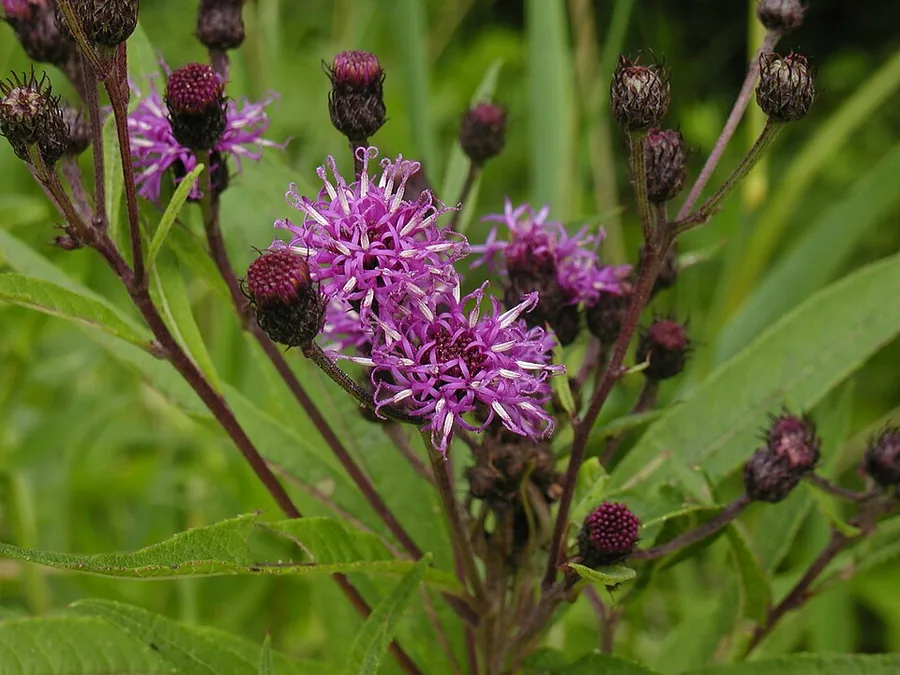
Ironweed is a tall native perennial of eastern United States streambanks, wet meadows, and low-lying ground. Within the daisy family, it carries flat clusters of deep purple flowers on stems that rise well above the surrounding border from mid-summer into fall. The common name records a real trait: the stems become tough and wiry as they attain full height.
Its 4 to 8 feet of growth position it at the back of a border or in a rain garden, clear of shorter plantings. It performs in moist to wet soil that would induce root rot in less adapted perennials, and its hardiness carries it through cold to -20°F (-29°C). Because the bitter foliage deters deer and livestock, it holds ground where more palatable species are grazed out.
Its horticultural value peaks late in the season, when few perennials remain in flower. The purple heads sustain butterflies and bees as summer bloom declines, and the hollow stems, left standing, provide overwintering habitat for native bees.
Care
The short version: full sun with steady moisture in rich, slightly acidic soil that never dries out completely. Omit fertilizer, cut stems back by half in late spring to prevent lodging, and leave the spent stalks standing through winter for the bees.
Light
Provide full sun, which drives the strong, self-supporting stem growth the plant is capable of. Partial shade is tolerated, but the reduced light yields weaker tissue and floppier stems that lean and need cutting back.
Water
Maintain even moisture and do not let the soil dry out, consistent with a streambank native adapted to medium to wet ground and even occasional flooding. Irrigate through any dry spell rather than waiting for wilt to appear.
Soil
Grow it in rich, moist soil on the acidic side, at a pH of 5.0 to 6.5. It handles heavy clay and saturated rain-garden sites that would drown less tolerant perennials, which suits it to low ground.
Temperature
Ironweed withstands a broad thermal range, from -20°F to 95°F (-29°C to 35°C). That cold hardiness is what carries the crown through hard winters and returns it reliably each spring.
Humidity
Ambient outdoor humidity is adequate, so no target figure applies. Its real requirement is moisture at the root zone rather than in the surrounding air.
Feeding
Feed sparingly or not at all, since as a native it subsists on little to no fertilizer and an annual topdress of compost meets its needs. Surplus nitrogen produces soft growth that lodges.
Pruning
Cut the stems back by roughly half in late spring or early summer to hold the plant shorter and reduce lodging. Deadhead spent flowers before seed set to suppress volunteers. Leave the hollow dead stems standing 12 to 24 inches through winter, where native bees nest, and clear them once they have broken down.
Size & spacing
Ironweed attains 4 to 8 feet (120 to 240 cm) in height, placing it at the back of a border. Allow each plant 3 to 4 feet (90 to 120 cm) to develop into a full clump.
When to plant
Ironweed is governed by seasonal cues. Cold-stratify the seed to satisfy its chilling requirement and start it indoors in late winter, plant out divisions or seedlings after the last spring frost, and expect deep purple bloom from July through September.
Northern hemisphere
Southern hemisphere
Typical months for a temperate climate: start earlier in warm zones, later where spring frosts linger.
- Sow: Sow seed and cold-stratify for about 4 to 8 weeks; start indoors in late winter, roughly 8 to 10 weeks before the last frost.
- Plant: Transplant or direct-sow after the last spring frost once soil has warmed; divide established clumps in spring.
- Harvest: Deep purple flowers from mid-summer to mid-fall, roughly July through September.
Hardiness
USDA hardiness zones: 5–9
Temperature: down to -29°C
Troubleshooting
Ironweed is an undemanding perennial with only two recurring issues, both easily diagnosed. Stems tall enough to lodge account for one, and its prolific seed set for the other. Read the symptom below against your plant, then intervene early.
Tall stems lodging or bending at the base
The disorder here is flopping, driven by low light or soils carrying more fertility than ironweed evolved for. As a stem reaches 4 to 8 feet, weak tissue laid down in shade or under excess nitrogen can't carry the load, so it lodges at the base or middle, and a stake only masks the cause. Correct the light by shifting the plant to full sun, withhold feeding, and reduce the height by cutting stems back roughly half in late spring so shorter, thicker growth replaces the tall growth.
Fix:
- Cut stems back by about half in late spring or early summer to keep plants shorter and bushier
- Site in full sun rather than partial shade
- Avoid fertilizing rich soils
Volunteer seedlings recruiting around the parent
This is straightforward self-seeding, and it follows from the sheer seed output of a mature flower head. Left to ripen, that seed disperses and germinates through the surrounding bed the next spring, so the effective control is to remove the heads before the seed matures. Any volunteers that do appear lift cleanly while young, before their root systems establish.
Fix:
- Remove flower heads before seed develops
- Pull or transplant unwanted seedlings while young
Toxicity
The safety verdict is reassuring: ironweed is non-toxic across the board. Vernonia does not appear on the ASPCA toxic list, and no part of the leaves, stems, or flowers presents a hazard to cats, dogs, livestock, or people. Animals avoid it purely on account of the bitter taste.
Safe for
People · Cats · Dogs · Horses · Rabbits · Livestock · Birds
Cats None
Ironweed carries no compounds toxic to cats, so it sits firmly in the safe column. A nibble may bring transient stomach upset from the coarse plant material itself, a mechanical rather than chemical effect, and nothing further.
Dogs None
Dogs face no chemical risk from ironweed, which holds nothing poisonous. A chewed leaf or stem warrants no intervention.
Horses Safe
Horses take no harm from ironweed. Its bitterness generally deters grazing in the first place, and the small amount ingested has no toxic consequence.
Rabbits Safe
Rabbits can browse ironweed without toxic effect, since the tissue holds nothing harmful. The bitter compounds that flavor the foliage typically direct them to more palatable forage.
Livestock Safe
Cattle, goats, and sheep are unaffected by ironweed. Bitterness rather than toxicity keeps them off it, and that avoidance explains why it persists in pastures grazed hard around it.
Birds Safe
Ironweed poses no toxic risk to birds, and its ripened seed heads provide late-season forage for finches and other small species.
People Safe
Ironweed is not toxic to people. It is not cultivated as an edible, but handling the plant and working around it carry no chemical hazard.
Varieties
Ironweed spans a group of related native species along with a few selected cultivars. The following are the ones most likely to reach a garden.
Vernonia fasciculata (prairie / common ironweed)
A prairie and wetland species of the Midwest distinguished by flat-topped clusters of purple flowers, and recognized on the Xerces pollinator list.
Vernonia gigantea (giant ironweed)
A species that reaches nearly 10 feet with purple flowers, white only on rare individuals, and its unpalatability to livestock lets it persist where pastures are grazed bare.
Vernonia lettermannii 'Iron Butterfly'
A compact threadleaf cultivar of only 2 to 3 feet whose fine fernlike foliage adapts it to smaller gardens where the towering species would overwhelm the scale.
How to propagate
Ironweed propagates readily by two methods, either by dividing an established clump or by capitalizing on its free-reseeding habit.
DivisionEasy
Spring, as new growth emerges · One growing season
Division is the most reliable method: lift a mature clump in spring as new shoots emerge and separate it, which also restrains an oversized specimen. Reset the divisions immediately into moist soil so the exposed roots do not desiccate, and they reestablish across a single growing season.
SeedEasy
Sow in fall or cold-stratify and start in late winter · Blooms typically in the second year from seed
Seed offers the second route, and the plant's own free reseeding shows how readily it germinates. Sow in fall so overwintering supplies the required chilling, or cold-stratify a moist seed batch and start it indoors in late winter. Seedlings raised this way generally reach flowering size only in their second year.
Myths
Ironweed is poisonous to pets and livestock and should be kept out of pastures.
Vernonia does not appear on the ASPCA toxic list and carries a non-toxic rating. The mechanism keeping cattle and other livestock away is palatability, not toxicity: the foliage is simply too bitter, and that selective avoidance is precisely why it persists in overgrazed pastures as surrounding forage is grazed to the ground.
Ironweed must be staked because it always flops.
Lodging is an environmental response, traced to shade or excess soil fertility rather than any inherent structural fault. Site it in full sun on average ground, or reduce its height by cutting back half in late spring, and it stands upright unaided without staking.