Houseplant · Dryopteridaceae
Holly Fern
Cyrtomium falcatum
Glossy, holly-shaped fronds on a pet-safe, shade-adapted fern built for the low light of a room.
Partial shade
Every 5–7 days
50–75°F · 10–24°C
USDA 6–10
Overview
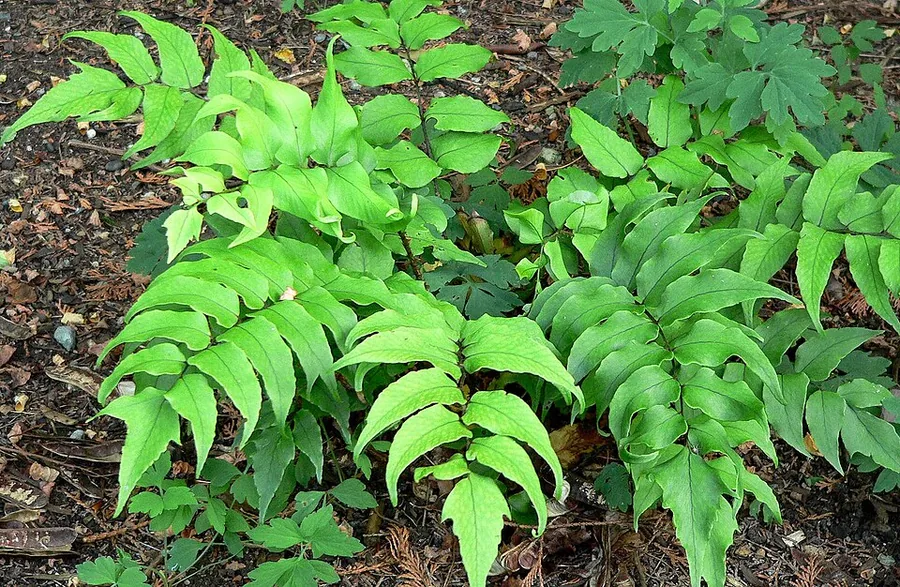
Holly fern draws its common name from fronds divided into glossy, leathery leaflets that mirror the outline of holly leaves. The species sits in the wood fern family, Dryopteridaceae, and originates in East Asia, where it colonizes shaded, rocky ground. That habitat explains its shade adaptation, and despite the mimicry it is a true fern with no relation to the toxic holly shrub.
As a houseplant it performs reliably. The dark green fronds arch from a central crown into a clump of modest dimensions, and the thick, leathery lamina resists the low humidity and dim light of interiors far better than the thin-tissued ferns commonly sold. Its slow growth rate means an established specimen keeps its form for years without outgrowing its position.
The plant's requirements track its origins: steady soil moisture, shade, and elevated humidity. It is also non-toxic to pets and children, and that combination of a durable, handsome habit and a benign safety profile accounts for its long standing as an indoor fern.
Care
The short version: part to full shade, soil held evenly moist but never saturated, room temperatures between 50°F and 75°F (10°C to 24°C), and humidity kept high around the fronds.
Light
Holly fern is adapted to part to full shade and performs well in the bright to medium indirect light of a typical room. Direct sun scorches the fronds and bleaches the deep green to a washed-out yellow, because the shade-type foliage is not built to dissipate that intensity, so keep it out of the sun's path.
Water
Hold the soil evenly moist but never waterlogged, watering on the order of every 5 to 7 days once the surface begins to dry. The species does not tolerate prolonged drying, so the roots should never desiccate between waterings while the soil is still allowed to breathe.
Soil
Use rich, humusy, well-drained loam that retains steady moisture without becoming anaerobic mud. It accepts a broad pH span from 5.5 to 7.5, so most general potting mixes serve well once amended with a little compost to build the humus content.
Temperature
Standard room warmth between 50°F and 75°F (10°C to 24°C) matches its range. Cold drafts and the dry heat of radiators both draw moisture from the leaf margins and crisp them, so position the plant clear of each.
Humidity
This is a humidity-demanding fern, best kept at 50% to 70%. In dry interiors, group it with other plants or stand the pot on a pebble tray, since low ambient humidity desiccates the frond tips first.
Feeding
Through the spring and summer growth phase, feed monthly with a balanced liquid fertilizer diluted to half strength. Withhold feed in fall and winter, when growth slows and the plant has little use for added nutrients.
Pruning
Routine pruning is unnecessary. Cut away any damaged, dead, or winter-burned fronds at the base, which keeps the clump tidy and clears space for new fronds to emerge.
Repotting
Repot into a slightly larger container every 2 to 3 years, or sooner once roots emerge from the drainage holes and water runs straight through without being absorbed. A crown packed tight against the pot wall is the third indicator that the plant is rootbound.
Size & spacing
Indoors the clump attains 12 to 24 inches (30 to 60 cm) in height and spreads 24 to 35 inches (60 to 90 cm) across. Allow that spread so air circulates freely around the fronds, which suppresses the fungal problems that follow stagnant conditions.
Troubleshooting
Holly fern is durable, yet a small set of disorders recurs under interior conditions. The great majority trace to excess soil moisture or stagnant air, and the earliest evidence appears on the fronds and at the crown. Compare the symptom to the entries below and intervene before it advances.
Frond collapse above a softening, discolored crown
Wilting fronds over a blackened, mushy base signal root rot, the outcome when waterlogged soil starves the roots of oxygen and lets pathogens take hold. Lift the plant and read the roots, which stay firm and pale when healthy but turn brown, soft, and foul-smelling once rotted. Excise every compromised root, repot into fresh well-draining humusy mix, and cut back the watering so the crown is never left standing in saturated soil.
Fix:
- Remove the plant and trim away all soft, blackened roots
- Repot into fresh, well-draining humusy mix
- Reduce watering and ensure the container drains freely
Raised tan bumps, honeydew residue, and chlorotic fronds
The raised brown or tan bumps along the stalks are scale insects, and the white cottony tufts lodged in the leaf axils are mealybugs. Both feed by piercing the fronds and excreting honeydew, which is the sticky film that recruits ants and seeds sooty mold, and their draw on the sap is what yellows the foliage. Remove them with soapy water or a swab of 70% alcohol, then apply horticultural oil to the frond undersides where they shelter, and isolate the plant so the crawlers cannot reach neighboring pots.
Fix:
- Wipe off insects with a cloth dipped in soapy water or 70% isopropyl alcohol
- Treat with horticultural oil or insecticidal soap, covering frond undersides
- Isolate the plant until the infestation clears
Necrotic spotting and blotching on the foliage
Discrete brown or black lesions, frequently ringed or water-soaked, indicate fungal leaf spot, a disease that establishes where still, damp air keeps the foliage wet long enough for spores to germinate. Remove and discard the marked fronds to strip out the inoculum. Increase air movement around the plant and deliver water at the soil line, since dry foliage denies the spores the surface moisture they need to spread.
Fix:
- Remove and discard affected fronds
- Improve air circulation and avoid wetting the foliage when watering
- Apply a fungicide if spotting is widespread
Toxicity
The safety verdict is clear: holly fern is non-toxic across the board. The ASPCA and extension sources record it as safe for cats, dogs, and horses, and as a true fern it lacks the toxic principle of the Ilex shrub it superficially resembles. Site it anywhere a curious pet or child might investigate.
Safe for
People · Cats · Dogs · Horses · Rabbits · Livestock · Birds
Cats None
The ASPCA classifies holly fern as non-toxic to cats, so ingestion carries no poisoning risk. A cat that consumes a large volume of any plant may regurgitate it, but that response owes to indigestible fiber rather than any toxin.
Dogs None
As a true fern with no toxic principle, holly fern poses no hazard to dogs that chew the fronds. A large mouthful might pass as a transient, mild gastrointestinal upset and nothing worse.
Horses None
The record documents no toxic effects in horses. This is the benign true fern, not the toxic English holly whose leaf outline it resembles.
Rabbits None
The fronds contain no compounds known to affect rabbits, which leaves the plant safe in their company.
Livestock None
Grazing stock incur no poisoning risk here, because the fern lacks the toxins present in true holly.
Birds None
Pet and backyard birds may perch on and pick at the fronds with no toxic consequence.
People None
Holly fern presents no poisoning hazard to people, children included, though it is cultivated as an ornamental and not as food.
No special handling required; safe to grow around pets and children.
Varieties
The straight species accounts for most plants in trade, though two named forms circulate and warrant a note on how to tell them apart.
'Rochfordianum'
A vase-shaped selection recognized by arching, glossy fronds whose leaflets bear coarsely fringed, deeply toothed margins.
var. maritimum
A more compact variety distinguished by smaller, glossy dark green fronds that fit a confined position.
How to propagate
Holly fern increases slowly but predictably, and dividing an established clump is markedly more reliable than raising it from spores.
DivisionModerate
Spring · 1-2 months
Division in spring is the dependable method, timed to the start of the growing season when the fern can rebuild roots fastest. Lift a mature clump and separate it so each section retains its own roots and several fronds, and the divisions will establish over the following one to two months. Spores released from the fronds offer an alternative, but spore culture is slow and far less reliable, which is why division remains the standard approach.
Myths
The foliage that mimics holly signals that this fern shares holly's toxicity.
The leaflets converge on holly only in outline, and the resemblance carries no botanical weight. Holly fern is a true fern, Cyrtomium falcatum, whereas the poisonous holly is English holly (Ilex), an unrelated flowering shrub in a wholly different lineage. The fern is non-toxic and safe to keep around pets and children.