Ornamental · Dryopteridaceae
Wood Fern
Dryopteris marginalis
A durable native fern for shaded ground, holding its blue-green fronds through the season on little more than moisture and shade.
Partial shade
Every 5–7 days
USDA 3–8
12–24 in · 30–60 cm
Overview
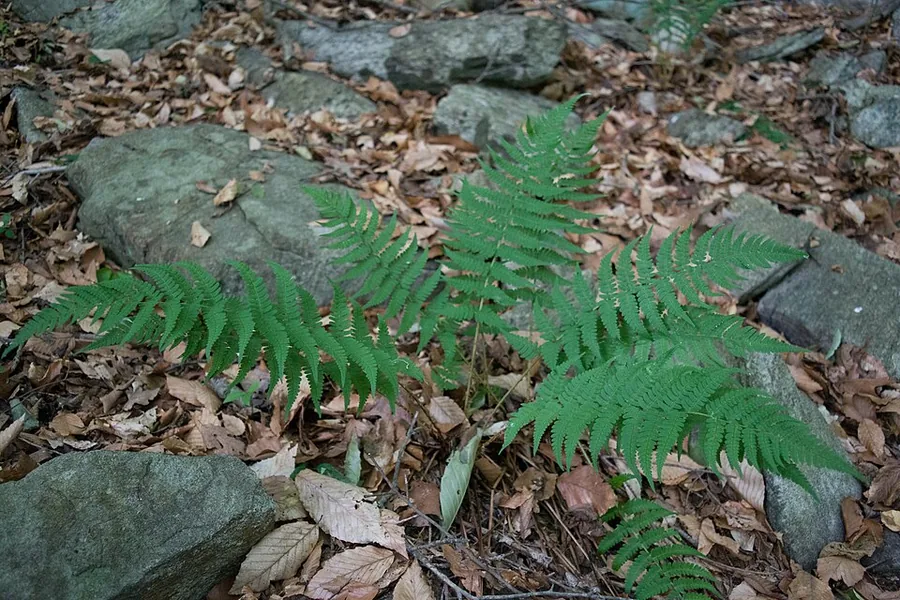
Dryopteris marginalis, the marginal wood fern, ranks among the least demanding ferns for shaded ground. A native of eastern North American woodland, it is adapted to the low, filtered light of the forest understory, where competition from other plants is thin. Its leathery, blue-green fronds resist wear through the growing season and persist as semi-evergreen foliage into winter in milder climates.
The epithet marginal refers to the placement of the sori, the clustered spore cases, which sit along the very margins of the frond undersides rather than across the blade. Growth is slow and clump-forming, so the plant occupies a stable footprint of roughly 1 to 2 feet (30 to 60 cm) without spreading into neighboring plantings. That restraint suits it to shade borders, woodland margins, and the shaded north aspect of a structure.
Its requirements follow directly from that woodland origin. Shade, an organic-rich substrate, and soil that does not dry out satisfy nearly all of its needs. Cold hardiness extends to zone 3, and as a perennial it persists for many years with minimal intervention.
Care
The short version: partial to full shade, a substrate kept evenly moist and high in organic matter, and one annual removal of spent fronds before the fiddleheads emerge.
Light
The species performs best in partial to full shade, consistent with the understory light of its native woodland. Limited morning or filtered sun is tolerated provided the soil remains moist, but direct midday sun raises leaf temperature and transpiration beyond what the fronds can sustain, producing marginal scorch.
Water
Maintain the soil evenly moist but never waterlogged, which under most conditions means irrigation every 5 to 7 days. An established clump withstands brief dry intervals once rooted, yet prolonged drought exceeds its tolerance and the frond margins desiccate to brown.
Soil
Grow it in humus-rich, well-drained loam high in organic matter, reproducing the open, moisture-retentive structure of a forest floor. The species is indifferent to pH across the range 5.0 to 7.0, so no amendment for acidity is typically required.
Temperature
This is a notably cold-hardy fern, rated from about -22°F to 86°F (-30°C to 30°C). Low temperatures pose no difficulty, whereas hot, dry air drives the transpirational stress that damages the fronds.
Humidity
It succeeds at average to moderate humidity, around 40% to 60%. Outdoors this is rarely limiting; consistent soil moisture and a sheltered position influence performance more than ambient humidity does.
Feeding
Ferns are light feeders, and this species needs little supplemental nutrition. A single spring application of compost or a balanced slow-release fertilizer at the start of the season meets its requirements.
Pruning
Pruning is minimal and largely cosmetic. In late winter to early spring, remove tattered, dead, or winter-burned fronds before the new fiddleheads unfurl, timing the cut so it does not damage the emerging crosiers.
Repotting
The clump is long-lived and resents disturbance, so routine division is unnecessary. Divide the clump every 3 to 5 years only when the crown becomes congested, the center declines, or frond vigor falls, which signal that the planting has outgrown its space.
Size & spacing
A mature specimen reaches roughly 1 to 2 feet (30 to 60 cm) in height with a comparable spread. Allow that footprint per plant so the fronds arch without crowding and air circulates through the stand, which limits fungal problems.
When to plant
A fern sets neither flower nor fruit, so planting is governed by root establishment rather than a bloom or harvest date. Install it in spring once the frost has passed, or in early fall while residual soil warmth still favors rooting. The same conditions apply when dividing established clumps.
Northern hemisphere
Southern hemisphere
Typical months for a temperate climate: start earlier in warm zones, later where spring frosts linger.
- Plant: Spring after frost danger passes, or early fall
Hardiness
USDA hardiness zones: 3–8
Temperature: down to -40°C
Troubleshooting
Sited correctly, this fern presents few problems, and most complaints reduce to two related stresses: excess sun and insufficient soil moisture. Because the fronds register both quickly, early symptoms give ample warning. Match the sign below and correct the underlying condition before it progresses across the clump.
Browned, scorched frond margins and tips
The pattern indicates frond scorch, a response to excess solar radiation compounded by a dry root zone. Exposed to midday sun, the margins lose water faster than the roots can resupply it and desiccate first. Relocate the plant to deeper shade in spring or fall, restore even soil moisture, and apply a leaf-litter mulch to moderate the root-zone temperature and retain water.
Fix:
- Increase watering to keep soil evenly moist
- Provide additional shade or relocate to a shadier site in spring or fall
- Mulch with leaf litter or compost to retain moisture
Fronds wilting and collapsing in drought
When soil moisture falls well below the surface, turgor is lost and the fronds collapse, often without overnight recovery, a clear case of drought stress. Newly set plants are the most vulnerable because their root systems have not yet extended. Irrigate deeply and consistently, then mulch to slow evaporation from the root zone.
Fix:
- Water deeply and consistently
- Apply organic mulch to conserve moisture
Dark or rusty lesions on the fronds
First rule out the fern's normal sori, the ordered rows of round spore cases along the frond margins, which are reproductive structures rather than damage. Genuine fungal leaf spot or rust appears as irregular lesions and establishes where air is stagnant and foliage stays wet. Where disease is confirmed, excise affected fronds, increase spacing to improve ventilation, and irrigate at the base to keep the blades dry.
Fix:
- Remove and discard affected fronds
- Improve air circulation and avoid overhead watering
Toxicity
As a true fern, the marginal wood fern is not listed as toxic to pets, livestock, or people, and incidental contact or tasting of the foliage carries no meaningful risk. Genus-level caution applies only to the rhizomes, so children and animals should be kept from chewing the underground parts of any garden plant.
Safe for
People · Cats · Dogs · Horses · Rabbits · Livestock · Birds
Cats None
The species is non-toxic to cats, so contact or a nibbled frond produces no toxic effect.
Dogs None
Dogs are not poisoned by the foliage; ingestion of a large quantity of any plant may cause transient gastrointestinal upset, but no specific toxin is involved.
Horses None
No toxic constituents affect horses. The fronds are not typical forage, and incidental grazing causes no harm.
Rabbits None
Rabbits are unaffected, and occasional browsing of a frond carries no toxic consequence.
Livestock None
Cattle, goats, and sheep are not poisoned by this fern, which lacks the toxins present in certain pasture species.
Birds None
The foliage presents no toxic hazard to pet or wild birds.
People None
The plant is safe to handle and cultivate for adults and children. The young fiddleheads of some ferns are eaten, but this species is not recommended for consumption.
Foliage poses little risk, but avoid letting pets or children chew the rhizomes; the marginal wood fern itself is not listed as toxic.
Helpline numbers

United States
ASPCA Animal Poison Control: (888) 426-4435 (fee applies)

United Kingdom
Animal PoisonLine: 01202 509000 (fee applies)

Australia
Animal Poisons Helpline: 1300 869 738
Varieties
The marginal wood fern is the species usually cultivated, though several related Dryopteris occur in shade gardens. The distinctions below separate them.
Dryopteris erythrosora (autumn fern)
An Asian species valued for fronds that emerge coppery bronze and age to green.
Dryopteris filix-mas (male fern)
A Eurasian and North American species whose rhizome was formerly employed as an anthelmintic and can prove irritant in quantity.
Dryopteris affinis 'Cristata The King'
A golden-scaled male fern selection distinguished by crested, tasseled apices on every frond.
How to propagate
Vegetative division is the dependable method of increase, exploiting the clump-forming habit of an existing plant.
DivisionEasy
Early spring or fall · 1 to 2 growing seasons
Division exploits the clump-forming habit to yield new plants reliably. In early spring or fall, lift a mature crown and separate it into sections, each retaining both roots and an active growing point, and replant without delay. Establishment of the divisions requires 1 to 2 growing seasons. Spore culture is also feasible but slow, demanding sterile, humid conditions to succeed.
Myths
Ferns reproduce from seed as flowering plants do.
Ferns produce neither flowers nor seed. Reproduction proceeds by spores borne in the sori on the frond undersides, which is why propagation in the garden relies on dividing the clump rather than sowing.
Wood ferns require deep, full shade and perish in any sun.
Their affinity for partial to full shade is a preference set by their understory origin, not an absolute limit. Where soil moisture is held constant, they accept morning or filtered sun without injury.