Ornamental · Dryopteridaceae
Christmas Fern
Polystichum acrostichoides
Sited in shade with sharp drainage, the Christmas fern carries evergreen fronds intact through winter.
Partial shade
Every 5–10 days
USDA 3–9
12–35 in · 30–90 cm
Overview
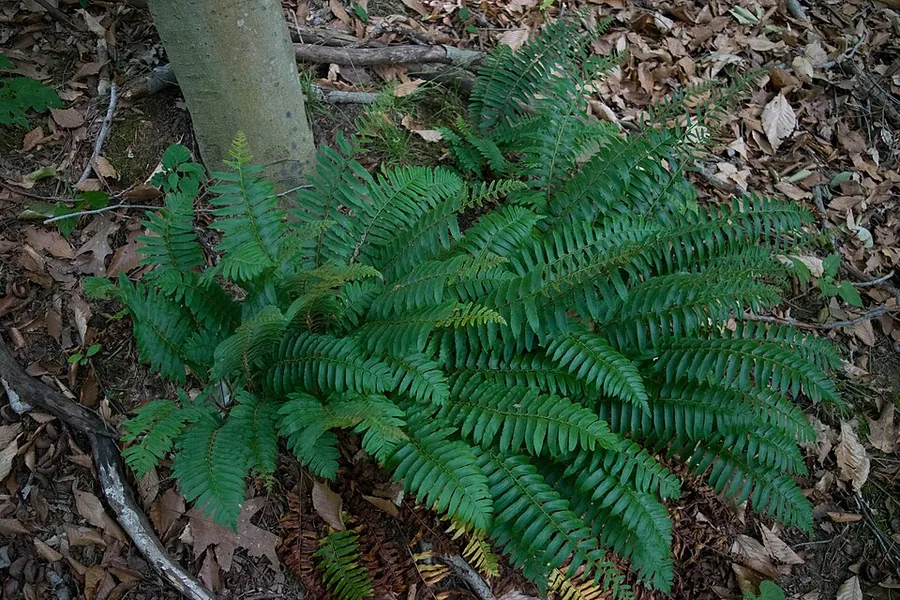
Polystichum acrostichoides ranks among the most dependable native ferns for the temperate garden and is one of the few that holds its foliage through winter. It builds a compact, non-spreading clump of leathery, dark green fronds, and the pinnae bear a slight resemblance to Christmas stockings, the feature behind the common name. A member of the wood fern family, it occurs naturally across much of the eastern woodlands.
Its defining trait is sheer resilience. The species withstands cold to -40°F (-40°C), performs in deep shade, and establishes in the dry, rocky, root-competitive soil beneath canopy trees where most understory plants fail. Because new fiddleheads emerge in spring while the previous season's fronds frequently persist, the crown is rarely without foliage.
Once established, its cultural demands are minimal. Provide shade, free-draining soil, and time for the clump to mature, and it sustains a steady, evergreen presence over many seasons. The non-spreading habit makes it well suited to stabilizing a shaded slope or forming groundcover in a woodland bed.
Care
The short version: establish it in part to full shade in rich, well-drained soil, maintain even moisture through establishment, and thereafter intervene rarely.
Light
This is fundamentally a shade species. It performs best in partial to full shade and tolerates deep shade, an attribute that suits it to the darkest positions in the garden. Limited morning sun is acceptable, but intense afternoon exposure scorches the fronds.
Water
Maintain even soil moisture during establishment, irrigating every 5 to 10 days when rainfall is insufficient. Once the root system is anchored the plant tolerates brief drought without injury, so frequency can be reduced. The one condition it will not tolerate is standing water.
Soil
Site it in rich, well-drained loam with abundant organic matter, though it adapts to sandy or shallow rocky substrates. It favors a mildly acidic pH of 5.0 to 6.5. Drainage is the governing factor, since waterlogging at the crown precipitates rot.
Temperature
Cold hardiness is exceptional among garden plants. The species endures -40°F to 86°F (-40°C to 30°C), spanning USDA zones 3 through 9. Winter cold presents no threat, and the fronds retain their pigmentation throughout it.
Humidity
Ambient outdoor humidity is sufficient, so no target value applies. Consistent soil moisture is the operative variable for this fern, considerably more than atmospheric moisture.
Feeding
Nutrient demand is very low. A light topdressing of compost or a balanced slow-release fertilizer in spring meets it fully, and many growers omit feeding altogether. Excess fertility is counterproductive.
Pruning
Pruning is an annual operation. In late winter or early spring, before the new fiddleheads emerge, remove the old, tattered, or winter-damaged fronds so the incoming flush develops unobstructed.
Size & spacing
A mature clump attains 12 to 35 inches (30 to 90 cm) in height with an equivalent spread. Space plants accordingly to accommodate the arching fronds, and the non-spreading habit ensures the clumps retain their form without encroaching on neighbors.
When to plant
A fern offers no bloom period to plan around and no harvest. Set it out in spring as the soil warms and the fiddleheads begin to extend, allowing a season or two for establishment.
Northern hemisphere
Southern hemisphere
Typical months for a temperate climate: start earlier in warm zones, later where spring frosts linger.
- Plant: spring
Hardiness
USDA hardiness zones: 3–9
Temperature: down to -40°C
Troubleshooting
This fern remains healthy with little intervention, so problems are uncommon and nearly always trace to excess soil moisture or a single defoliating pest. Recognize the two diagnostic signs below to catch either early. Match the symptom, then act before it progresses.
Frond collapse traced to a rotting crown
Collapsing fronds above soft, blackened basal tissue indicate crown rot, a condition that develops where saturated soil starves the rhizome of oxygen, most often through a wet winter. Reduce watering and correct the drainage so the root zone can breathe again, then excise and discard the darkened, decayed tissue at the base. Resetting the rhizome at a slight angle matters because it sheds water off the crown rather than letting it collect on the growing point.
Fix:
- Improve drainage and reduce watering
- Plant the rhizome at an angle to shed water from the crown
- Remove and discard affected tissue
Defoliated fronds from nocturnal feeding
Ragged leaflet margins and stripped rachises are the signature of the Florida fern caterpillar, a nocturnal feeder that can defoliate a frond in a single night, which is why daytime inspection so often misses it. Scout the plant by flashlight after dark, when the larvae are active, and remove them by hand. An appropriate insecticide is warranted only under heavy pressure, since consistent monitoring and early removal generally hold populations below damaging levels.
Fix:
- Hand-pick caterpillars
- Treat with an appropriate insecticide if infestation is heavy
Toxicity
For households with pets and children, the assessment is favorable: the Christmas fern is non-toxic across the board. The ASPCA confirms it as non-toxic to cats, dogs, and horses, and the fronds contain no toxic principle of concern to other animals or to people.
Safe for
People · Cats · Dogs · Horses · Rabbits · Livestock · Birds
Cats None
The ASPCA classifies this fern as non-toxic to cats, so an exploratory nibble carries no real consequence. A large quantity of fronds may provoke transient gastrointestinal upset, as indigestible plant fiber can in any species, but no toxic principle is involved.
Dogs None
Dogs face no toxicological risk from this fern, which contains no harmful compounds. Light chewing is harmless, though a substantial volume of coarse foliage can cause mechanical digestive upset on its way through.
Horses None
Confirmed non-toxic to horses, this fern poses no danger to a grazing animal. Its fronds contain nothing poisonous.
Rabbits Safe
Rabbits may browse the fronds without ill effect, since the plant holds no compound capable of harming them.
Livestock Safe
Cattle, goats, and sheep can graze in proximity to this fern safely, as it contains no toxic principle. It does not carry the toxicity that makes certain pasture ferns a livestock hazard.
Birds Safe
Pet and aviary birds are unaffected by this fern. The fronds contain no compound that would harm them.
People Safe
The plant presents no poisoning hazard to people, children handling the fronds included. It is not cultivated as an edible, so there is no reason to consume it, yet incidental contact or tasting produces no toxic effect.
Varieties
In contrast to many ornamentals, this fern is grown almost entirely as the wild species, with named cultivars rarely offered. For practical purposes there is a single taxon to know.
Polystichum acrostichoides (species)
Cultivated almost exclusively as the straight species, it bears leathery, evergreen, dark green fronds whose stocking-shaped pinnae retain their color through winter into the Christmas season, and named cultivars are seldom encountered.
How to propagate
Propagating the Christmas fern is uncomplicated, whether by dividing an existing clump or by the slower process of raising plants from spores.
DivisionEasy
Spring · 1 to 2 growing seasons
The most reliable method is to divide an established clump in spring, separating the crown into rooted sections and replanting them, after which the divisions need a season or two to re-establish and fill out. Propagation from spores borne on the upper third of the fertile fronds is also possible, but that route is considerably slower.
Myths
The Christmas fern is named for blooming or fruiting at Christmas.
As a fern, it reproduces by spores and never produces flowers or berries, so the name cannot derive from any winter bloom. It refers instead to the leathery fronds that remain green through winter into the Christmas season, together with pinnae shaped like miniature Christmas stockings.