Ornamental · Asteraceae
Goldenrod
Solidago canadensis
Grown in full sun and lean soil, goldenrod delivers weeks of late-summer bloom and sustains a wide range of pollinators.
Full sun
Every 7–14 days
USDA 4–9
2–6 ft · 0.6–1.8 m
Overview
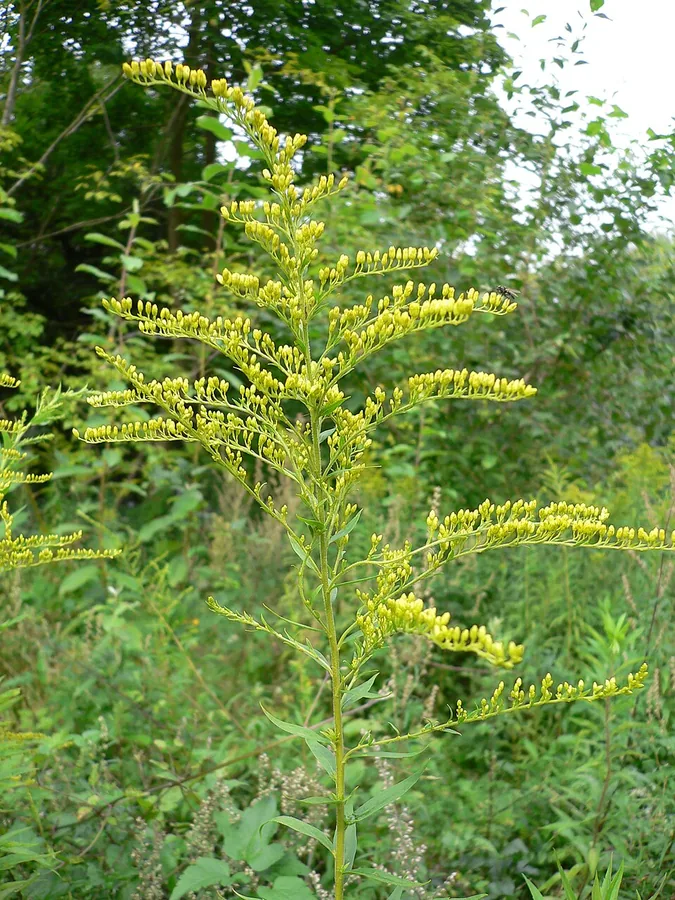
Goldenrod produces its plumes of small golden flowers on tall, leafy stems in late summer, the display that lights up open fields and roadsides. A member of the aster family, it is a tough, long-lived perennial distributed across most of North America. Its low maintenance follows directly from that wild adaptability: it demands little and flowers for weeks after most other species have finished.
Its value to pollinators is difficult to overstate. The flowers open when nectar and pollen have grown scarce elsewhere, so they concentrate bees, butterflies, and beneficial insects, while the seedheads feed birds through winter. That late, reliable resource is what makes goldenrod a structural element of any habitat planting.
The trait to manage is its spread. Tall goldenrod advances through a bed by rhizome and recruits new plants by self-seeding, so it can displace less competitive neighbors over time. Selecting a clump-forming species avoids the problem, and dividing the vigorous types every few years keeps their footprint in check.
Care
The short version: site it in full sun with ordinary to poor, well-drained soil. Irrigate only through extended drought and otherwise rely on rainfall, withhold fertilizer, and divide vigorous clumps every few years to contain their spread.
Light
Site goldenrod in full sun for the strongest flowering and the most self-supporting stems. It tolerates partial shade, but reduced light causes the stems to elongate and lodge and thins the bloom, since less energy reaches the flower heads.
Water
Goldenrod prefers soil kept evenly moist but never waterlogged, and established plants withstand short dry spells through developed root systems. Rainfall meets its needs in most temperate gardens, so supplemental watering is warranted only in prolonged drought.
Soil
It grows in clay or loam provided drainage is adequate, and it succeeds on poor ground that limits more demanding plants. A pH range of 5.5 to 7.5 suits it, and lean soil is advantageous because it restrains the soft, weak growth that richer sites produce.
Temperature
Goldenrod is exceptionally cold and heat hardy, enduring -29°F (-34°C) at the low end and above 95°F (35°C) at the high end. That physiological range explains why it persists unassisted across so much of the continent.
Humidity
Average outdoor humidity is sufficient, so no target figure applies. Air movement is the operative factor, because stagnant, humid air keeps the leaf surface wet long enough for rust and powdery mildew to establish.
Feeding
Fertilizer is unnecessary except on the poorest soils. Goldenrod is adapted to low fertility, and surplus nitrogen drives soft, floppy, weak-stemmed growth, so limit inputs to a light spring topdressing of compost where the ground is genuinely deficient.
Pruning
Remove spent flower stems after bloom, or retain the seedheads as a winter food source for birds. Cut all stems to ground level in late winter before growth resumes, and a pinch in early summer shortens the tall types and reduces lodging.
Size & spacing
Mature plants stand 2 to 6 feet (61 to 183 cm) tall with a spread of 4 to 6 feet (122 to 183 cm), so allow each clump ample room. That wide spread is also the reason the vigorous species require periodic division to remain within their allotted space.
When to plant
Goldenrod's schedule tracks the temperate season closely. Start seed in late winter or sow outdoors in fall, transplant in spring after frost, and expect flowering to build from late summer through the depth of fall.
Northern hemisphere
Southern hemisphere
Typical months for a temperate climate: start earlier in warm zones, later where spring frosts linger.
- Sow: Late winter, 8 to 10 weeks before last frost; seeds benefit from cold-moist stratification and need light to germinate
- Plant: Spring after the last frost, or in early fall
- Harvest: Late summer through fall (August to October)
Hardiness
USDA hardiness zones: 4–9
Temperature: down to -34°C
Troubleshooting
Goldenrod is seldom affected by anything serious, and nearly all of what appears is cosmetic. The common problems trace back to crowding and prolonged leaf wetness, so improving airflow corrects more than any spray. Identify the symptom below and intervene only when the appearance warrants it.
Rust-colored spore pustules beneath the leaves
The orange to brown pustules on the leaf undersides are the spore-bearing stage of rust, caused by the fungus Coleosporium asterum, and they release the colored powder that rubs off on your fingers. Because the spores need leaf moisture to germinate, the disease advances fastest in crowded, poorly ventilated clumps. Remove the worst leaves, thin or divide to open the canopy, and water at the base so foliage dries quickly.
Fix:
- Remove and destroy heavily infected leaves
- Improve air circulation by thinning or dividing crowded clumps
- Avoid overhead watering and water at the base
Grayish-white powdery growth on stems and foliage
The gray-white film is powdery mildew, a foliar fungus that colonizes the leaf surface and shows up late in the season when humid nights and shade favor its spread. It disfigures the canopy but rarely threatens a well-rooted clump. Cut back the coated foliage, then raise sun exposure and airflow to dry the leaf surface, and clear the infected debris before winter so it does not overwinter.
Fix:
- Cut back affected foliage
- Increase spacing and sun exposure to improve air movement
- Remove infected debris at season end
Colonies of soft-bodied insects at the stem tips with honeydew
Soft-bodied aphids colonize the tender new growth and flower buds and excrete honeydew, the sticky residue that in turn recruits ants. Because goldenrod supports a broad guild of beneficial insects, a modest colony is best tolerated so predators can respond. Dislodge dense clusters with a strong jet of water, and reserve insecticidal soap for infestations that persist.
Fix:
- Spray off with a strong jet of water
- Tolerate where possible since goldenrod supports many beneficial insects
- Use insecticidal soap only if infestation is heavy
Globular or spindle-form swellings on the stem
The rounded or spindle-shaped swellings are galls, produced when the goldenrod gall fly oviposits into the stem and its larva develops within the tissue. The plant carries them without measurable harm, and the larvae inside sustain birds and other wildlife over winter. Prune out affected stems only where appearance matters, since leaving them costs the plant nothing.
Fix:
- Prune out and discard galled stems if appearance is a concern
- Otherwise leave in place as galls rarely harm the plant and feed wildlife
Toxicity
Goldenrod carries no toxicity for people, pets, or livestock, so it can be sited without safety concerns. Its long association with hay fever is a misattribution that properly belongs to ragweed. Plant it where children and animals have access, and the leaves can even be brewed as a herbal tea.
Safe for
People · Cats · Dogs · Horses · Rabbits · Livestock · Birds
Cats None
Goldenrod contains no compound that harms cats, so it poses no toxic risk. The most a curious cat would experience from a nibble is transient, mild gastrointestinal upset, which is typical of any plant material outside its normal diet.
Dogs None
No toxic principle in goldenrod affects dogs, which makes it safe in their company. Ingesting a large quantity of foliage may produce brief drooling or loose stool from bulk alone, and that resolves without treatment.
Horses Safe
True goldenrod is non-toxic to horses and occurs in many grazed pastures without incident. It should not be conflated with the toxic lookalike it is sometimes mistaken for, so grazing alongside it presents no hazard.
Rabbits Safe
Rabbits browse goldenrod without toxic effect, as wild populations regularly demonstrate. The foliage and flowers hold no harmful constituents, though any novel green is best offered gradually to avoid digestive upset.
Livestock Safe
Cattle, goats, and sheep can graze near goldenrod without harm, since it carries no toxicity for ruminants. In practice they tend to leave it for more palatable, tender forage.
Birds Safe
Goldenrod poses no danger to birds and in fact benefits them, since they feed on both the seeds and the insects the flowers attract. No part of the plant is harmful to avian species.
People Safe
Goldenrod is safe for people, and its leaves and flowers have a long documented history of use as a herbal tea. It does not trigger hay fever, because its heavy pollen is insect-dispersed and does not become airborne.
Varieties
Goldenrod is a genus rather than a single plant, and its species differ considerably in stature and spreading behavior. The following are the ones most worth evaluating before planting.
Solidago rugosa 'Fireworks'
A compact 3 to 3.5 foot selection whose arching sprays of small flowers radiate outward like a burst of fireworks, spreading by rhizomes at a controlled, non-invasive pace.
Solidago canadensis
The vigorous tall species, reaching 2 to 6 feet with broad pyramidal inflorescences and spreading rapidly by both seed and rhizome.
Solidago speciosa (Showy goldenrod)
An upright clump-former adapted to poor, dry ground that holds its position far more reliably than the tall goldenrod.
Solidago caesia (Bluestem/wreath goldenrod)
A woodland species with bluish arching stems that bears its flowers in the leaf axils and tolerates shade well.
How to propagate
Goldenrod propagates readily by two routes, dividing an established clump or raising new plants from seed.
DivisionEasy
Spring or early fall; divide established clumps every 2 to 3 years to control spread and maintain vigor · One growing season
Division is the most reliable method of propagation and doubles as spread control on rhizomatous clumps. Lift the plant in spring or early fall, separate it into sections that each retain roots and active shoots, and replant them promptly so the divisions do not desiccate. Repeated every 2 to 3 years, this maintains vigor, and each division reestablishes within a single growing season.
SeedEasy
Sow in fall outdoors or stratify and start indoors in late winter · Blooms typically in the second year from seed
Seed propagation succeeds readily but demands light and a cold period to break dormancy. Surface sow outdoors in fall, or apply cold-moist stratification and start indoors in late winter, and never bury the seed, since germination is light-dependent. Plants generally flower in the second season and self-seed freely once established.
Myths
Goldenrod is responsible for seasonal hay fever symptoms.
Goldenrod pollen grains are large, sticky, and heavy, which makes them dependent on insect vectors for transfer between flowers and effectively unable to travel on air currents. The genuine cause of late-summer allergy symptoms is ragweed, an inconspicuous species that flowers on the same schedule and releases abundant light, wind-borne pollen. Goldenrod simply provides the conspicuous bloom that observers notice when their symptoms begin.