Ornamental · Asteraceae
Gazania
Gazania rigens
Give it full sun and dry feet, and the treasure flower expands bold, daisy-bright heads across the season.
Full sun
Every 7–14 days
USDA 8–11
6–12 in · 15–30 cm
Overview
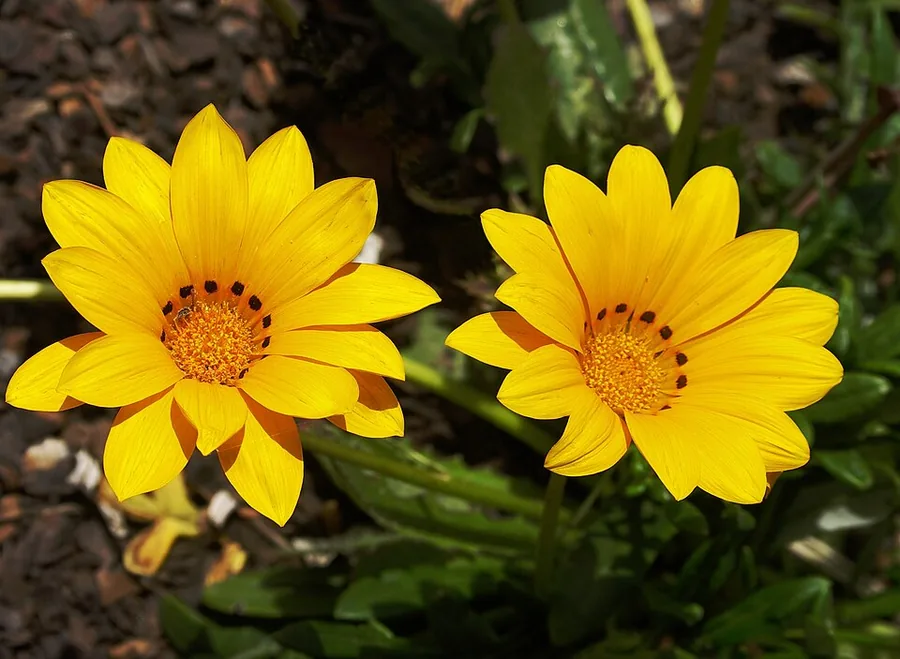
Gazania, the treasure flower, is a low, spreading member of the Asteraceae from southern Africa. Its bold flower heads in hot oranges, yellows, reds, and stripes sit on short stems just clear of a dense mat of foliage. Its origins explain its cultivation pattern: hardy enough to persist as a tender perennial where winters stay mild, it is grown as an annual in colder regions and set out in beds, borders, and containers that receive full exposure.
The plant's defining trait is its economy of demand. It performs in poor, sandy soil, tolerates drought once its root system is established, and flowers from spring into fall. That undemanding nature carries one condition: the heads track available light, expanding in bright sun and folding at night or under cloud, so full sun is not preference but the mechanism behind a complete display.
Supplied with heat, light, and a fast-draining medium, gazania is close to self-sufficient. The same drought adaptation that makes it tough becomes a liability under excess irrigation, because its roots have no tolerance for saturated soil and rot follows quickly once oxygen is displaced from the profile.
Care
The short version: full sun, a light well-drained medium, and restrained watering. Let the profile dry between waterings, deadhead spent heads to prolong bloom, and feed lightly through the growing season.
Light
Site it in full sun, at least six hours a day. Because the flower heads expand in response to light intensity, shade leaves them shut while bright, direct exposure opens them fully, making the sunniest position the correct one.
Water
Restraint is the operative principle. Let the top half of the soil dry out between waterings, on the order of every 7 to 14 days once established, and extend that interval in cool or wet weather. Drought it withstands, but saturated soil drives rot in the roots and crown.
Soil
Grow it in light, well-drained ground, and it will accept even poor sandy soil. A pH between 5.5 and 7.5 suits it, and free drainage matters far more than fertility because it governs whether the roots stay aerated.
Temperature
It functions across a broad range, roughly 19°F to 90°F (-7°C to 32°C). Summer heat it takes in stride and a light chill it survives, but a hard frost destroys tissue on a plant grown in the open.
Humidity
Ambient outdoor humidity is sufficient, so no target applies. Damp, stagnant air is the condition to avoid, since it creates the still, moist microclimate powdery mildew exploits on the foliage.
Feeding
Apply a balanced general fertilizer lightly through the growing season, about monthly. Because the plant is adapted to lean soil, a light feed outperforms a heavy one, favoring flowering over excess vegetative growth.
Pruning
No structural pruning is required. Deadheading spent heads as they fade redirects the plant away from seed set and sustains the production of fresh buds.
Size & spacing
Growth stays low and compact, near 6 to 12 inches (15 to 30 cm) in height and a comparable spread. Allotting each plant roughly that spacing maintains airflow and lets the mat close without crowding.
When to plant
Gazania is heat-adapted and intolerant of hard frost, which sets the schedule. Sow seed indoors 6 to 8 weeks before the last spring frost, transplant once the cold has passed and the soil has warmed, and expect flowering from spring through fall until frost terminates the season.
Northern hemisphere
Southern hemisphere
Typical months for a temperate climate: start earlier in warm zones, later where spring frosts linger.
- Sow: 6 to 8 weeks before the last spring frost date
- Plant: After the last spring frost date once soil has warmed
- Harvest: Blooms spring through fall, often until first frost; flowering may pause during the hottest part of summer
Hardiness
USDA hardiness zones: 8–11
Temperature: down to -12°C
Troubleshooting
The great majority of gazania problems reduce to two causes: surplus water or a shortfall of light. The roots, foliage, and flower heads register these early, and reading them correctly points to a single corrective adjustment. Match the observed symptom below and intervene before it advances.
Browning, mushy crown and stems ahead of collapse
Softening at the base points to root and stem rot, the predictable result of waterlogged soil starving the roots of oxygen. Because the crown tissue cannot regenerate once it breaks down, remove and discard the plant rather than attempting a rescue. Amending the bed with grit to speed drainage, reducing irrigation, and letting the profile dry between waterings all address the underlying cause.
Fix:
- Reduce watering
- Improve soil drainage
- Remove and discard affected plants
A powdery white colony forming across the foliage
The white bloom is powdery mildew, a foliar fungus that establishes where humid, stagnant air sits against the leaves. Removing the most affected leaves lowers the spore load, and opening the planting to improve airflow denies the fungus the still, moist conditions it needs. Directing water to the soil rather than the canopy keeps leaf surfaces dry and further checks its progress.
Fix:
- Improve air circulation
- Avoid overhead watering
- Remove affected foliage
Cottony masses and honeydew on overwintered plants
The enclosed, pest-friendly conditions of indoor overwintering favor mealybugs and aphids, which betray themselves through cottony deposits and the sticky honeydew they excrete onto stems. A physical wash to dislodge the insects followed by insecticidal soap, repeated until populations collapse, brings them under control. Isolating the affected plant prevents the mobile stages from moving onto neighboring stock.
Fix:
- Wash off pests
- Apply insecticidal soap
- Isolate infested plants
Capitula that remain shut or open only partly
This is normal light-driven behavior rather than a fault. The flower heads close at night and under overcast skies and expand fully only in bright, direct sun, a response tied to light intensity. Relocating the planting to a site receiving at least six hours of direct light restores full opening.
Fix:
- Site in full sun (6+ hours direct light)
Toxicity
Gazania ranks among the safer ornamentals for a household and garden. Not listed as toxic, it poses no threat to cats, dogs, or grazing animals, and incidental sampling by a child or pet has no consequence. It can be planted without reservation.
Safe for
People · Cats · Dogs · Horses · Rabbits · Livestock · Birds
Cats None
Cats are not at risk. Ingestion of a leaf or flower produces no toxic effect.
Dogs None
Dogs face no hazard from the plant. It is not poisonous to them, so a mouthful taken from the bed has no ill effect.
Horses Safe
Horses grazing in its vicinity are unaffected, as the plant contains no compounds harmful to them.
Rabbits Safe
Rabbits can consume the foliage without any toxic consequence.
Livestock Safe
Cattle, goats, and sheep can be pastured near it safely, since it holds nothing toxic to them.
Birds Safe
Birds feeding on the seeds or petals encounter no toxin in the plant.
People Safe
It presents no hazard to children. Although not cultivated as food, incidental ingestion carries no toxic risk.
Varieties
The gazanias in commerce derive from a small set of breeding lines, differentiated by earliness of bloom, flower coloration, and foliage character. The following selections are the ones worth identifying by name.
Daybreak series (e.g. Daybreak Bright Yellow)
A compact bedding selection notable for flower heads that open earlier in the morning and remain open longer than the older strains.
New Day Tiger Mix
An early-flowering F1 hybrid mix bearing boldly striped, bicolored heads, though it shows greater susceptibility to Phytophthora root and stem rot than most.
Talent series (e.g. Talent Orange)
Valued for its silvery-gray foliage as much as its flowers, which continue to open even under reduced light.
How to propagate
Gazania propagates readily by two routes: fresh seed raised each spring, or division that carries a chosen plant forward unchanged.
SeedEasy
Start indoors 6 to 8 weeks before the last frost; transplant outdoors after frost · Several weeks to form an established plant after transplanting
Seed propagation is the standard route for bedding stock. Sowing indoors 6 to 8 weeks before the last frost yields transplants ready to set out once the cold has passed, and these require several weeks in the ground before they can be considered established.
DivisionEasy
Take basal offsets in late summer to early fall and root them · A few weeks to root and establish
Division preserves a specific plant or named cultivar over winter, since it reproduces the parent exactly. Basal offsets lifted in late summer to early fall and rooted indoors establish within a few weeks, carrying the identical clone into the following season.
Myths
Gazania needs frequent watering like most annuals.
Established plants demand considerably less water than a typical annual and tolerate extended dry periods. The genuine risk is excess moisture, because saturated soil drives rot in the roots and crown from below.
Gazania flowers stay open around the clock.
The heads respond to light, closing at night and under dull, cloudy skies. Full expansion occurs only in bright light, so a shaded site or a prolonged spell of gray weather leaves the display closed for long intervals.