Shrub · Rubiaceae
Gardenia
Gardenia jasminoides
Match its need for acidic soil, steady moisture, and humid air, and the gardenia returns intensely fragrant white flowers.
Partial shade
Every 3–7 days
50–90°F · 10–32°C
USDA 8–11
Overview
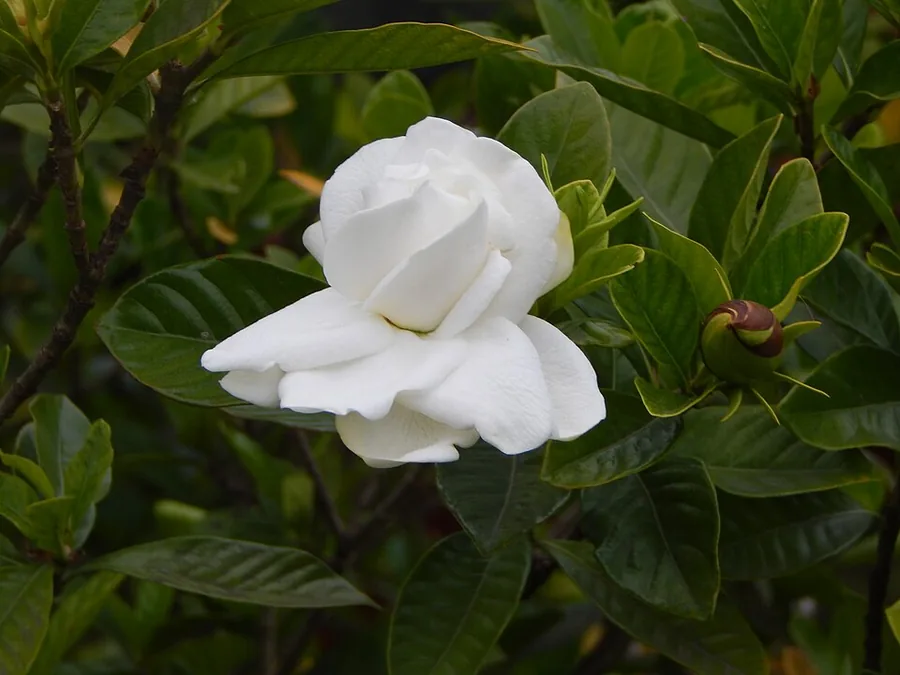
The gardenia is grown above all for the potent fragrance of its creamy white flowers, borne in late spring and summer. A broadleaf evergreen shrub in the madder family, Rubiaceae, it holds glossy dark foliage that carries the plant between flushes of bloom. It performs in the open ground through the mild South and adapts to container culture farther north, where the trade for that scent is warmth and steady attention.
Its reputation for difficulty is earned by a narrow set of requirements: acidic soil, even moisture, and humid air. Miss any of them and the plant registers the stress visibly. The two disorders growers meet most, bud drop and leaf yellowing, are physiological responses to conditions rather than disease, which is why both respond to correcting the environment.
Given its preferred soil chemistry and humidity, the gardenia performs as a long-lived perennial shrub. Hold the pH in range and keep the air moist, and it flowers over a span of weeks while the fragrance travels well beyond the plant itself.
Care
The short version: part shade with morning sun, acidic soil held at a pH of 5.0 to 6.0, even moisture supplied with rainwater, and humid air. Apply an acid-forming fertilizer in spring and keep night temperatures stable through bud set.
Light
Site gardenias in part shade, favoring morning sun with protection from intense afternoon heat. Full sun is workable in cooler climates and bright indirect light suffices indoors, but deep shade suppresses flowering.
Water
Hold the soil evenly moist yet well-drained, because both saturation and drought induce bud drop. Water every 3 to 7 days as conditions dictate, and use rainwater or other non-alkaline water so irrigation does not progressively raise the soil pH.
Soil
Grow it in well-drained, humus-rich, acidic soil rich in organic matter. Keep the pH between 5.0 and 6.0; above that range iron becomes unavailable and the foliage yellows.
Temperature
The plant tolerates 50°F to 90°F (10°C to 32°C). Cool nights of 50°F to 55°F (10°C to 13°C) actually promote bud formation, whereas abrupt swings in either direction trigger bud drop.
Humidity
Provide humidity above 50%, as dry indoor air stresses the shrub. Grouping plants, a pebble tray, or a humidifier all raise local humidity, and doing so removes one of the leading causes of bud drop.
Feeding
Use an acid-forming azalea or camellia fertilizer such as 10-8-8, applied lightly in spring after frost and again about 6 weeks later. Withhold feeding by fall, since late nitrogen forces soft growth that fails to harden before cold.
Pruning
Prune immediately after flowering in summer to remove straggly branches and spent blooms. Delaying it removes the wood on which next season's buds develop.
Repotting
Pot up container plants every 2 to 3 years, or sooner when roots circle the base, water runs straight through, or growth stalls with yellowing leaves. Repotting into fresh acidic mix restores the pH the roots depend on.
Size & spacing
A mature gardenia attains 4 to 8 feet (122 to 244 cm) in height and a comparable spread. Allow 4 to 8 feet (122 to 244 cm) between plants so air circulates through the canopy, which reduces the settling of pests.
When to plant
Gardenia is a warm-climate shrub for zones 8 to 11, flowering from late spring into early summer and continuously in the warmest zones. Establish new plants in spring after the last frost, and time pruning to immediately after flowering, since the buds for next season form on wood that later cuts would remove.
Northern hemisphere
Southern hemisphere
Typical months for a temperate climate: start earlier in warm zones, later where spring frosts linger.
- Plant: spring after last frost
- Harvest: late spring to early summer (year-round in warm climates)
Hardiness
USDA hardiness zones: 8–11
Temperature: down to -12°C
Troubleshooting
In gardenia the earliest diagnostic signs appear on the buds and leaves, and most trace to soil, water, or air rather than to a pathogen. Reading those signs early lets you correct the conditions before bloom is lost. Identify the pattern below, then address the underlying cause.
Buds abort and drop before the flowers open
Bud drop is the classic gardenia disorder, and it stems from environmental stress rather than pathogen. Nights below 50°F to 55°F (10°C to 13°C) interrupt proper bud formation, while swings in soil moisture and low humidity add to the strain that makes the plant shed its buds. Hold moisture even, keep humidity up, and steady the temperature during bud set so the buds are not sacrificed to a shifting environment.
Fix:
- Maintain consistent, even soil moisture with good drainage
- Provide cool night temperatures of 50-55 degrees F during bud set
- Raise humidity around the plant
- Provide adequate light and avoid over-fertilizing
Interveinal yellowing on new growth with green veins
Yellowing between the veins of new leaves is textbook iron chlorosis, and the mechanism is a pH problem: once the soil turns alkaline, iron becomes chemically unavailable to the roots even when it is present. Confirm with a soil pH test, then acidify with water-soluble sulfur and feed an acid-forming azalea or camellia fertilizer. Chelated iron restores the deficiency directly, and switching to rainwater keeps alkaline irrigation from undoing the correction.
Fix:
- Lower soil pH using water-soluble sulfur or aluminum sulfate
- Apply chelated iron to soil or as a foliar spray
- Use an acid-forming (azalea/camellia) fertilizer such as 10-8-8
- Irrigate with rainwater or non-alkaline water
Honeydew and black sooty mold on the foliage
The black sooty mold is not a primary infection but a fungus colonizing the honeydew that sap-sucking insects excrete overhead. On gardenia the source is most often whitefly, followed by scale, aphids, and mealybugs, all feeding on the leaf undersides. Treat the insects with insecticidal soap or horticultural oil under the leaves at 5 to 7 day intervals, and once their feeding stops the honeydew ends and the mold wipes away.
Fix:
- Spray insecticidal soap or horticultural oil thoroughly on leaf undersides
- Repeat treatments at 5-7 day intervals
- Wipe sooty mold off with a moist cloth once insects are controlled
- Apply sprays when temperatures stay below 90 degrees F
Toxicity
Gardenia is mildly toxic to animals and essentially safe for people. The foliage and flowers contain the iridoid compounds geniposide and genipin, which irritate the gut of a cat, dog, or horse and produce vomiting, diarrhea, or hives. Because the effect is mild but real, exposure of curious pets and grazing animals is best avoided.
Toxic to
Cats · Dogs · Horses · Rabbits · Livestock · Birds
Safe for
People
Cats Mild
In cats, ingestion of the leaves or flowers produces vomiting, diarrhea, or hives. The active compounds, geniposide and genipin, are only mild irritants, so recovery is generally uneventful without intervention.
Dogs Mild
Dogs ingest more plant material than cats, and the result is vomiting, loose stools, and occasional raised skin welts. The reaction remains mild and self-limiting, though veterinary advice is warranted if signs persist.
Horses Mild
A horse that grazes the foliage develops mild gastrointestinal upset with loose droppings. The effect is minor, but excluding the shrub from paddocks removes the exposure entirely.
Rabbits Caution
Rabbits are absent from the ASPCA listing, yet the same gut-irritating iridoid compounds are present in the tissue. Treat the plant as unsuitable and monitor for soft stools should a rabbit ingest any.
Livestock Caution
No documented poisoning exists in cattle, goats, or sheep, but the iridoid glycosides could plausibly disturb digestion. Physical exclusion by fencing is the prudent measure.
Birds Caution
Gardenia has not been evaluated in pet birds, whose low body mass raises the relative dose of any irritant. Denying access to the leaves and flowers is the conservative choice.
People Essentially safe
For people the plant is essentially safe, and the same compounds appear in foods dyed with gardenia extract. It is nonetheless not an edible, so children should be kept from chewing the leaves.
Keep plants and fallen plant parts away from pets; ingestion causes mild gastrointestinal upset.
Helpline numbers

United States
ASPCA Animal Poison Control: (888) 426-4435 (fee applies)

United Kingdom
Animal PoisonLine: 01202 509000 (fee applies)

Australia
Animal Poisons Helpline: 1300 869 738
Varieties
Garden gardenias are largely selections of one species, distinguished mainly by hardiness, habit, and bloom. A few named forms are worth specifying at purchase.
Kleim's Hardy
A single-flowered selection chosen for cold tolerance, reported to withstand conditions down to roughly USDA zone 7.
Radicans
A dwarf, low-spreading selection whose small leaves and flowers suit it to use as a creeping groundcover.
Veitchii
A compact everblooming form valued for the length and dependability of its flowering season.
How to propagate
Gardenia propagates dependably by vegetative means, whether rooting a summer cutting or layering a low branch into a self-supporting new plant.
Stem cuttingsModerate
Summer (June through August) · 6-12 weeks to root
Propagation from cuttings is standard for gardenia, taken in summer from June through August. Select semi-hardwood, the point where green wood is beginning to turn brown, treat the base with rooting hormone, and root under intermittent mist or a covered pot to hold the humidity that drives callus and root formation. Rooting takes 6 to 12 weeks, and softwood tip cuttings taken in early to mid summer root readily as well.
LayeringModerate
Growing season · Several weeks to months
Layering is a reliable vegetative method during the growing season, exploiting a branch's ability to root while still attached to the parent. Pin a low branch into the soil and leave it to root in place over several weeks to a few months before severing and potting the established plantlet.
Myths
Gardenias are completely safe houseplants that pose no risk to pets.
The ASPCA classifies gardenia as toxic to cats, dogs, and horses, with a mild reaction of vomiting, diarrhea, or hives. The toxicity is real but low-grade, so the sensible response is to clear dropped buds and leaves rather than to assume the plant is inert.
Yellow gardenia leaves always mean you are overwatering.
On new growth, yellowing is far more consistent with iron chlorosis driven by alkaline soil than with excess water. Restoring the pH to 5.0 to 6.0 and supplying iron corrects the deficiency and returns the leaves to green.