Shrub · Rubiaceae
Coffee
Coffea arabica
Supply warmth, bright indirect light, and humid air, and the coffee plant develops into a glossy evergreen capable of setting its own cherries in time.
Bright indirect
Every 5–7 days
59–82°F · 15–28°C
USDA 10–11
Overview
Coffea arabica is a tropical evergreen native to the highland forests of Africa, where it occupies the understory beneath taller canopy trees. That origin explains its habit, since a plant adapted to dappled forest light can reach the stature of a small tree in the wild yet remains a compact, glossy-leaved shrub under cultivation. Its ornamental foliage carries the plant for years before any reproductive maturity.
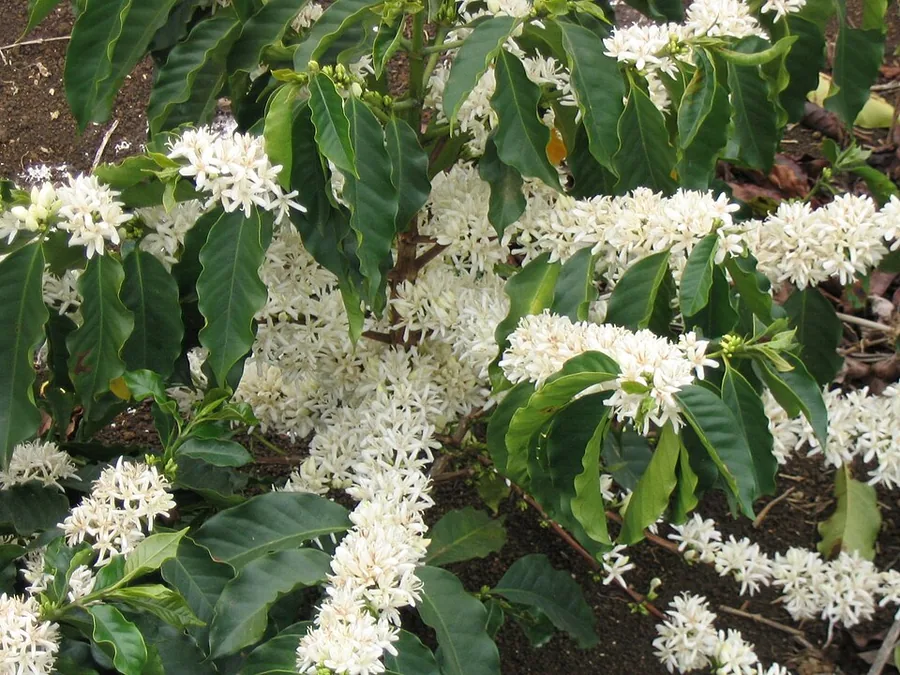
In the home it earns its place chiefly through dense, waxy, deep green leaves, which form well ahead of fruiting. Given sustained warmth, the shrub produces fragrant white flowers, and those flowers give way over the following months to red cherries enclosing the seeds harvested as beans. Because reproductive maturity arrives only at 3 to 4 years old, foliage remains the primary reward for most growers.
The plant performs well within a fairly narrow set of conditions that mirror its native habitat. Steady warmth, elevated humidity, and bright filtered light sustain healthy growth, whereas cold drafts and unfiltered sun cause rapid decline. Replicate the forest understory and it holds its condition over many seasons.
Care
The short version: bright indirect light, warmth held above 60°F (16°C), humid air, and a substrate kept evenly moist but never soggy, supported by a monthly feed across the growing season.
Light
Coffee requires bright, indirect light, equivalent to the illumination behind a sheer curtain or roughly an arm's length from a sunny window, since the species evolved beneath a forest canopy. It accepts partial shade or partial sun, but direct rays exceed what the foliage tolerates and scorch it. Site it in the brightest position that excludes direct exposure.
Water
Maintain the substrate evenly moist but never soggy, watering at intervals near 5 to 7 days and reducing the frequency in winter as growth slows. Allow the surface to dry slightly between applications, then water until it drains from the base. Roots held in standing water lose oxygen, which is the principal route to leaf yellowing.
Soil
Grow it in an organically rich, well-drained loam of slightly acidic reaction, near a pH of 6.0 to 6.5, because that range governs nutrient availability for the species. A peat-based medium amended with perlite retains the moisture coffee prefers while preserving drainage. Adequate drainage is what keeps the root zone aerated and healthy.
Temperature
Hold the plant within 59°F to 82°F (15°C to 28°C) under consistent year-round warmth. Cold is the limiting factor, since drafts and exposure near 50°F (10°C) induce sudden leaf drop in a chill-sensitive tropical. Keep it away from cold glazing through winter.
Humidity
As a high-humidity species it performs best at 50% to 80% relative humidity. Dry indoor air desiccates the leaf margins, producing crisp edges, so raise ambient moisture by clustering plants, using a pebble tray, or running a nearby humidifier. The closer the air is to its tropical norm, the better the foliage holds.
Feeding
Apply fertilizer monthly through spring and summer, the period of active growth, using a balanced or acid-loving liquid formulation. Suspend feeding in the cooler months, when reduced growth lowers nutrient demand. Frequent light applications suit the plant better than infrequent heavy ones.
Pruning
Prune in spring to manage height and form, since unmanaged plants extend upward. Pinching the growing tips removes apical dominance and redirects growth into lateral branches, yielding a fuller, bushier habit. Consistent tip pinching is what maintains density in a young specimen.
Repotting
Repot every 2 to 3 years in spring, or earlier if the plant signals constraint. Roots emerging from drainage holes, stalled growth, and a substrate that dries almost overnight all indicate the plant has outgrown its container. Advance only one pot size at each repotting to avoid an excess of unused medium.
Size & spacing
Pruned indoors, coffee remains a manageable shrub, but unchecked it attains 5 to 10 feet (1.5 to 3 m) in height with a spread of 3 to 6 feet (90 to 180 cm). Allow space for air movement around the canopy, since circulation suppresses the pest and fungal problems that follow stagnant air.
When to plant
Indoors the species observes no defined planting season and grows continuously while conditions stay warm. In the landscape it is limited to the frost-free tropics of zones 10 and 11, planted only once cold has fully passed, because it carries no frost tolerance. Flowering occurs in spring and summer, and the resulting cherries require about 6 to 9 months to ripen.
Northern hemisphere
Southern hemisphere
Typical months for a temperate climate: start earlier in warm zones, later where spring frosts linger.
- Sow: year-round in warm conditions above 70°F using fresh seed
- Plant: after all frost danger has passed; year-round outdoors in zones 10-11
- Harvest: fragrant white flowers in spring/summer; red cherries ripen about 6-9 months later, usually once the plant is 3-4 years old
Hardiness
USDA hardiness zones: 10–11
Temperature: down to -1°C
Troubleshooting
Most disorders in coffee originate when light, water, or temperature drifts beyond the range this understory species tolerates. The foliage registers stress first, browning, yellowing, or abscising according to the cause. Identify the symptom below, then correct the underlying condition before localized damage progresses to defoliation.
Scorched foliage with browned, brittle margins
Brown, crisp margins indicate leaf scorch, which develops where intense direct sun combines with dry air. The cause traces to the species' canopy origin, since foliage adapted to filtered light cannot dissipate the load from harsh exposure. Relocate the plant to bright indirect light and raise the surrounding humidity, after which subsequent growth emerges undamaged.
Fix:
- Move to bright indirect light or filtered shade
- Raise humidity by grouping plants or using a humidity tray
Basal foliage yellowing before upper growth
Lower leaves yellowing while the substrate stays wet point to overwatering, with the roots held in saturated medium. The species needs sustained moisture rather than saturation, because waterlogged roots lose access to oxygen. Reduce the watering frequency, confirm the container drains freely, and discard any water collected in the saucer.
Fix:
- Reduce watering frequency
- Ensure the pot drains freely and empty the saucer
Abrupt defoliation triggered by cold
An abrupt loss of leaves reflects cold-shock leaf drop, generally following a draft or a night near 50°F (10°C). The response is consistent with a warmth-adapted tropical that lacks chill tolerance. Move it to a sheltered position above 60°F (16°C) and keep it clear of cold windows and doors.
Fix:
- Move the plant to a warm spot above 60°F
- Keep away from cold windows and doors
Honeydew film, cottony masses, and stippled dull leaves
Sticky residue, cottony tufts, or a dull stippled surface signal sap-sucking pests, namely scale, mealybugs, or spider mites, which feed on cell contents. Examine the leaf undersides and stems for the insects, their honeydew, or fine webbing. Wipe the populations off, treat with insecticidal soap or horticultural oil, and isolate the plant until the infestation is controlled.
Fix:
- Wipe off pests and treat with insecticidal soap or horticultural oil
- Isolate the plant until controlled
Toxicity
This species warrants strict separation from animals. Every tissue contains caffeine and related methylxanthines, from the leaves through the cherries to any spent grounds nearby, and these compounds are toxic to cats, dogs, horses, and others. The roasted bean is consumed routinely by people, but the raw plant poses a real hazard to pets and children.
Toxic to
Cats · Dogs · Horses · Rabbits · Livestock · Birds · People
Cats Severe
In cats, a nibbled leaf or a few beans can produce vomiting and agitation, a racing heart, and tremors that may progress to seizures, which warrants immediate veterinary care.
Dogs Severe
Dogs commonly ingest the beans or spent grounds, and the caffeine elicits vomiting, restlessness, a pounding heartbeat, and tremors, with higher doses capable of producing seizures.
Horses Toxic
In horses the same caffeine and related methylxanthines act strongly, causing colic, an elevated pulse, jitteriness, and muscle tremors, so all plant parts should remain inaccessible.
Rabbits Toxic
A rabbit's small body tolerates caffeine poorly, and even small amounts of the leaves or cherries can disturb the gut and induce a rapid, irregular heartbeat, which excludes the plant from its diet entirely.
Livestock Toxic
Grazing animals such as cattle, goats, and sheep can ingest dangerous quantities from foliage and fallen cherries, resulting in digestive distress and overstimulation of the heart and nervous system.
Birds Toxic
Birds are sensitive to caffeine, which can produce an erratic heartbeat, agitation, and tremors, so pet birds should be kept from the plant and from any coffee in the household.
People Caution
The roasted, brewed bean is an ordinary beverage, but the raw plant differs, since chewing the leaves or unripe cherries delivers a substantial caffeine dose, so children should be prevented from sampling it.
Keep the plant, its cherries/beans, and any coffee grounds out of reach of pets and children.
Helpline numbers

United States
ASPCA Animal Poison Control: (888) 426-4435 (fee applies)
Poison Control: (800) 222-1222



Canada
Poison Centres: 1-844-764-7669
Varieties
Several named Arabica selections circulate among home growers, distinguished by stature, productivity, and cup quality. The following are the selections most worth understanding before choosing.
'Typica'
The original tall heirloom Arabica, valued for cup quality despite yielding less than later selections.
'Bourbon'
A high-quality heirloom that crops more heavily than Typica and bears rounder leaves and cherries.
'Caturra'
A natural Bourbon mutation that concentrates higher yields onto a shorter, more compact plant.
'Nana' (Dwarf)
A small, bushy selection developed for container culture and reliable indoor growing.
Companions
Plant near
shade trees such as banana or Inga: Provide the filtered light and wind protection coffee prefers, mimicking its natural understory habitat.
Keep apart
turfgrass or aggressive groundcovers at the base: Compete with shallow coffee roots for moisture and nutrients.
How to propagate
Coffee propagates from seed or from stem cuttings, and the method chosen determines the interval before the plant reaches fruiting.
SeedModerate
Spring or year-round in warmth · 2-3 months to germinate; several years to first fruit
Sow only fresh seed, because coffee loses viability rapidly and stored seed germinates poorly. Under warm conditions germination takes 2 to 3 months, after which the seedling needs several years of growth before setting its first fruit. The flowers are self-fertile, so a solitary plant can still produce cherries without a pollination partner.
Stem cuttingsModerate
Warm season · About 6-8 weeks to root
Cuttings shorten the interval to a fruiting plant relative to seed. Take semi-hardwood pieces about 3/16 to 5/16 inch thick during the warm season, treat the cut end with rooting hormone, and hold them under a humidity tent in moderate shade. Rooting proceeds over roughly 6 to 8 weeks.
Myths
Coffea arabica requires full sun for healthy growth.
Coffea arabica is a tropical understory shrub, so it performs best under filtered sun or partial shade rather than full exposure. Direct light beyond its tolerance scorches the foliage. Bright, indirect light is what it actually requires, consistent with the canopy it grows beneath in habitat.
Coffee is a tree, not a shrub.
Coffee is a woody evergreen shrub that develops into a small tree if left unpruned, and growers typically cut it back to shrub proportions. Both forms are the very same plant, differing only in the height to which they are maintained.
Brewed coffee grounds won't harm cats or dogs.
Spent grounds retain substantial caffeine, as do the beans and leaves. All of them remain toxic to cats and dogs on ingestion, so the grounds belong in a sealed container rather than anywhere a pet can reach.