Ornamental · Rubiaceae
Sweet Woodruff
Galium odoratum
A rhizomatous shade groundcover that knits into a self-sustaining mat where the soil stays cool and moist.
Full shade
Every 3–7 days
USDA 4–8
6–12 in · 15–30 cm
Overview
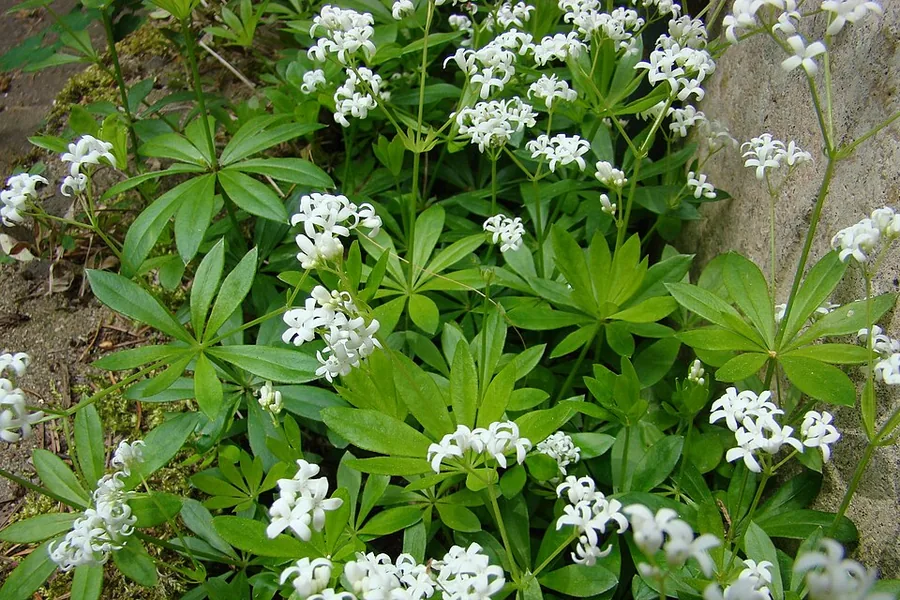
Sweet woodruff is a low groundcover suited to the cool shade that limits most species. A member of the Rubiaceae family, it bears narrow leaves in whorls set around distinctly square stems, and it lifts small white star-shaped flowers above the foliage in late spring. Crushing or drying the leaves releases coumarin as a sweet, fresh-cut-hay fragrance, the property that secured its place in historic herb gardens.
In the dappled shade beneath trees or along a shaded north wall, it closes into a dense, even mat within a single season. Two mechanisms drive that coverage: creeping rhizomes extend the colony underground while self-seeding populates open ground, so the same vigor that makes it an effective groundcover also carries it into adjacent beds without a rhizome barrier. Sited in hot, dry sun it scorches and enters summer dormancy, a stress response to conditions outside its woodland tolerance.
It ranks among the lower-maintenance groundcovers, with no serious pests or diseases once established in the cool, moist, humus-rich soil that suits it. The qualification is the coumarin its leaves accumulate, the very compound behind the scent. Trace amounts flavor traditional German May wine, but the same compound makes large quantities unsafe to consume.
Care
The short version: match its woodland origins with cool, moist, humus-rich shade and a mildly acidic soil. Irrigate through drought, feed sparingly, and edge it because its rhizomes will not stop at your bed line.
Light
Site it in full to partial shade, the filtered light of a woodland edge. It accepts limited morning sun, but hot, dry, full sun exceeds its tolerance, scorching the foliage and forcing early dormancy as the plant conserves resources.
Water
Hold the soil cool and evenly moist, which typically means watering every 3 to 7 days during dry weather. Established plants tolerate dry shade, but foliage stays greenest where the root zone never fully dries, since drought stress is what triggers scorch and dormancy.
Soil
It performs best in humus-rich, well-drained loam at a mildly acidic pH of 5.0 to 6.5, conditions that mirror a leaf-litter woodland floor. Incorporating leaf mold or compost supplies both the organic matter and the moisture retention it draws on.
Temperature
Cold hardiness runs to about -29°F (-34°C), and it grows well up to roughly 84°F (29°C). Above that range, combined heat and drought push it into scorch and summer dormancy until temperatures moderate.
Humidity
Ambient outdoor humidity meets its needs, so no target figure applies. In dense stands the limiting factor is air circulation rather than moisture in the air, because stagnant, humid conditions at the foliage favor occasional leaf spot.
Feeding
This is a low-demand feeder. A thin spring topdressing of compost or leaf mold covers its nutrient needs, and heavier feeding is counterproductive because it accelerates the spread most growers are working to limit.
Pruning
Pruning requirements are minimal. Shearing or mowing after bloom removes tattered or scorched foliage, prompts fresh growth, and, by cutting spent flowers, limits the self-seeding that extends the colony.
Repotting
In containers, divide and repot every 1 to 2 years as the rhizome mat consumes the available root volume. Roots circling the pot, a thinning center, and a mat outgrowing its space all indicate the plant has become rootbound and needs dividing.
Size & spacing
Mature height stays low at 6 to 12 inches (15 to 30 cm), with growth directed outward rather than upward. Each plant spreads 12 to 24 inches (30 to 60 cm), so spacing at roughly that interval lets the colony close without leaving gaps.
When to plant
Its cycle tracks the cool season. Sow in late winter to early spring to satisfy the cold requirement, transplant divisions in spring or early fall while soil moisture is reliable, and expect white flowers in late spring.
Northern hemisphere
Southern hemisphere
Typical months for a temperate climate: start earlier in warm zones, later where spring frosts linger.
- Sow: Late winter to early spring; seed germinates slowly and benefits from cold stratification
- Plant: Spring or early fall in shade
- Harvest: White star-shaped flowers in late spring (April to May)
Hardiness
USDA hardiness zones: 4–8
Temperature: down to -34°C
Troubleshooting
Most complaints trace to a mismatch between the site and this plant's woodland preferences rather than to pests. Vigor in the wrong place reads as invasion; sun and drought read as scorch. Identify the disorder below and correct the underlying condition.
Colony advancing beyond the planted area
The vigorous advance is rhizomatous spread reinforced by self-seeding, and the cool, moist shade it prefers only accelerates it into neighboring beds. Install a rhizome barrier or sunken edging at planting, and remove escaped runners by loosening the soil and lifting the rhizomes intact, since the brittle stems fracture under tension and leave fragments behind. Shearing after bloom removes the seed source that would extend the colony further.
Fix:
- Install a physical root barrier or plant in a contained bed or sunken edging
- Dig out unwanted rhizomes by loosening the soil and lifting them whole rather than pulling stems, which break easily
- Deadhead or shear after flowering to limit self-seeding
Scorched, browning foliage over a thinning stand
Browning is leaf scorch, the plant's response to hot, dry, sunny exposure in place of the cool shade it requires, and in severe cases it retreats into summer dormancy. Relocate it to part or full shade, mulch to buffer soil temperature and retain moisture, and irrigate through dry spells. Cutting back the scorched foliage clears the damage so fresh growth resumes once conditions cool.
Fix:
- Move or establish plants in part to full shade
- Keep soil cool and evenly moist with mulch and supplemental water in dry spells
- Cut back scorched foliage to encourage fresh regrowth once conditions cool
Foliar spotting in a still, crowded stand
An occasional fungal leaf spot develops where poor air circulation keeps the foliage wet. Thinning dense growth restores airflow, watering at soil level keeps the leaves dry, and removing marked foliage takes out the inoculum. Given adequate spacing, sweet woodruff has no serious pest or disease pressure.
Fix:
- Improve air circulation by thinning crowded growth
- Avoid overhead watering and water at soil level
- Remove and discard affected foliage
Toxicity
The concern with sweet woodruff is chemical, not acute. Its foliage holds coumarin, the aromatic compound responsible for the scent, which is benign in the trace amounts used to flavor May wine. In quantity coumarin acts as an anticoagulant and is hepatotoxic, which is why the FDA prohibits it as a food additive, so restrict intake for pets, livestock, and people.
Toxic to
Cats · Dogs · Horses · Rabbits · Livestock · Birds · People
Cats Caution
A trace nibble carries little consequence, but the coumarin in the foliage makes a substantial ingestion inadvisable. Digestive upset or lethargy would be the signs to watch for beyond a leaf or two.
Dogs Caution
Small quantities generally pass without effect, whereas larger amounts deliver enough coumarin to impair clotting and stress the liver. Prevent a dog from grazing an entire stand, and consult a veterinarian after a significant ingestion.
Horses Caution
Incidental grazing within pasture is minor, but consuming a large volume of the coumarin-rich foliage can produce coagulation problems and a dull, unthrifty appearance.
Rabbits Caution
A brief browse is tolerated, though the coumarin content argues against making it a dietary constant. Limit access to an occasional sprig rather than a regular ration.
Livestock Caution
Cattle, goats, and sheep tolerate small intakes, but a large volume of fresh or dried foliage raises the risk of internal bleeding and hepatic strain attributable to coumarin.
Birds Caution
Birds show little interest, and incidental pecking is inconsequential. The relevant risk is sustained feeding on the coumarin-bearing foliage.
People Caution
Trace amounts safely flavor May wine and teas, the historic culinary use. Consumed in quantity, the coumarin can cause hepatic damage, bleeding, and dizziness, so portions must stay small.
Foliage contains coumarin, the compound behind its sweet, fresh-cut-hay scent (which intensifies as it dries). In large quantities coumarin can have blood-thinning (anticoagulant) effects and cause liver issues, and the FDA prohibits coumarin as a food additive, so only small culinary amounts are traditionally used and large quantities should not be eaten.
Helpline numbers

United States
ASPCA Animal Poison Control: (888) 426-4435 (fee applies)
Poison Control: (800) 222-1222



Canada
Poison Centres: 1-844-764-7669
Varieties
The genus offers little to select among here. Cultivation centers almost entirely on the straight species.
Galium odoratum (straight species)
Cultivation rests almost entirely on the straight species, which carries few named cultivars and was formerly classified under the earlier name Asperula odorata.
How to propagate
Because it is rhizomatous and self-fertile, sweet woodruff propagates readily, whether by dividing established clumps or by collecting the seed it sets on its own.
DivisionEasy
Spring (or any time in the growing season if kept moist until established) · A few weeks to a season
Division is the most reliable method. Lift the rhizomatous clumps in spring, separate them into pieces, and replant into moist shade, where each division re-establishes within a few weeks to a season as the rhizomes reconnect.
SeedModerate
Late winter to early spring; benefits from cold stratification · One or more seasons; germination is slow
The plant self-seeds freely, though deliberate seed propagation is slower and less certain. Sow in late winter to early spring after cold stratification to break dormancy, and anticipate slow, uneven germination that can take a season or more to fill in.
Myths
Its use in May wine proves sweet woodruff is edible in unlimited amounts.
Edibility is limited to small culinary quantities. The foliage contains coumarin, an anticoagulant that is hepatotoxic in quantity, and the FDA prohibits it as a food additive. Use trace amounts as a flavoring and avoid ingesting the plant in bulk.