Houseplant · Oxalidaceae
False Shamrock
Oxalis triangularis
Purple, three-cornered leaflets that track the light by day and fold shut at night, rising from a colony of small bulbs.
Bright indirect
55–75°F · 13–24°C
USDA 8–11
6–18 in · 15–46 cm
Overview
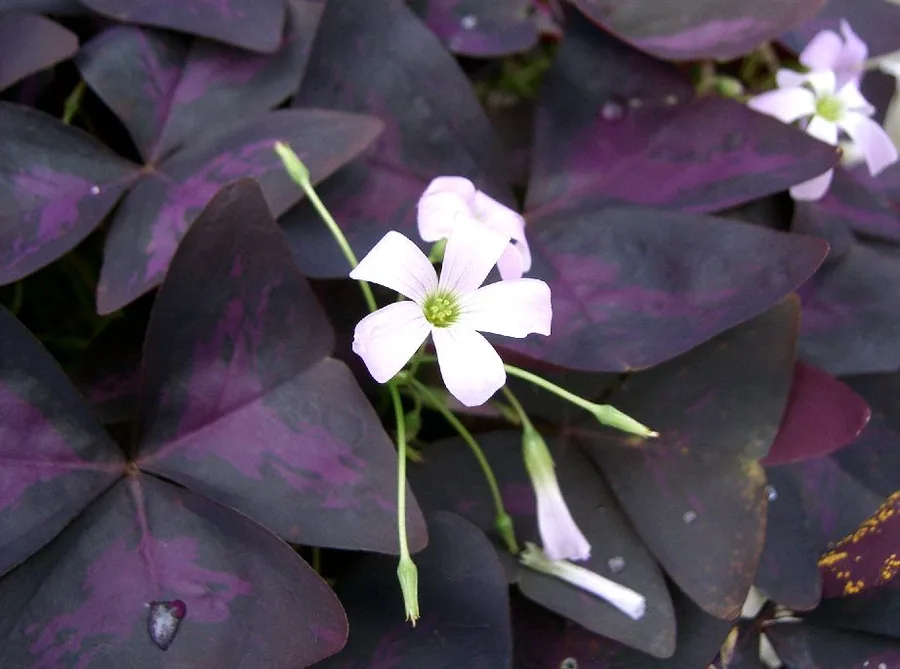
False shamrock is grown chiefly for foliage, not bloom. Each leaf divides into three deep purple, triangular leaflets that open in the morning and fold down at dusk, a nyctinastic movement driven by changing light. Native to Brazil and Paraguay, it grows from small bulbs and performs as an easy, striking houseplant given a bright windowsill.
Its die-back tends to confuse growers because it mimics death. After a hot stretch or in autumn, the foliage yellows and collapses and the pot appears spent. It is not. The plant is entering dormancy, holding its energy in the bulbs below soil until a cool interval and renewed watering signal regrowth, after which it returns in full.
Its requirements are modest. Bright indirect light, soil held barely moist, and respect for its rest cover nearly all of them. The single real hazard is that every part holds oxalic acid, so it warrants placement away from pets inclined to chew.
Care
The short version: bright indirect light, soil held barely moist and never waterlogged so the bulbs do not rot, and ordinary room warmth between 55°F and 75°F (13°C to 24°C). Honor the die-back as a true rest, then resume watering to break dormancy.
Light
Provide bright, indirect light to develop the deepest anthocyanin coloring in the leaves. It accepts some full sun and tolerates partial shade, but insufficient light causes etiolation, so the plant grows leggy and the purple fades toward green.
Water
Hold the soil barely moist but never wet, allowing the top inch or so to dry between waterings, because saturated medium starves the bulbs of oxygen and induces rot. As the foliage begins to die back, reduce watering and then withhold it entirely to allow the rest period to proceed.
Soil
Use a loose, well-drained potting mix, soil-based or soilless. Texture matters little, and the plant accepts a broad pH range from 6.0 to 8.0, so any general houseplant medium suffices provided it drains freely rather than holding water at the bulbs.
Temperature
Standard room warmth suits it, ideally 55°F to 75°F (13°C to 24°C) with cooler nights. It responds poorly to real heat, which frequently acts as the trigger that pushes it into an early dormancy.
Humidity
Average household air meets its needs, with no humidity figure to target. Root-zone moisture governs its health far more than ambient humidity, so consistent watering outweighs any misting.
Feeding
Apply a balanced houseplant fertilizer about once a month, but confine feeding to spring through fall while growth is active. Stop entirely once dormancy sets in, since the resting bulbs are not metabolizing and cannot use the nutrients.
Pruning
Pruning is essentially sanitation. Remove any yellowing or dead leaves, and excise any rust-marked foliage as soon as it appears to interrupt the fungus before it sporulates and spreads.
Repotting
Repot every few years, or sooner once the bulbs crowd the pot and leaf size declines from competition. Set the bulbs just under the surface in a well-drained mix, which is also the appropriate moment to divide a clump that has grown dense.
Size & spacing
Mature plants form a low mound roughly 6 to 18 inches (15 to 46 cm) tall with a spread of 12 to 24 inches (30 to 61 cm). Its compact stature and slow, even habit make it straightforward to site on a windowsill or shelf.
Troubleshooting
This species presents few disorders, and the most alarming one is a programmed rest rather than a fault. The skill is reading a normal bulb die-back apart from genuine trouble. Match the symptom below before adjusting watering.
Rust-colored pustules and spotting on the leaves
This is oxalis rust, a fungal infection that raises orange to brown pustules on the leaf surface with discolored tissue surrounding them. Prune off and discard affected leaves promptly to remove the inoculum. Increase air movement around the plant and keep water off the foliage, since the spores require a wet leaf surface to germinate and spread.
Fix:
- Prune and dispose of diseased foliage
- Improve air circulation and avoid wetting foliage
Foliage yellows, collapses, and the plant appears dead
This is almost always natural dormancy, not disease. False shamrock grows from bulbs that rest annually, generally after a heat episode or in autumn, and the foliage senesces while the bulbs persist underground. Withhold water, clear the dead growth, hold the pot in a cool, dark place for about a month, then return it to light and resume watering as a cue to break the rest.
Fix:
- Stop watering and let the leaves dry out
- Remove dead foliage and place the pot in a cool, dark spot for about a month
- Resume watering and return to light when new growth appears
Toxicity
Classify this as a mildly toxic plant. The whole plant carries soluble oxalic acid, distinct from the insoluble raphides of aroids, and the ASPCA lists it as toxic to cats, dogs, and horses. Because the soluble form is absorbed systemically, a small nibble tends to cause only oral or gastric upset, while a large ingestion can depress blood calcium and burden the kidneys, so keep it out of reach of pets and children.
Toxic to
Cats · Dogs · Horses · Rabbits · Livestock · Birds · People
Cats Caution
A small nibble generally produces no more than salivation and mild gastric upset. Real harm requires a large quantity of leaves, and the bitter, acidic taste usually deters a cat well short of that dose. Monitor for vomiting or tremors if one consumes a lot.
Dogs Caution
A dog that chews a leaf or two may salivate slightly and show a transient stomach upset. The risk rises only when a dog ingests a genuine quantity of foliage, which can produce vomiting and, uncommonly, depressed blood calcium.
Horses Caution
A brief taste is unlikely to affect a horse. The concern is sustained grazing on a large amount, where the soluble oxalates can drive colic and signs of calcium imbalance over time.
Rabbits Caution
The same soluble oxalates that affect cats and dogs apply to rabbits, so exclude it from their diet. An incidental bite is minor, but rabbits should not be permitted to graze on the leaves.
Livestock Caution
Goats, sheep, and cattle carry the same dose-dependent exposure. Harm follows bulk consumption rather than a single mouthful, so keep larger plantings out of reach of grazing animals.
Birds Caution
Treat it as off-limits for pet birds. The oxalic acid in the leaves can irritate the digestive tract, and there is no benefit to allowing a bird to pick at it.
People Caution
This is not cultivated as food, and the leaves are tart with oxalic acid. A child who chews one may develop a sore mouth and gastric upset, so keep it out of small hands, though the bitter flavor usually ends a taste-test quickly.
All parts have toxic potential; keep out of reach of pets and children.
Helpline numbers

United States
ASPCA Animal Poison Control: (888) 426-4435 (fee applies)
Poison Control: (800) 222-1222



Canada
Poison Centres: 1-844-764-7669
Varieties
Commercial stock sold as false shamrock is almost invariably the purple-leaved subspecies, and it is the form worth recognizing.
Oxalis triangularis subsp. triangularis
This is the purple-leaved subspecies most growers picture, bearing deep maroon triangular leaflets in threes that fold shut each night through nyctinasty or when the plant is disturbed.
How to propagate
The plant propagates itself by increase, since each growing season the parent bulb produces a colony of small offsets that detach with a light pull.
Bulbs & cormsEasy
During dormancy · A few weeks once watering resumes and new growth begins
Wait for full dormancy, then tip the clump out of its pot and separate the many small bulbs, which detach from one another with almost no resistance. Set them into fresh pots in small groups, just beneath the soil surface. New leaves emerge within a few weeks once watering resumes and growth restarts.
DivisionEasy
During dormancy or at repotting · A few weeks
When a pot becomes congested, lift it at repotting time or during dormancy and divide the dense mass of bulbs into smaller groups. Replant each group, and they reestablish within a few weeks.
Myths
False shamrock behaves like a pothos or philodendron and causes only brief mouth irritation.
The two contain chemically different oxalates. A pothos holds insoluble calcium oxalate crystals that only sting the mouth on contact, whereas false shamrock holds soluble oxalate that the body absorbs systemically, which in large amounts can lower blood calcium and stress the kidneys. The ASPCA lists it as toxic to cats, dogs, and horses, so a substantial ingestion is a real concern even though a small nibble is not.
Once the leaves die back, the plant has died and should be discarded.
A bare pot reads as finished, but the bulbs are merely resting through a normal dormancy. Withhold water, hold the pot in a cool, dark spot for about a month, then water again, and new foliage emerges from the bulbs.