Shrub · Celastraceae
Evergreen Euonymus
Euonymus japonicus
A tough, shade-friendly evergreen that shears cleanly into hedging and demands little once it is sited well.
Full sun
Every 7–14 days
USDA 6–9
10–15 ft · 3–4.6 m
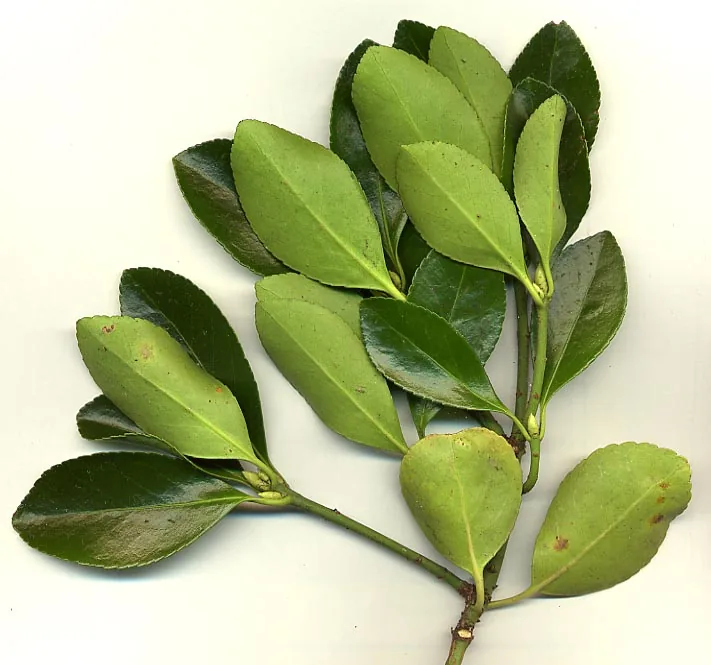
Overview
Evergreen euonymus earns its reputation as a low-input shrub. It retains its glossy foliage through every season, performs across the full light gradient from sun to deep shade, and withstands cold to -9°F (-23°C). That cold hardiness and shade tolerance explain its prevalence in clipped hedges and foundation plantings.
The plant belongs to a large genus of spindle trees, and the upright Japanese species (Euonymus japonicus) is among the most widely cultivated. Growers favor it because it responds cleanly to shearing, knits together at a moderate pace, and includes variegated forms with gold or white-margined leaves that lighten a shaded position.
Its flowers are small and inconspicuous, so the species is grown for foliage and structure rather than bloom. Provide well-drained soil and adequate air movement around the canopy and it remains presentable for years. Restrict that airflow and you create the humid microclimate that favors its two recurring problems, scale and mildew.
Care
The short version: any light from sun to full shade, well-drained soil, and a deep irrigation only once the top half of the root zone has dried. Shear to shape in late spring, apply a light feed once in early spring, and monitor for scale.
Light
This shrub performs across the entire light range, from full sun to full shade. Sun yields the densest canopy and the strongest variegation because photosynthesis and pigment expression are highest there, whereas a shaded position still supports the plant but produces looser, more open growth.
Water
Irrigate deeply, then withhold water until the top half of the root zone dries, which generally falls every 7 to 14 days. The species is drought tolerant once established yet intolerant of saturated soil, since waterlogging starves the roots of oxygen, so drainage outranks frequency.
Soil
It establishes in clay, loam, or sand, though a moist, humusy, well-drained medium gives the best performance. The tolerated pH spans 5.5 to 8.0, a broad band that lets most garden soils support it without amendment.
Temperature
Both cold-hardy and heat-tolerant, it operates from -9°F to 100°F (-23°C to 38°C). That wide thermal range encompasses many climate zones and accounts for the species turning up almost everywhere it is grown.
Humidity
Ambient outdoor humidity is sufficient, so no level requires managing. Far more consequential is airflow around the leaves, because static, humid air sustains the leaf-surface moisture that lets scale and powdery mildew establish.
Feeding
Its nutrient demand is modest. Incorporate a balanced general-purpose shrub fertilizer once in early spring and stop there, since excess nitrogen forces soft growth that is more attractive and more vulnerable to pests.
Pruning
Few shrubs tolerate shearing as well, which makes it dependable as formal hedging. Shear to shape in late spring after the new growth flushes, and remove any scale-infested or diseased branches as soon as they are identified.
Repotting
In a container it seldom needs a larger pot. Repot only when roots circle the pot, water passes straight through, or growth stalls, because the species is slow to outgrow its space.
Size & spacing
Grown unsheared it attains 10 to 15 feet (3 to 4.5 m) in height and a spread of 5 to 8 feet (152 to 244 cm). Allocate a hedge that footprint, or shear it down and plant on tighter centers to form a denser green wall.
When to plant
As a four-season evergreen rather than a seasonal crop, this species has no sowing window to track. Establish new plants in spring or fall while the soil remains workable, allowing them to root in during the cool, moist interval that precedes summer heat.
Northern hemisphere
Southern hemisphere
Typical months for a temperate climate: start earlier in warm zones, later where spring frosts linger.
- Plant: Spring or fall
- Harvest: Inconspicuous greenish-white flowers in late spring to early summer (June)
Hardiness
USDA hardiness zones: 6–9
Temperature: down to -23°C
Troubleshooting
Nearly all euonymus disorders express on the foliage, and the more serious ones trace to crowded canopies and stagnant air that hold humidity at the leaf surface. Detect scale and mildew early and they remain manageable. Match the symptom below, then intervene before it moves through the hedge.
Armored scale crusting along the leaves and stems
The yellowing, spotting, and early leaf fall point to euonymus scale, an armored insect whose stylet pierces the tissue and withdraws sap faster than the leaf can replace it. The dimorphic colonies give it away: slim white males and dark oystershell-shaped females pack the leaf undersides and the stems. Because the crawler is the only mobile, unarmored stage, prune out the heaviest branches and then aim a thorough horticultural oil spray at the orange crawlers as they emerge in late winter or spring.
Fix:
- Hand-scrape or prune out lightly to heavily infested branches and discard them
- Apply horticultural oil with thorough coverage timed to crawler emergence in late winter or spring
- Use a soil-applied systemic such as dinotefuran once in spring for heavy infestations
- Conserve natural enemies such as predatory beetles (Chilocorus species) and parasitic wasps
Corky tumor galls at the crown and lower stems
Rough, tumor-like galls at the crown are the hallmark of crown gall, a soil bacterium that enters through wounds and induces disorganized tissue that interrupts the vascular flow, so the leaves above yellow and the branches die back. No treatment cures a stem once it is galled. Excise affected stems below the swelling, disinfect tools with rubbing alcohol between cuts to avoid spreading the bacterium, and leave that ground free of a susceptible host for a few years.
Fix:
- Prune affected stems below the galls and sterilize tools with rubbing alcohol between cuts
- Destroy severely infected plants
- Avoid replanting susceptible species in contaminated soil for 2 to 3 years
White-gray fungal film on the upper leaf surface
A flat white-gray growth that rubs off the upper leaf is the mycelium of powdery mildew, a fungus that colonizes and distorts expanding young leaves, leaving them curled and scarred. It establishes where shade and still, humid air slow evaporation at the leaf surface, so the most durable correction is cultural: widen the spacing and move the shrub into more sun. Remove the fallen infected leaves, keep irrigation off the foliage, and turn to a labeled fungicide only when the infection continues to spread.
Fix:
- Prune out diseased branches and remove fallen leaves
- Improve air circulation with proper spacing and plant in sunny areas
- Avoid overhead watering
- Apply a labeled fungicide such as myclobutanil, propiconazole, sulfur, or horticultural oil, rotating products to prevent resistance
Honeydew and curled tissue on tender shoots
Soft-bodied insects massed on the tender shoots are aphids, phloem feeders whose excreted honeydew sets the stage for sooty mold. The colonies are loosely attached, so a strong jet of water dislodges most of them before any treatment. Follow with insecticidal soap or horticultural oil on the survivors, and moderate nitrogen, because the flush of soft growth it drives is precisely the tissue aphids colonize.
Fix:
- Dislodge aphids with a strong spray of water
- Apply insecticidal soap or horticultural oil to affected growth
- Conserve beneficial predators such as lady beetles
Toxicity
Regard this shrub as unsuitable for ingestion by animals or small children. Its leaves, bark, and bright fruit contain alkaloids and cardiac glycosides that irritate the digestive tract and, at larger doses, disturb the cardiac rhythm. No part of it is food, so keep dropped berries and prunings cleared from areas pets and children use.
Toxic to
Cats · Dogs · Horses · Rabbits · Livestock · Birds · People
Cats Toxic
In a cat, chewed leaves or fruit first irritate the gut, producing drooling and vomiting followed by diarrhea and abdominal pain. At a larger dose the cardiac glycosides reach the myocardium, where they can disrupt the rhythm and precipitate collapse.
Dogs Toxic
A dog that ingests the foliage or seeds typically develops vomiting, diarrhea, and drooling within hours as the gut reacts. With a sufficient dose the same cardiac-glycoside effect on heart rhythm follows, which warrants a veterinary call rather than watchful waiting.
Horses Toxic
A horse browsing the leaves or bark presents with colic and dullness alongside loose manure and weakness. Since the cardiac glycosides act on the heart, even an incidental nibble of the hedge merits attention.
Rabbits Toxic
For a rabbit the alkaloids and glycosides render every part of the shrub hazardous. Even a few leaves can induce diarrhea and a rapid, distressed decline, so exclude the animal from the plant entirely.
Livestock Toxic
Cattle, sheep, and goats that graze the foliage can develop digestive upset together with the same cardiac effects. Fence the shrub away from pasture and keep prunings out of any area stock can access.
Birds Toxic
The seeds within the appealing fruit carry the toxins, and pet birds in particular can suffer gut upset and cardiac disturbance from sampling them. Exclude dropped berries from any aviary or run.
People Caution
No part of this shrub is edible. A child who ingests the bright fruit may develop vomiting and diarrhea, and a large quantity risks heart-rhythm effects, so site the plant where small hands cannot reach the berries.
Keep fallen fruit, seeds, and prunings away from pets and children; wash hands after pruning.
Helpline numbers

United States
ASPCA Animal Poison Control: (888) 426-4435 (fee applies)
Poison Control: (800) 222-1222



Canada
Poison Centres: 1-844-764-7669
Varieties
The named selections are distinguished mainly by leaf color and size, ranging from gold-margined uprights to fine box-leaf dwarfs. The following are the forms encountered most often.
'Aureomarginatus'
A widely grown variegated selection identified by green leaves bordered with bright golden-yellow margins.
'Microphyllus'
A dwarf box-leaf selection whose small leaves and dense, compact habit make it a functional substitute for boxwood in low edging.
'Microphyllus Variegatus'
A small-leaved dwarf that retains the fine box-leaf texture while displaying white-variegated foliage.
'Green Spire'
An upright, columnar selection furnished with dense, glossy dark green leaves.
How to propagate
Increasing this shrub is straightforward, and cuttings outperform seed both in rooting speed and in keeping a variegated form true to the parent.
Stem cuttingsEasy
Summer using semi-hardwood cuttings · Several weeks to a few months to root
Vegetative cuttings are the easy and reliable method for increasing this shrub. Semi-hardwood material taken in summer roots readily, though rooting spans anywhere from several weeks to a few months. Because the offspring is genetically identical to the parent, this clonal route preserves a variegated form true to type.
SeedModerate
Sow ripe seed after cleaning the fleshy fruit · Slower and more variable than cuttings
Seed propagation is feasible but seldom chosen. Clean the fleshy aril from the ripe seed before sowing, then anticipate slower, more uneven results than cuttings provide; because seedlings segregate, a variegated parent will not necessarily reproduce true.
Myths
Evergreen euonymus is the same plant as the invasive wintercreeper.
These are distinct species, not one plant. Evergreen euonymus (Euonymus japonicus) is an upright shrub, whereas wintercreeper (Euonymus fortunei) is a climbing groundcover vine that has become invasive across much of the eastern United States. They share a genus, not a habit, so the growth form, not the genus name, is what should guide your planting choice.
Sources
- NC State Extension Gardener Plant Toolbox
- Missouri Botanical Garden Plant Finder
- Clemson Cooperative Extension Home & Garden Information Center
- NC State Extension Publications
- UC IPM (University of California Agriculture and Natural Resources)
- Pet Poison Helpline
- USDA / University-sponsored Invasive.org (Center for Invasive Species and Ecosystem Health)