Shrub · Celastraceae
Burning Bush
Euonymus alatus
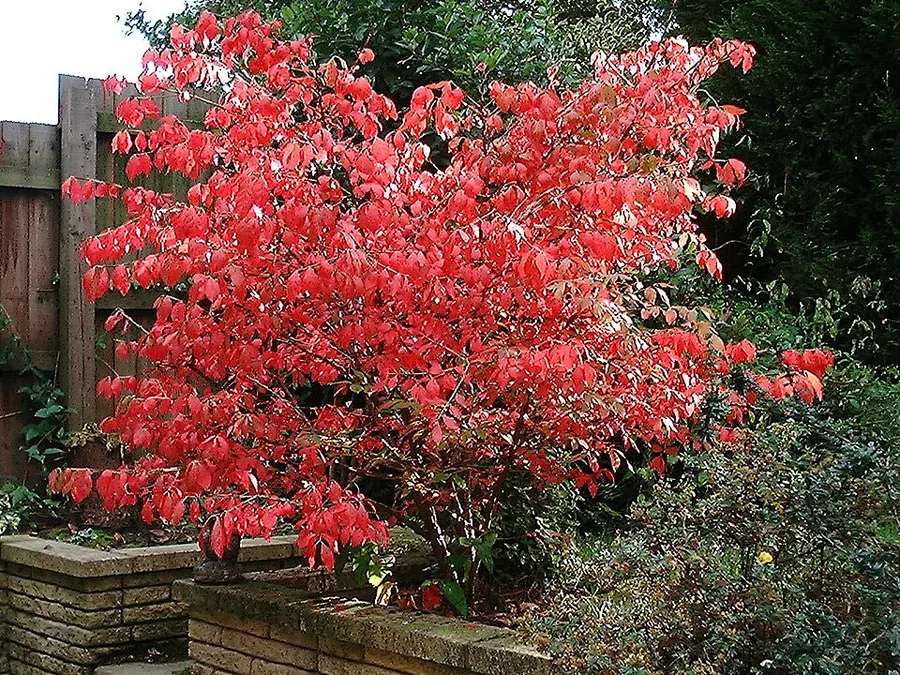
Site it in full sun and the autumn foliage ignites to a deep scarlet visible clear across the yard.
Full sun
Every 7–14 days
USDA 4–8
15–20 ft · 4.6–6.1 m
Overview
Burning bush is a durable, undemanding shrub planted for a single trait: its autumn color. Through summer the foliage holds a plain, reliable green, but as daylength drops the leaves shift to a fierce scarlet-red that defined countless yards and parking lots for decades. Corky, winged ridges run along the stems, the feature behind names like winged euonymus.
Its cultural needs are minimal. Once rooted in it withstands drought, accepts clay, loam, or sand without protest, and endures winters to -29°F (-34°C). That same hardiness is the liability. Birds eat the orange-red fruit and deposit the seed in woods and fencerows, where it builds dense thickets that displace native plants.
For that reason burning bush is now invasive across much of the eastern and central United States and banned outright in several states. To get the same autumn fire without the spread, turn to natives like chokeberry, serviceberry, or ninebark.
Care
The short version: site it in full sun to maximize fall color, set it in well-drained soil of nearly any texture, water it through establishment and then largely leave it be, and prune in late winter to maintain its form.
Light
Provide burning bush with full sun to drive the strongest fall color, because the red anthocyanins form only under bright light. It accepts partial shade and grows perfectly well there, but shaded plants leaf out green in autumn and forgo the scarlet display that justifies growing the shrub.
Water
Water a new plant regularly through its first year, then ease off as the roots take hold. Once established it is genuinely drought tolerant and needs water only every 7 to 14 days during dry spells. Keep it away from constantly wet soil, which creates the conditions for twig blight.
Soil
This shrub accepts nearly any well-drained soil, from clay through loam to sand, across a broad pH of 5.5 to 8.0. Drainage is its one firm requirement, since saturated ground is the source of most of its disease problems.
Temperature
Burning bush is cold-hardy from roughly -29°F to 95°F (-34°C to 35°C), spanning USDA zones 4 through 8. Severe winters do not set it back, and that same resilience is part of why it escapes so readily into wild land.
Humidity
Ambient outdoor humidity suits it, so there is no level to regulate. Air movement matters more than atmospheric moisture, because stagnant, congested growth is what gives fungal twig blight a foothold.
Feeding
This shrub seldom requires feeding. A single application of balanced slow-release fertilizer in spring is plenty, and only when growth is clearly poor. Excess nitrogen drives soft leafy growth at the expense of the autumn color the plant was chosen for.
Pruning
Prune in late winter or early spring before new growth breaks, whether shaping or cutting back hard, which it absorbs without harm. Clipping off the spent fruit also reduces the seedlings that make this plant a liability.
Repotting
Burning bush is a landscape shrub and rarely held in a pot, so repotting is seldom relevant. If a young one is grown in a container, step it up when roots circle the base, water drains straight through, or the top growth stalls.
Size & spacing
Unchecked it develops into a large shrub of 15 to 20 feet (4.5 to 6 m) tall and 8 to 12 feet (2.4 to 3.7 m) wide. Allow that footprint, or commit to routine pruning to keep it in bounds.
When to plant
Burning bush is a hardy deciduous shrub, which keeps the schedule straightforward. Set it out in spring or fall under mild conditions, expect inconspicuous green flowers near May, and anticipate the main event when the foliage reddens in autumn beside its orange-red fruit.
Northern hemisphere
Southern hemisphere
Typical months for a temperate climate: start earlier in warm zones, later where spring frosts linger.
- Plant: Spring or fall
- Harvest: Inconspicuous yellow-green flowers in spring (about May), followed by red-purple fall foliage and orange-red fruit
Hardiness
USDA hardiness zones: 4–8
Temperature: down to -34°C
Troubleshooting
Burning bush gives a grower little trouble, and its problems are easy to diagnose. Weak fall color traces back to the planting site, while stippling, webbing, or dieback signals a pest or a waterlogged root zone. Match the symptom below and respond before it advances.
Bronzed, mottled foliage and silk threads in dry heat
A washed-out, finely stippled leaf surface paired with thin webbing on the undersides is the signature of spider mites, which reproduce explosively in hot, dry, dusty conditions. Confirm by rapping a leaf over white paper and watching for moving specks. A forceful jet of water dislodges the colony mechanically, and a follow-up with horticultural oil or insecticidal soap, repeated on a schedule, catches the next hatch before it rebuilds.
Fix:
- Spray foliage forcefully with water to dislodge mites
- Apply horticultural oil or insecticidal soap
- Repeat treatments to break the mite life cycle
Twigs and small branches dying back
Random dead twigs and sunken cankers are the classic presentation of twig blight, a fungal pathogen that establishes where the root zone stays saturated. The disease concentrates in poorly drained sites where soil never dries between waterings. Cut each affected stem well below the visible lesion, sanitize the blades between cuts so spores aren't carried to clean wood, and correct the drainage that opened the door.
Fix:
- Prune out and dispose of affected twigs well below the damage
- Improve drainage and avoid overwatering
- Clean pruning tools between cuts
Encrusted white scale colonizing stems, foliage yellowing
Crusty white and brown encrustations gripping the bark are euonymus scale, a sap-feeding insect that drains vigor and yellows the foliage as the population builds. Remove the most heavily colonized stems outright, then coat the remainder with horticultural oil, which works by smothering the insects under their protective covers. Spray timing is decisive: the oil only penetrates when the soft-bodied crawlers are exposed and on the move through late spring and summer.
Fix:
- Prune out heavily infested stems
- Apply horticultural oil to smother scale
- Treat crawlers when active in late spring to summer
Muted autumn foliage lacking scarlet pigment
The red autumn pigments depend on bright light, so when a plant flushes green or muddy instead of scarlet the cause is almost always too little sun. Shaded specimens photosynthesize and leaf out normally but never build the anthocyanins that drive the color, and surplus nitrogen redirects the plant toward soft leafy growth at the expense of that pigment. Shift it into full sun and pull back on feeding to restore the display.
Fix:
- Relocate or transplant to a full-sun site
- Reduce or stop nitrogen fertilizing
- Thin overhanging vegetation to increase light
Toxicity
Regard the entire shrub as poisonous. The leaves, bark, and fruit carry alkaloids and cardiac glycosides that induce vomiting and diarrhea and, at higher intake, disturb the heartbeat. It is unsafe for dogs, cats, horses, livestock, and people, so keep the fallen berries and prunings well beyond reach.
Toxic to
Cats · Dogs · Horses · Rabbits · Livestock · Birds · People
Cats Moderate
When a cat chews on the leaves or fruit, expect drooling and vomiting first, then diarrhea and abdominal pain. With a larger dose the cardiac glycosides begin to disrupt the heart rhythm, and at that point it becomes a veterinary emergency.
Dogs Moderate
Dogs typically vomit and pass loose, painful stools within hours of sampling any part of the shrub. A substantial mouthful adds weakness and an irregular heartbeat from the glycosides, which is the point to phone a veterinarian.
Horses Moderate
Because horses cannot vomit, the toxins are retained and present as colic, diarrhea, and a weak, unsteady gait. A genuine quantity can destabilize the heartbeat and calls for immediate veterinary attention.
Rabbits Toxic
The same alkaloids and glycosides overwhelm a rabbit's small body quickly, triggering gut stasis, diarrhea, and rapid deterioration. Keep every part of this plant out of any space a rabbit can access.
Livestock Toxic
Cattle, sheep, and goats that browse the foliage or pick up fallen fruit suffer severe digestive distress, with dangerous heart-rhythm disturbance once intake climbs. Exclude grazing stock from any hedge or windbreak that contains it.
Birds Caution
Birds eat the bright arils and pass the seed intact, and that gut transit is precisely the mechanism that carries the shrub into wild land. They tolerate the fleshy fruit, yet the seeds and leaves remain a hazard for caged or ground-feeding species.
People Caution
No part of this shrub is edible. The fruit and seeds provoke vomiting and diarrhea, and a heavy dose carries the same heart-rhythm risk, so keep inquisitive children clear of the conspicuous berries.
Keep fallen fruit and prunings away from pets and small children; ingestion of several leaves or seeds commonly causes gastrointestinal upset.
Helpline numbers

United States
ASPCA Animal Poison Control: (888) 426-4435 (fee applies)
Poison Control: (800) 222-1222



Canada
Poison Centres: 1-844-764-7669
Varieties
A handful of named selections appear at garden centers, most of them simply smaller versions of the same plant. Note that none of them resolves the invasive concern.
Compactus
A dwarf winged form that caps out near 10 feet with denser growth than the species, yet it still produces heavy crops of seed and naturalizes just as aggressively.
Rudy Haag
A markedly compact, slow-growing selection holding at roughly 3 to 5 feet tall and setting considerably less fruit than typical forms.
How to propagate
Burning bush propagates readily, which is part of why it spreads so freely in the wild. Cuttings can be rooted deliberately, or, all too commonly, seedlings emerge on their own.
Stem cuttingsModerate
Softwood cuttings in early summer or semi-hardwood cuttings in mid to late summer · Several weeks to root, then grown on for a season or more
Collect softwood cuttings in early summer or semi-hardwood ones slightly later, treat the cut bases with rooting hormone, and hold them under high humidity to limit water loss while they form roots. Rooting runs over several weeks, after which they need a full season or more of growing on before they can be set out.
SeedEasy
Seed sown after cleaning and cold stratification · Germinates readily; note that prolific self-seeding is the main reason this plant is invasive
Cleaned and cold-stratified seed germinates with ease, and that is the heart of the problem. Birds consume the fruit and broadcast the seed over long distances, which is the route by which the shrub leaves cultivation and turns invasive. Raising it deliberately from seed is discouraged.
Myths
The reduced-size cultivars of burning bush pose no invasive risk, so planting them is perfectly acceptable.
Compact selections such as Compactus still set abundant bird-dispersed seed, so they colonize wild ground exactly as the full-size shrub does. Burning bush is banned or regulated in several states no matter the cultivar, dwarf forms included.