Bulb · Asteraceae
Dahlia
Dahlia × hybrida
Built on full sun, rich soil, and steady moisture, the dahlia flowers from midsummer to frost.
Full sun
Every 2–4 days
50–84°F · 10–29°C
90–120 days
Overview
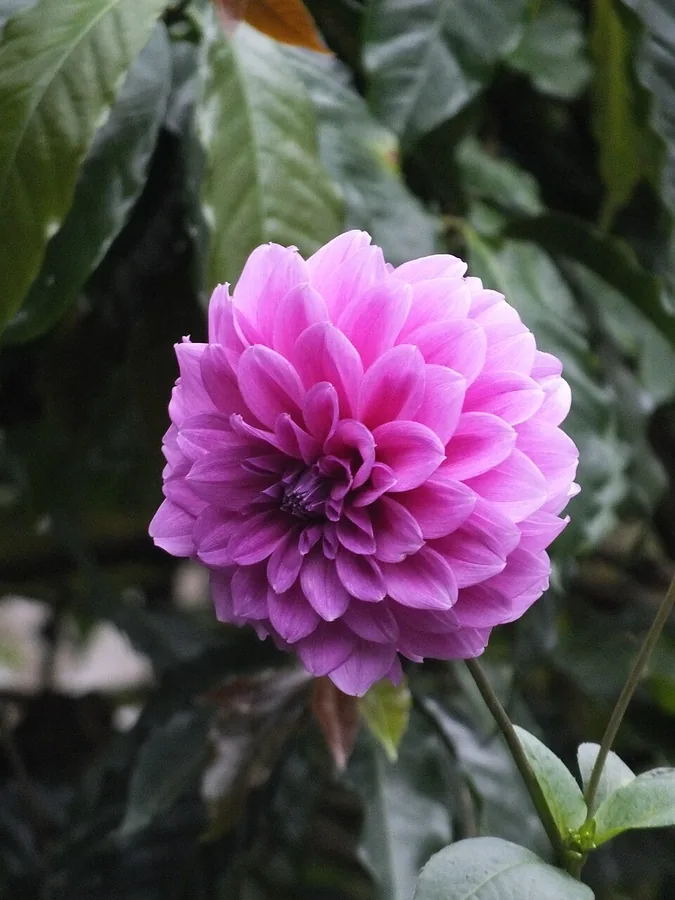
Few subjects anchor a late-summer border as effectively as the dahlia. A member of the Asteraceae, it arises from a fleshy tuber and produces fast, bushy growth that flowers from midsummer until the first frost ends the display. Flower size spans a wide range, from compact pompons to heads the diameter of a dinner plate.
The genus offers exceptional formal diversity. Decorative, cactus, pompon, ball, and dwarf bedding classes cover a broad span of shape and scale, with plants reaching from 1 to 6 feet (30 to 183 cm) in height. The taller classes excel as cut flowers and require staking, while the dwarf seed-raised forms suit the front of a planting.
Dahlias respond well to good culture without demanding advanced technique. Provided full sun, rich soil, and moisture held just short of dry, they flower for months. Two conditions account for most losses: waterlogged soil, which rots the tubers, and winter cold, which compels lifting and storage of the tubers in any zone colder than zone 7.
Care
The short version: full sun, rich and sharply drained soil held evenly moist, a low-nitrogen feed across the summer, and a fall lift of the tubers in any zone colder than zone 7.
Light
Dahlias flower most heavily in full sun, on the order of 6 or more hours daily, because high light drives the photosynthate that bud production depends on. A little afternoon shade is acceptable in hot-summer regions, but deep shade etiolates the stems and suppresses flowering.
Water
Hold the soil evenly moist through the growing season and avoid drying out, irrigating deeply every 2 to 4 days with mulch to buffer the root zone. Stop short of saturation, because waterlogged soil excludes oxygen from the tubers and induces rot.
Soil
Site dahlias in rich, well-drained soil high in organic matter. Drainage is the decisive factor, since tubers held in wet ground are deprived of oxygen and rot, so incorporate compost and raise the bed where the soil retains water.
Temperature
Dahlias perform across roughly 50°F to 84°F (10°C to 29°C) and flower through the warm season. They have no frost tolerance, since freezing destroys the top growth and endangers the tubers beneath.
Humidity
Ambient outdoor humidity satisfies them, so no target figure applies. Air movement matters more, because crowded, still air around the canopy creates the leaf-surface conditions that allow powdery mildew to establish.
Feeding
Apply a low-nitrogen fertilizer such as 5-10-10 or 5-20-20 monthly through summer. Surplus nitrogen diverts resources into vegetative growth at the expense of flowers and predisposes the tubers to rot.
Pruning
Pinch the taller varieties while young to break apical dominance and force bushier, sturdier growth. Then deadhead spent blooms as they fade, which redirects energy from seed set back into continued flowering until frost.
Repotting
Lift and divide the tubers every 2 to 3 years to sustain vigor. Congested clumps flower less and produce smaller blooms as the eyes compete, so division relieves the crowding and renews performance.
Size & spacing
Plants range from 1 to 6 feet (30 to 183 cm) tall with a spread of 1 to 3 feet (30 to 91 cm). Space them to that width so the canopy stays open and the humid microclimate that favors mildew never forms.
When to plant
Dahlias are frost-tender warm-season tubers, so soil temperature governs the calendar more than the date. Starting them indoors in late winter advances the season, transplanting waits until the soil clears 60°F (16°C), and flowering runs from midsummer until frost terminates the top growth.
Northern hemisphere
Southern hemisphere
Typical months for a temperate climate: start earlier in warm zones, later where spring frosts linger.
- Sow: Start tubers or seed indoors 4 to 6 weeks before the last spring frost in colder zones.
- Plant: Plant tubers outdoors in spring after the last frost once soil has warmed to at least 60 degrees F.
- Harvest: Mid-summer through first fall frost (roughly July to first frost).
Hardiness
USDA hardiness zones: 7–10
Temperature: down to -18°C
Troubleshooting
Dahlia problems separate cleanly into foliar disorders above ground and tuber disorders below it, and the cause usually explains the cure. Identify the early signs and intervention can halt a disorder before it moves through the clump. Match the symptom below, then correct the underlying condition driving it.
Soft, mushy tubers that never sprout
This is tuber rot, driven by wet, poorly drained soil that starves the tissue of oxygen, with damage or excess feeding accelerating decay in storage. Diagnosis rests on a mushy, discolored tuber with a foul odor, or a plant that wilts at the base and fails to emerge. Discard soft tubers, amend the bed with organic matter to improve drainage, and store cured tubers dry and cool over winter.
Fix:
- Discard rotted tubers and avoid replanting in the same wet spot
- Improve soil drainage with organic matter and raised beds
- Store cured tubers dry at 35 to 45 degrees F in vermiculite or dry sand
Dusty white film spreading over the leaves
This is powdery mildew, a foliar fungus that establishes where crowding and stagnant air raise leaf-surface humidity. It appears late in the season and rubs off the cuticle like flour. Open the canopy to move air, irrigate at the base to keep foliage dry, and remove the most heavily colonized leaves to reduce inoculum.
Fix:
- Improve air circulation by proper spacing and thinning
- Avoid overhead watering and water at the base
- Remove and dispose of severely affected foliage
Curled, mottled leaves on a stunted plant
Inspect the leaf undersides for aphids and leafhoppers, soft-bodied sap feeders that also vector mosaic virus between plants. Mottling that does not wash off indicates viral infection rather than feeding injury alone. Dislodge light populations with a strong water jet, rogue out any plant showing persistent viral symptoms, and suppress the insect vectors to limit spread.
Fix:
- Spray off light aphid infestations with a strong stream of water
- Remove and destroy plants showing persistent viral symptoms
- Control insect vectors to limit virus spread
Toxicity
Dahlias rate as only mildly toxic and lack the serious hazards of some ornamentals. Ingested foliage tends to provoke mild gastrointestinal upset, and the sap can irritate skin on contact, yet people are essentially unaffected and the tubers are edible once cooked. Even so, prevent pets from grazing the leaves and tubers.
Toxic to
Cats · Dogs · Horses · Rabbits · Livestock · Birds
Safe for
People
Cats Mild
A cat that ingests foliage may salivate or vomit and lose interest in food for a short period, and contact with the plant can produce a patch of mild dermatitis.
Dogs Mild
A dog chewing the leaves or stems tends toward mild gastric upset and some drooling, and the sap can redden the skin on contact.
Horses Mild
A horse grazing the foliage generally develops no more than transient digestive upset, with a possibility of mild dermatitis at points of contact.
Rabbits Mild
The same irritant compounds disturb a rabbit's gut, so the plant belongs away from the hutch and run rather than within browsing reach.
Livestock Mild
Cattle, goats, and sheep ordinarily avoid dahlias, but an animal that consumes a quantity of foliage can develop a mild digestive upset.
Birds Caution
Firm data on birds is lacking, so the species is rated a caution, and pet birds should be kept from pecking the leaves and stems.
People Low risk
People are essentially unaffected, and the tubers are edible once cooked, leaving contact dermatitis as the only real concern. Wear gloves where skin reacts to the sap.
Wear gloves when handling foliage if you are prone to contact dermatitis, and keep tubers and cuttings out of reach of pets.
Helpline numbers

United States
ASPCA Animal Poison Control: (888) 426-4435 (fee applies)

United Kingdom
Animal PoisonLine: 01202 509000 (fee applies)

Australia
Animal Poisons Helpline: 1300 869 738
Varieties
Dahlias span thousands of registered cultivars, which horticulturists organize into a few classes defined by floret form and flower shape. These are the classes worth recognizing.
Decorative dahlias
Defined by fully double blooms with broad, flat-tipped ray florets, this is the most widely grown class in gardens and the florist trade.
Cactus dahlias
Distinguished by double flowers whose narrow, rolled, pointed florets give the head a spiky, star-like outline.
Pompon and ball dahlias
Marked by small, rounded, tightly packed globes assembled from neatly cupped petals.
Dwarf bedding dahlias
Compact seed-raised plants around a foot tall suited to bedding, though their tolerance of real heat is limited.
How to propagate
Dahlias propagate readily by three methods, each suited to a different aim: dividing an established clump, rooting basal cuttings in spring, or raising seed for a variable population.
DivisionModerate
Divide tuber clumps in fall after digging or in spring once eyes begin to sprout. · Several weeks to emerge after planting in warm soil
Division is the standard means of increasing a selected cultivar while preserving its traits. Split the clump in fall after lifting, or in spring as the eyes begin to swell, ensuring every division carries part of the crown with at least one live eye, since the eye is the only source of new shoots. Set into warm soil, divisions take several weeks to emerge.
Stem cuttingsModerate
Take basal cuttings in spring from sprouted tubers. · 2 to 4 weeks to root
Basal cuttings clone a cultivar without dividing the parent clump. In spring, detach the basal shoots arising from a sprouting tuber and root them, a process of about 2 to 4 weeks, to bulk up stock of a chosen variety.
SeedEasy
Start seed indoors 4 to 6 weeks before last frost. · 1 to 2 weeks to germinate
Seed is the simplest method but the least faithful, sown indoors 4 to 6 weeks before the last frost and germinating within a week or two. Because dahlias are highly heterozygous, the seedlings don't come true to the parent and largely produce dwarf bedding plants.
Myths
Dahlias are completely safe around pets because they are common garden flowers.
Garden ubiquity carries no information about palatability or safety. The ASPCA classifies dahlia as toxic to cats, dogs, and horses, producing mild gastrointestinal upset and possible dermatitis. The toxicity is low-grade, yet the plant still warrants placement beyond a pet's reach.
Dahlia tubers can be left in the ground over winter anywhere.
Hardiness extends only to about zone 7, so in colder regions a hard ground freeze kills the tubers outright. In those zones the standard practice is to lift the tubers in fall and store them cool and dry, or to replant fresh stock each spring.