Tree · Lythraceae
Crepe Myrtle
Lagerstroemia indica
Site it in full sun with open airflow and prune lightly, and Lagerstroemia indica flowers all summer before exfoliating into mottled winter bark.
Full sun
Every 7–14 days
USDA 6–9
15–25 ft · 4.6–7.6 m
Overview
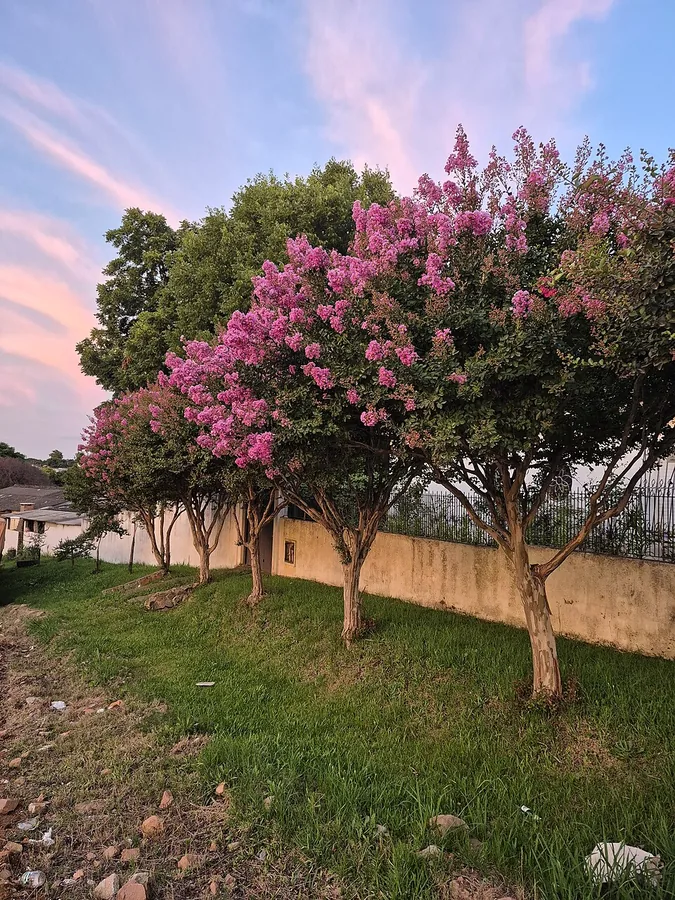
Lagerstroemia indica earns its place in the southern landscape because it flowers across the hottest months, opening crinkled, crepe-textured panicles from July into September in white, pink, lavender, and deep red. As the season turns, the outer bark exfoliates to expose smooth, mottled wood. The tree grows fast and tolerates heat, drought, and a broad range of soils once the root system is established, which is why it performs where less adaptable species fail.
This is a full-sun tree that needs room. A mature specimen reaches 15 to 25 feet tall with a comparable spread, so it functions as the small flowering tree that fills the niche true lilacs cannot in the warm South, hence the name lilac of the south. Sun drives flowering, and adequate spacing keeps the canopy open, both of which the plant relies on to bloom well and stay clean.
Most decline in this species traces back to over-management rather than neglect. The tree flowers heavily on its own and requires only sun, sharp drainage, and a measured late-winter prune. Hard topping is counterproductive, since removing the framework forces weak, congested regrowth instead of improving bloom.
Care
The short version: full sun, well-drained soil, and deep watering only during establishment. Prune lightly in late winter to refine structure, limit nitrogen so the plant partitions energy into flowers, and keep the canopy open so airflow suppresses mildew and scale.
Light
Site the tree in full sun, meaning 6 or more hours daily. It persists in light shade but at a measurable cost, fewer flowers and markedly higher powdery mildew pressure, because reduced light and the cooler, more humid microclimate of shade both favor the pathogen.
Water
Irrigate a young tree regularly through the first season to drive root extension, the basis of its later resilience. Once established it is heat- and drought-tolerant and needs supplemental water only in prolonged drought. Allow the top half of the soil profile to dry between irrigations to avoid saturating the root zone.
Soil
The species is edaphically adaptable, performing in clay, loam, sand, or shallow rocky ground provided drainage is adequate, since standing moisture is the real limitation rather than texture. It tolerates a wide pH range from 5.0 to 8.0, so most sites need no amendment.
Temperature
Adapted to southern conditions, the tree withstands summer heat to 100°F (38°C) without stress. Cold hardiness extends to roughly -9°F (-23°C), which underpins its reliability through zone 6, although a severe winter can kill the top while the root crown resprouts.
Humidity
Ambient outdoor humidity is immaterial here, so no target value applies. The operative variable is airflow: stagnant, humid air within a congested canopy sustains the leaf-surface moisture that powdery mildew and Cercospora leaf spot require to establish.
Feeding
Apply a balanced fertilizer in spring, guided by a soil test so inputs address actual deficiencies rather than assumptions. Keep nitrogen moderate, because excess nitrogen shifts the plant toward vegetative growth at the expense of floral initiation.
Pruning
Prune lightly in late winter or early spring. Remove crossing limbs, suckers, and spent seed heads, and progressively limb up the lower branches to develop a clean tree form. Avoid severe topping, which destroys the structural framework and provokes weak, water-sprout regrowth.
Repotting
As a landscape tree, crepe myrtle is seldom maintained in containers long term. A container specimen requires infrequent repotting, with the indicators being roots circling the drainage holes and a substrate that dries almost immediately after irrigation, both signs the root mass has outgrown the volume.
Size & spacing
Allow for a mature tree of roughly 15 to 25 feet (4.5 to 7.5 m) in height with an equal spread. Spacing to the full mature width is a disease-management tool, because the resulting airflow through the canopy reduces the leaf wetness that fungal pathogens exploit.
When to plant
Lagerstroemia indica is reliably hardy from zone 6 through 9 and is governed by warm-season growth. Establish a new tree in spring or fall, when moderate temperatures let the roots extend before heat or freeze stress, and expect the bloom period to run from July through September.
Northern hemisphere
Southern hemisphere
Typical months for a temperate climate: start earlier in warm zones, later where spring frosts linger.
- Plant: spring or fall
- Harvest: July to September
Hardiness
USDA hardiness zones: 6–9
Temperature: down to -23°C
Troubleshooting
Nearly all crepe myrtle disorders are fungal or insect in origin, and both express first on the foliage or the bark. Early intervention generally arrests the problem before it compromises the canopy. Match the diagnostic signs below, then treat at the point of detection.
White powdery growth on leaves and buds that fail to open
These signs indicate powdery mildew, caused by a fungus that proliferates during the mild, humid intervals of spring and fall and can prevent buds from opening entirely. Exposure to sun and air movement removes the humid microclimate it needs, so open the canopy, clear congested basal sprouts, and apply a labeled fungicide only when infection is severe.
Fix:
- Site in full sun with good air circulation
- Remove basal sprouts and crowded growth to improve airflow
- Apply a labeled fungicide such as myclobutanil, propiconazole, or thiophanate-methyl if severe
Yellow leaf spots followed by late-summer defoliation
Yellow spotting that develops in warm, moist weather is Cercospora leaf spot, a fungus capable of defoliating a tree by late summer. Because it depends on leaf wetness and infected debris, keep water off the foliage, open the canopy for faster drying, and rake and remove fallen leaves to eliminate the overwintering inoculum.
Fix:
- Improve air circulation and avoid wetting foliage
- Rake and remove fallen infected leaves
- Apply thiophanate-methyl or myclobutanil if needed
White felt-like crusts on bark exuding pink when crushed
White, felted encrustations on the trunk and branches are crapemyrtle bark scale, confirmed when a crushed individual releases a pink fluid. The scale secretes honeydew that drives heavy sooty mold across the tree. Mechanically wash the bark with mild soapy water and a soft brush to remove scale and mold, then integrate a spring systemic soil drench with a late-winter dormant oil application to disrupt successive generations.
Fix:
- Wash trunk and branches with mild soapy water and a soft brush to remove scale and mold
- Apply a systemic soil drench (e.g., imidacloprid) in spring per label
- Use dormant horticultural oil sprays in late winter
Sticky leaves with a black film over the surface
The sticky residue is honeydew excreted by crape myrtle aphids feeding on the lower leaf surfaces, and the black sooty mold is a saprophytic fungus colonizing that sugar rather than the leaf itself. Dislodge the aphids with a strong water stream, treat with insecticidal soap or neem oil, and conserve lady beetles and lacewings as predators. Once the aphid population drops, the sooty mold loses its food source and weathers away.
Fix:
- Spray plants with a strong stream of water to dislodge aphids
- Use insecticidal soap or horticultural/neem oil
- Encourage predators such as lady beetles and lacewings
Toxicity
The toxicological profile here is clean: crepe myrtle is safe across the board. The ASPCA classifies it as non-toxic to cats, dogs, and horses, and no toxin is recorded for other animals or people. The only practical concern is aesthetic, since fallen petals can stain a walkway or vehicle.
Safe for
People · Cats · Dogs · Horses · Rabbits · Livestock · Birds
Cats None
The ASPCA records crepe myrtle as non-toxic to cats, so ingestion of a leaf or fallen bloom presents no toxicological risk.
Dogs None
Dogs may mouth the leaves, flowers, or bark without consequence. The plant is safe if a low branch is chewed, though consuming a large volume of any plant can cause transient gastrointestinal upset.
Horses None
Horses grazing in proximity are unaffected. The species is not poisonous to horses, and no exclusion fencing is warranted.
Rabbits Safe
Rabbits incur no risk from the foliage or stems, since the plant contains no known toxin and an incidental bite is harmless.
Livestock Safe
Cattle, goats, and sheep can browse around the tree safely, as the foliage holds nothing toxic to ruminants.
Birds Safe
Backyard and wild birds are at no risk. They frequently work the seed capsules, and the plant is safe for them.
People Safe
Crepe myrtle is harmless to people, children included. No part is a recognized food, so there is no reason to consume it, but an incidentally tasted petal or leaf causes no harm.
No special toxicity precautions are needed; fallen flowers may stain walkways or vehicles.
Varieties
Hundreds of selections circulate in the trade, but the cultivars worth specifying are the disease-resistant indica and fauriei hybrids. The following four recur in recommendations because their resistance and form are proven.
Natchez
A vigorous indica and fauriei hybrid reaching about 30 feet, distinguished by white flowers, cinnamon-brown bark that exfoliates in winter, and strong resistance to powdery mildew.
Muskogee
An indica and fauriei hybrid exceeding 20 feet, valued for light lavender flowers, an extended bloom period, and good mildew resistance.
Tuscarora
An indica and fauriei hybrid bearing coral-pink to dark pink flowers, combining solid resistance to both powdery mildew and Cercospora leaf spot.
Sioux
A mildew-resistant indica and fauriei hybrid that couples bright pink summer flowers with pronounced red-purple fall coloration.
How to propagate
Crepe myrtle can be increased by several methods, and the choice hinges on genetic fidelity: clonal techniques reproduce a named cultivar exactly, while seed yields genetically variable offspring.
Stem cuttingsEasy
Softwood cuttings in late spring to summer; hardwood cuttings in winter · 4 to 8 weeks to root
Cuttings give true-to-type plants because the offspring is genetically identical to the parent cultivar. Collect softwood cuttings in late spring or summer, or hardwood cuttings in winter, with rooting in 4 to 8 weeks.
SeedModerate
Collect ripe seed in fall and sow · One or more seasons
Seed offers a viable but slower route. Harvest ripe capsules in fall and sow them, accepting that the seedlings are genetically variable and will not reproduce a named cultivar, and that establishment takes a season or more.
LayeringModerate
Growing season · Several months
Layering exploits a branch's capacity to root while still attached. Pin a low branch to the soil during the growing season, allow several months for roots to form, then sever the rooted layer from the parent.
Myths
Crepe myrtles require a hard annual topping, the so-called crepe murder, to bloom well.
Topping confers no floral benefit and inflicts lasting structural harm. The species blooms abundantly on current-season growth without intervention, whereas severe heading cuts destroy the natural form and stimulate weak, congested water sprouts. The correct practice is a light structural prune in late winter.