Ornamental · Lythraceae
Cuphea
Cuphea ignea
Site it in full sun and pinch the tips on schedule, and cuphea flowers without pause from spring to frost.
Full sun
Every 3–7 days
USDA 9–12
2–3 ft · 0.5–0.9 m
Overview
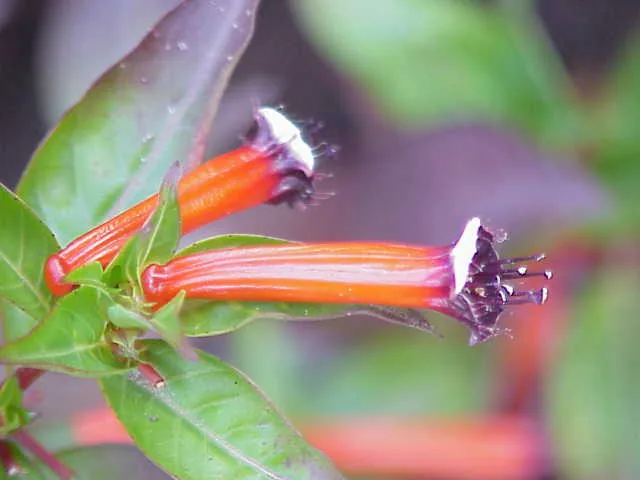
Cuphea is a heat-adapted flowering plant whose value lies in a bloom period that runs from late spring until frost. The cigar flower, Cuphea ignea, is named for inch-long tubular flowers in reddish-orange finished with a white tip and a dark ring, a form that reads as a lit cigar. Taxonomically it sits in the Lythraceae and behaves as a tender perennial, hardy in the ground only through zones 9 to 12 and cultivated as a warm-season annual in colder regions.
The defining horticultural trait is the duration and continuity of flowering. Bloom proceeds with little interruption across the warm season, and because the plant is self-cleaning, spent corollas abscise on their own and deadheading becomes redundant. Hummingbirds work the tubular flowers throughout summer, a function of the corolla shape that recommends siting it near a patio or path.
Habit stays compact, with mature dimensions of roughly 1.5 to 3 feet (46 to 91 cm) in height and a comparable spread, suiting it to a border, a mixed container, or the front of a bed. Its requirements reduce to sun, consistent moisture, and periodic pinching. Without pinching, apical dominance drives leggy, open growth that strands flowers at the tips and leaves the lower stems bare.
Care
The short version: full sun, an evenly moist but well-drained soil, and a balanced feed through the season, with periodic tip pinching to enforce a bushy, dense habit.
Light
Flowering is maximized in full sun, which also sustains the dense, compact form. The plant tolerates partial sun or light shade, but reduced irradiance lowers bloom output and produces a looser, floppier habit.
Water
Maintain evenly moist conditions in well-drained soil, irrigating on roughly a 3 to 7 day interval according to heat and drainage. Established plants become somewhat drought tolerant, so the operative risk is excess: waterlogging deprives the roots of oxygen and induces rot.
Soil
Use an organically rich, well-drained loam or sand that retains moisture without saturating. The plant accepts a pH of 5.5 to 7.5, a range most amended garden beds already satisfy with incorporated compost.
Temperature
Physiologically warm-season, cuphea tolerates heat to about 95°F (35°C) and sustains injury as temperatures approach freezing. It persists to roughly 36°F (2°C), but frost terminates the canopy, which is why annual culture is standard where winters are cold.
Humidity
Ambient outdoor humidity is adequate, and no target percentage applies. The plant remains untroubled provided air movement is reasonable around the canopy.
Feeding
Apply a balanced water-soluble fertilizer every two weeks through the growing season, or incorporate a slow-release granular at planting to meter nutrients over time. Consistent nutrition supports the extended flowering period.
Pruning
Pinch the stem tips several times during active growth to suppress apical dominance and induce branching for a fuller, bushier plant. Deadheading is not required, as the self-cleaning habit sheds spent flowers without assistance.
Size & spacing
Mature plants reach about 1.5 to 3 feet (46 to 91 cm) in height with a comparable spread. Space each to its mature width so air circulates through the canopy and growth fills out evenly.
When to plant
Cuphea requires warmth and has no frost tolerance, so timing follows the frost date. Sow seed indoors well ahead of the last spring frost, transplant after the cold has passed and the soil has warmed, and the plant flowers from late spring through fall until the first freeze.
Northern hemisphere
Southern hemisphere
Typical months for a temperate climate: start earlier in warm zones, later where spring frosts linger.
- Sow: 10 to 12 weeks before the last spring frost
- Plant: After all danger of frost has passed and soil has warmed in spring
- Harvest: Blooms almost nonstop from late spring through fall until first frost
Hardiness
USDA hardiness zones: 9–12
Temperature: down to -7°C
Troubleshooting
Cuphea is an easy subject with a short list of disorders, most of them readily diagnosed from a single symptom. They range from open growth to winter dieback. Match the description below to what the plant shows and intervene early.
Sticky leaves, twisted new growth, or insects on the foliage
The sap-feeding trio of mealybugs, thrips, and whiteflies accounts for most infestations, and the enclosed warmth of indoor and greenhouse culture favors their buildup. Diagnosis rests on the leaf undersides and growing tips, where cottony masses, minute flying adults, or stippled feeding damage betray them. A water rinse dislodges a light population, while insecticidal soap or horticultural oil handles a persistent one by smothering the soft-bodied stages.
Fix:
- Rinse off light infestations with water
- Treat with insecticidal soap or horticultural oil as needed
Stems blacken and die back over winter
As a tender perennial, cuphea has no frost tolerance in its top growth, so frost or a hard freeze ruptures the cells and the stems blacken and collapse. In zones 8 to 9 the crown often survives if mulched, since insulation buffers the roots, and the plant resprouts from the base in spring. Below that, the dependable approach is to treat it as a warm-season annual or to root cuttings and overwinter them under cover.
Fix:
- Mulch well so the plant can resprout from the base in spring in zones 8 to 9
- Grow as a warm-season annual or overwinter cuttings indoors in colder regions
Open, floppy growth with bare lower stems
An unpinched cuphea concentrates extension growth at the apex and turns leggy, so flowering crowds the stem tips while the lower wood goes bare. Insufficient light worsens the stretch as the plant reaches for it. Pinching the semi-woody stems several times through the season removes apical dominance and breaks lateral buds, and full sun supports the dense, compact habit that results.
Fix:
- Pinch back the tips of the semi-woody stems a few times during the growing season
- Site in full sun for denser, more compact growth
Toxicity
For households with pets or young children, the record is clear: cuphea is non-toxic across the board. No part of the plant is documented as harmful to cats, dogs, livestock, or people, so it can be sited near a play area or a pet run without concern.
Safe for
People · Cats · Dogs · Horses · Rabbits · Livestock · Birds
Cats None
No toxic constituents are recorded in cuphea, so ingestion of a leaf or flower by an inquisitive cat presents no documented hazard.
Dogs None
The species carries no poisonous classification, so a dog that chews or brushes against it is at no recorded risk.
Horses Safe
No part of the plant is documented as harmful to horses grazing in its vicinity.
Rabbits Safe
Cuphea contains no compounds known to affect rabbits, so browsing on the foliage carries no recorded danger.
Livestock Safe
Cattle, goats, and sheep encounter no recorded poisoning from this plant in pasture or border settings.
Birds Safe
The tubular flowers attract hummingbirds, and the plant presents no documented threat to garden birds.
People Safe
Cuphea is classified as non-toxic, so handling of the foliage or blooms by children poses no recorded concern.
Varieties
The genus Cuphea spans a broad range, from low purple-flowered shrubs to firecracker types. The selections below are the ones most often encountered in cultivation.
Cuphea hyssopifolia (Mexican heather, false heather)
A densely branched sub-shrub of 1 to 2 feet, identifiable by its profusion of small lavender-purple trumpet flowers, with pink and white cultivars in circulation.
Cuphea ignea (cigar flower)
Recognized by inch-long tubular blooms in reddish-orange finished with a white tip and a dark ring that mimic a lit cigar, and reliably worked by hummingbirds.
Vermillionaire (Cuphea hybrid 'Cupver')
A vigorous firecracker-type hybrid that produces orange tubular flowers in quantity and performs through genuine heat.
How to propagate
Cuphea propagates without difficulty by two routes: seed sown in late winter, or tip cuttings rooted to carry a selection through the cold.
Stem cuttingsEasy
Take tip cuttings in fall and root indoors over winter for overwintering · A few weeks to root
For overwintering stock, tip cuttings taken in fall root readily indoors, generally within a few weeks. Reduce watering through fall and winter as they establish, since the cool, damp regime that suits dormancy also favors rot in unrooted material.
SeedEasy
Start indoors 10 to 12 weeks before the last spring frost · Germinate and grow on for transplanting after frost
Seed sown indoors 10 to 12 weeks before the last spring frost gives transplants of usable size once the frost risk lifts. Where that lead time is impractical, nursery transplants establish equally well.
Myths
Cuphea must be deadheaded to keep it blooming.
The species is self-cleaning, abscising its spent flowers without intervention, so manual deadheading is unnecessary. Flowering proceeds continuously from spring until the first frost on its own.
Cigar flower can only survive as a houseplant in cold climates.
It is a tender perennial, hardy in the ground only through zones 9 to 12, but cold-climate culture does not require a windowsill. Growing it as a warm-season annual, or overwintering rooted cuttings under cover, meets its needs.