Ornamental · Asteraceae
Cornflower
Centaurea cyanus
Sown into full sun and lean soil, cornflower returns true-blue flowerheads across the summer.
Full sun
Every 7–14 days
USDA 2–11
1–3 ft · 0.3–0.9 m
Overview
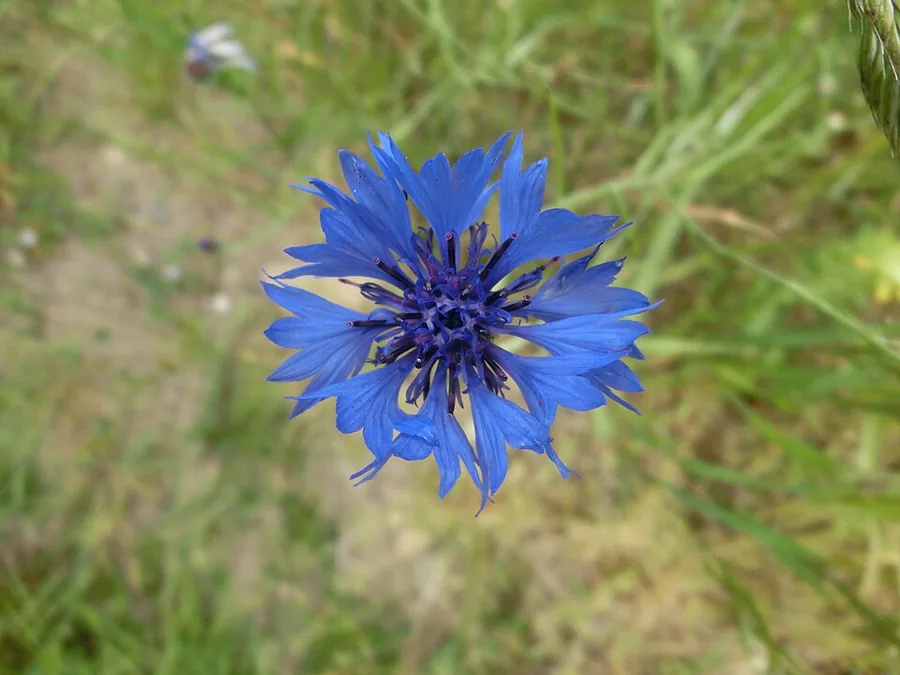
Cornflower, or bachelor's button, is a cool-season hardy annual in the Asteraceae that has accompanied cereal cultivation and cottage gardens for centuries. Its flowers carry a true blue that few species can equal, and the petals are edible, with a mild spicy-sweet flavor. The plant demands little beyond direct sun and open ground.
Its reputation for ease rests on real tolerance. It performs in poor, dry soil that would limit more demanding species, withstands cold to USDA zone 2, and reseeds so freely that a single sowing tends to persist as volunteers year after year. Given space, it forms a loose, open clump of 1 to 3 feet.
That vigor comes paired with one weakness: a tendency to lodge in shade or on rich ground. Sited in strong sun on lean soil, the stems stand firmer and the flower color deepens. Deadheading the spent flowers extends bloom for weeks by delaying the shift to seed production.
Care
The short version: full sun and average, well-drained soil kept on the lean side. Water once the top half of the profile dries, withhold fertilizer, and deadhead spent flowers to sustain the bloom.
Light
Cornflower requires full sun, on the order of 6 or more hours daily, to develop sturdy, free-flowering plants. It tolerates light shade, but inadequate light causes etiolation, so shaded plants stretch, lean, and lodge rather than standing erect.
Water
Supply medium, even moisture during establishment, allowing the top half of the soil to dry between waterings, which equates to roughly every 7 to 14 days. Established plants are drought-tolerant and accept low water. The critical limitation is wet, soggy ground, which the species will not endure.
Soil
Average, well-drained loam is sufficient, and the species in fact performs in poor soils that limit fertilization-dependent plants. It adapts across a broad pH range of 6.0 to 8.0, so most garden soils require no amendment.
Humidity
Ambient outdoor humidity meets the plant's needs, so no target value applies. The more relevant factor is air circulation, since stagnant, crowded conditions favor the rusts and rots to which the species is prone.
Feeding
Cornflower has minimal nutrient demand and frequently performs best unfertilized. Where feeding is used, a light balanced fertilizer at planting suffices, because excess fertility produces the weak, lodging-prone stems described above.
Pruning
Deadheading the spent flowers prolongs the bloom and restrains the species vigorous self-seeding. A clump that grows leggy mid-season can be cut back, which commonly stimulates a renewed flush of growth.
Size & spacing
Mature plants reach 1 to 3 feet (30 to 91 cm) in height and spread 12 to 24 inches (30 to 61 cm) wide. Allow that spacing so air moves through the planting and adjacent stems lend mutual support.
When to plant
Cornflower establishes best in cool conditions. Sow indoors 6 to 8 weeks before the last spring frost, or direct sow around the frost date. In mild-winter regions a fall sowing draws on the species cold tolerance for an earlier display, with flowers appearing from late spring into summer, roughly May to July.
Northern hemisphere
Southern hemisphere
Typical months for a temperate climate: start earlier in warm zones, later where spring frosts linger.
- Sow: 6 to 8 weeks before the last spring frost
- Plant: Direct sow at the last spring frost date, or in fall in mild-winter climates
- Harvest: Blooms late spring into summer, roughly May to July
Hardiness
USDA hardiness zones: 2–11
Temperature: down to -46°C
Troubleshooting
Cornflower is largely trouble-free, and its few disorders read clearly once you know the cause. Lodging signals inadequate light, sticky foliage indicates a sap-feeding pest, and wilting in moist soil points to root failure in wet ground. Match the symptom below and intervene early.
Wilt, basal rot, or rust pustules on the leaves
A plant that wilts in moist soil or develops a soft, mushy base is showing root and stem rot, the predictable result of waterlogged conditions that exclude oxygen from the roots. Orange pustules on the foliage indicate a separate rust infection. Rotted tissue cannot recover, so removal of affected plants, correction of drainage, and keeping the foliage dry are the only effective responses.
Fix:
- Improve soil drainage
- Avoid overhead watering and overwatering
- Remove and discard affected plants
Stems lodge and the plant sprawls open
Lodging in cornflower traces back to insufficient light: a plant in shade or a crowded bed etiolates and leans, while one in full sun develops the firm stems that keep it upright. Excess fertility or saturated soil compounds the problem by driving the soft, sappy growth that cannot bear its own weight. Correcting the site to full sun, withholding feed, and setting twiggy stakes around tall stems addresses both the cause and the symptom.
Fix:
- Grow in full sun
- Provide light support or grow-through staking for tall plants
- Avoid over-fertilizing
Sticky foliage colonized by small insects
Soft-bodied colonies on the stems and leaf undersides identify aphids, with mealybugs as a secondary culprit. Both are phloem feeders, so they excrete the sticky honeydew you notice and deform the actively expanding new growth they target. A forceful jet of water dislodges most of the population, insecticidal soap clears stubborn infestations, and resident ladybugs provide ongoing biological control.
Fix:
- Spray plants with a strong jet of water to dislodge pests
- Apply insecticidal soap if infestation is heavy
- Encourage natural predators such as ladybugs
Toxicity
There is no toxicological concern with this species. Cornflower is documented as non-toxic to pets, livestock, and people, and the petals are edible, with a mild spicy-sweet flavor. It can be sited freely around cats, dogs, horses, and children.
Safe for
People · Cats · Dogs · Horses · Rabbits · Livestock · Birds
Cats None
The species carries no compounds toxic to cats, so an investigative bite of leaf or flower presents no hazard.
Dogs None
Dogs may contact or ingest cornflower without consequence, as the plant contains nothing poisonous.
Horses None
Classified as non-toxic to horses, the plant poses no risk should a grazing animal take a mouthful.
Rabbits Safe
Rabbits can consume both foliage and petals without restriction, since the tissue holds no toxins.
Livestock Safe
Cattle, goats, and sheep grazing the plant in pasture encounter no toxicological risk.
Birds Safe
Seeds and flowers are non-toxic to birds, and finches commonly forage the spent seed heads.
People Safe
The petals are edible, carrying a mild spicy-sweet flavor that suits salads or an infusion for tea.
Varieties
The species extends well beyond its familiar blue. These are the color forms most often offered in the trade.
Blue cornflower
The type form, distinguished by intense blue double flowerheads that lend the species its common name.
Pink and lavender forms
Color selections that express pink, lavender, or purple in place of the wild blue.
White cornflower
A pure white selection that tempers a planting or completes a mixed-color grouping.
How to propagate
Cornflower is among the most straightforward annuals to raise from seed, and it perpetuates itself from volunteer seedlings without intervention.
SeedEasy
Start indoors 6 to 8 weeks before the last frost, or direct sow at the last spring frost; fall sowing works in mild-winter climates · Germinates and establishes within a few weeks; reseeds readily in the garden
As a cool-season hardy annual, cornflower performs best from direct seed and resents the disturbance of transplanting less when sown in place. Sow indoors 6 to 8 weeks before the last frost or direct sow at the last frost date, and in mild-winter regions a fall sowing exploits the species cold tolerance for earlier bloom. Germination and establishment follow within a few weeks, after which the plant reseeds itself freely, returning from volunteer seedlings the next season.
Myths
Cornflower is poisonous to pets like cats and dogs.
Centaurea cyanus is documented as non-toxic to cats, dogs, and horses, and its petals are edible for people. The plant contains no toxin of concern, so an exploratory bite by a pet or child carries no toxicological risk.
All Centaurea are noxious invasive weeds that should never be planted.
Certain relatives such as knapweed and star thistle are genuinely invasive, but the annual ornamental cornflower behaves as a manageable garden plant. Routine deadheading limits the self-seeding that would otherwise let it persist.