Shrub · Lardizabalaceae
Chocolate Vine
Akebia quinata
Fragrant chocolate-purple flowers and edible fruit on a climber whose vigor is both its asset and its liability.
Full sun
Every 7–14 days
USDA 4–8
20–40 ft · 6.1–12.2 m
Overview
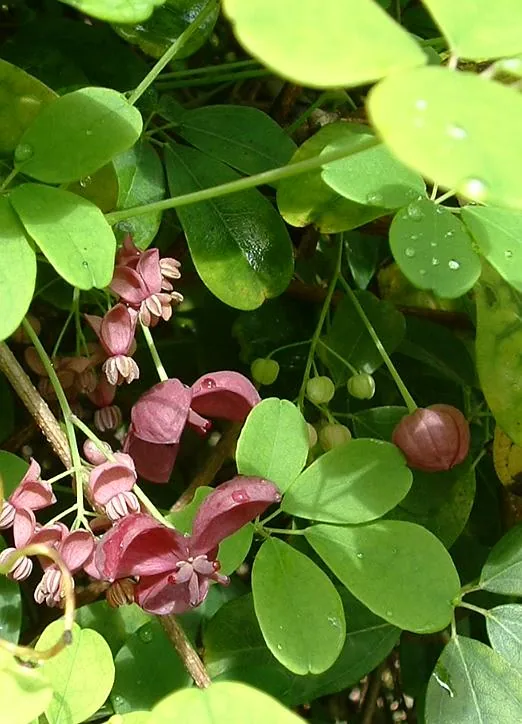
Akebia quinata is a fast, twining woody climber valued for early bloom and a chocolate and vanilla-spice fragrance carried on the spring air. The flowers are a deep chocolate-purple, and because the species is self-incompatible, fruit set depends on two genetically distinct plants growing together, after which they ripen into the characteristic sausage-shaped fruit with sweet, edible white pulp. The palmate, five-leaflet foliage accounts for the common name five-leaf akebia.
Its adaptability is the foundation of its reputation. Hardy across zones 4 to 8, it performs in full sun, partial shade, or full shade, tolerates poor loam, sand, or clay, and once the root system is established it withstands drought. That broad tolerance is precisely what makes it dependable, and precisely what makes it dangerous.
The same vigor that clothes an arbor in a single season allows chocolate vine to escape cultivation and smother native vegetation, and it is recognized as invasive across much of the eastern, mid-Atlantic, and southern United States. Site it only where hard pruning can be sustained and where it can be kept off the surrounding landscape.
Care
The short version: establish it in well-drained soil in sun or shade, water it through the establishment phase, then prune hard and repeatedly, because with chocolate vine the limiting factor is containment, not growth.
Light
The species succeeds in full sun, partial shade, or even full shade, a tolerance that partly explains its invasive success. Flowering and fruiting are heaviest under full sun, since reproductive output scales with available light, while deep shade still supports abundant vegetative growth.
Water
Supply regular water in well-drained soil during establishment, soaking every 7 to 14 days once the top half of the profile has dried. After the root system develops it becomes drought tolerant and seldom requires supplemental irrigation, reflecting its medium water demand.
Soil
It accepts most well-drained loam, sand, or clay and shows little soil preference. A pH from 5.5 to 7.5 is acceptable, a span wide enough that most garden soils need no amendment.
Temperature
Cold hardiness is a defining trait, with tolerance from roughly -29°F to 100°F (-34°C to 38°C). That range corresponds to USDA zones 4 through 8 and allows the plant to survive severe winters intact.
Humidity
Average outdoor humidity meets its needs, so no target value applies. The vine adjusts to ambient atmospheric moisture without intervention.
Feeding
A balanced general-purpose fertilizer in spring suffices, and in most years it can be omitted entirely. Because the plant already grows vigorously, added nutrients chiefly stimulate further growth that must then be removed.
Pruning
Pruning is the principal management task. Cut back hard immediately after flowering in late spring, since blooms form on old wood and later cuts sacrifice next year's flowers, and an overgrown specimen can be cut to the ground to renovate it. Additional pruning through the season is generally required to maintain its position.
Repotting
Chocolate vine is rarely cultivated in containers and needs little repotting. Where it is contained, pot it up when roots circle or escape the container, top growth stalls despite watering, or the medium dries unusually fast, all signs of a rootbound system.
Size & spacing
Allowed to climb, it attains 20 to 40 feet (6 to 12 m) with a spread of 6 to 9 feet (183 to 274 cm). Provide a sturdy trellis, arbor, or fence positioned well clear of shrubs and trees that it could otherwise overtop.
When to plant
Two phenological windows govern the calendar. Bloom runs early, from March into May, and where a compatible second plant is present fruit ripens through fall. Plant out in spring after the last frost, and time hard pruning to immediately follow flowering, because the blooms are borne on old wood and earlier cuts remove next season's flower buds.
Northern hemisphere
Southern hemisphere
Typical months for a temperate climate: start earlier in warm zones, later where spring frosts linger.
- Sow: Late winter to early spring after cold stratification
- Plant: Spring after last frost
- Harvest: Flowers March to May; sausage-shaped fruit ripens in fall
Hardiness
USDA hardiness zones: 4–8
Temperature: down to -34°C
Troubleshooting
Most problems with chocolate vine stem from excess vigor rather than weakness. The plant resists both slowing and removal, and an isolated individual frequently fails to fruit because of its breeding system. Identify the symptom below, then intervene early, before the root and stem network advances further.
Vine overtopping nearby shrubs and small trees
This expresses the invasive habit responsible for the plant's problem status across much of North America. The vine twines 20 to 40 feet, mats over its supports, and roots at every stem-to-soil contact, so each touch point becomes a new plant. Cut hard after flowering, repeat through the season, and excavate runners before they establish an independent colony.
Fix:
- Cut back hard after flowering and repeat through the season to keep it in bounds
- Cut to the ground to renovate an overgrown vine
- Trace and dig out long roots (a single vine can produce roots 22 ft long); remove rooted stem nodes and seedlings
An established vine that resists eradication
Persistence traces to the deep root system, which extends up to 22 feet and resprouts from any fragment remaining in the soil. Severed stumps and roots regenerate new shoots, and residual seedlings reoccupy cleared ground. Excavate as much of the root mass as possible, treat the cut stumps, and remove resprouts and seedlings on repeat until regeneration ceases.
Fix:
- Dig out as much of the root system as possible
- Cut and treat cut stumps, then monitor and remove resprouts and seedlings repeatedly
Abundant flowering with no sausage-shaped fruit
The cause is the plant's self-incompatible breeding system, under which a lone individual can flower for years yet never fertilize itself or set a pod. Adequate fruit ripening also requires a long, warm season. Establish two genetically distinct plants in proximity, or transfer pollen by hand from a different vine to achieve cross-pollination.
Fix:
- Plant two or more genetically different individuals for cross-pollination
- Hand-pollinate female flowers with pollen from a different plant
Toxicity
Chocolate vine presents no toxicological hazard to animals or people. It does not appear on the ASPCA toxic-plant lists, and the white pulp of the ripe fruit is consumed in parts of East Asia. The relevant risk is ecological rather than toxic, since the species spreads aggressively and displaces native flora, so management centers on placement rather than ingestion.
Safe for
People · Cats · Dogs · Horses · Rabbits · Livestock · Birds
Cats None
Akebia quinata does not appear on the ASPCA toxic list, so a cat that samples a leaf faces no toxic consequence. Only the nonspecific gastric upset that any large quantity of plant material can produce is possible, since the vine itself contains no known poison.
Dogs None
The species is non-toxic to dogs. A dog that chews foliage or a fallen fruit will not be poisoned, although ingesting a large volume of plant matter can loosen the stool as any greenery might.
Horses None
No constituent of the plant is toxic to horses, which may graze in its vicinity without harm.
Rabbits None
Rabbits can consume the foliage without toxic risk. As with any new browse, introduce it gradually to avoid disturbing their digestion.
Livestock None
Cattle, goats, and sheep are not poisoned by chocolate vine. The operative concern is the plant colonizing a paddock rather than any harm to the livestock grazing it.
Birds None
The plant poses no toxicity to birds, which consume the ripe fruit and thereby disperse the seed into new ground.
People None
The white pulp of the ripe sausage-shaped fruit is edible and is eaten in parts of East Asia. The remainder of the plant is not a food crop, so consumption should be limited to the ripe fruit and the rest treated as ornamental.
No special handling needed for pet safety. The main risk is ecological invasiveness, not poisoning.
Varieties
Apart from the typical purple-flowered species, a small number of selected forms exist, chosen chiefly for flower color or foliage variegation.
'Alba' (also sold as 'Shirobana')
A white-flowered selection in which the typical chocolate-purple bloom is replaced by pale flowers and correspondingly pale, whitish fruit.
'Rosea'
A selection that flowers in soft pink to rose-purple rather than the species' deep chocolate tone.
'Variegata'
A foliage selection whose leaves are mottled and splashed with white and cream.
Akebia trifoliata (three-leaf akebia)
A closely related species rather than a cultivar, distinguished by three leaflets per leaf against the five leaflets of Akebia quinata.
How to propagate
Chocolate vine propagates readily, almost too readily, because the rooting capacity that makes vegetative increase simple is the same mechanism that drives its spread in the landscape.
SeedModerate
Sow fresh seed in fall, or cold-stratify and sow in late winter to early spring · Several months to a year
Seed is the slower method and is constrained by the breeding system, since the plant is self-incompatible and two genetically distinct vines are required to obtain viable seed at all. Sow fresh in fall, or apply cold stratification and sow in late winter to early spring. Establishment from seed typically spans several months to a year before a seedling grows independently.
LayeringEasy
Spring to summer · One growing season
Layering is the simplest technique. A stem pinned to the soil in spring or summer roots within a single growing season and can then be severed and relocated. This same readiness to root at soil contact is the precise mechanism behind the plant's unwanted spread.
Stem cuttingsModerate
Summer (semi-ripe wood) · Several weeks to root
Take semi-ripe cuttings in summer and root them over bottom heat, a process that generally takes a few weeks. After roots develop, pot each cutting on and grow it before transplanting outdoors.
Myths
The flowers must be edible because the plant is called chocolate vine.
The common name describes a sensory character of the flowers, not their use as food. The blooms are chocolate-purple and emit a chocolate and vanilla-spice scent, and it is that color and fragrance, not any culinary role, that the name records. Only the white pulp of the ripe sausage-shaped fruit is actually eaten.