Shrub · Gelsemiaceae
Carolina Jessamine
Gelsemium sempervirens
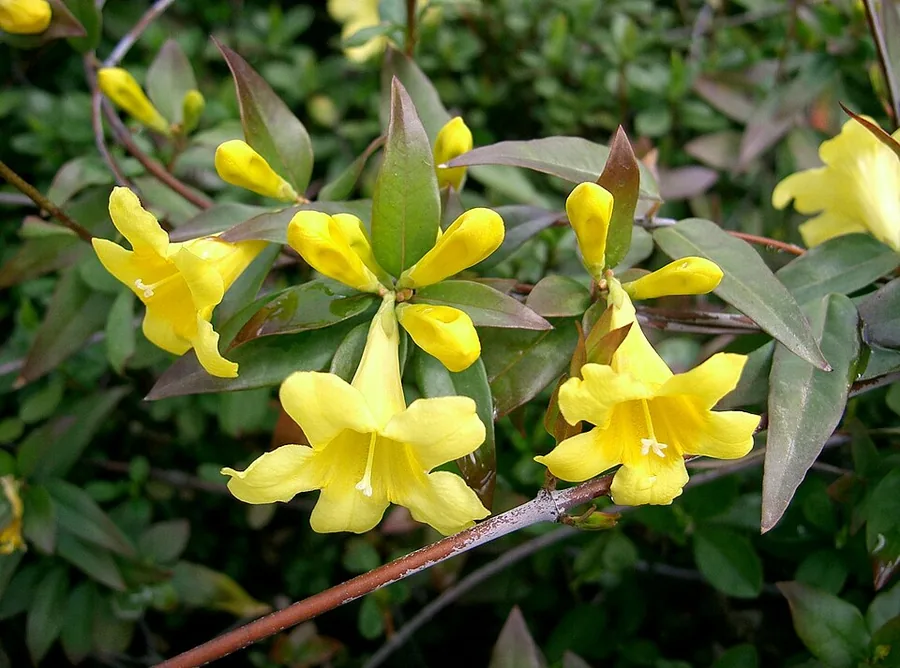
Site it in full sun on a sturdy support, and this evergreen vine sets fragrant yellow trumpets in late winter.
Full sun
Every 7–14 days
USDA 7–10
10–20 ft · 3–6.1 m
Overview
Carolina jessamine is an evergreen twining vine that opens fragrant yellow trumpets in late winter, well ahead of most southern bloom. Its stems climb fences, arbors, and mailboxes by twining, and in a single fast season can extend 12 to 20 feet. South Carolina recognized the species enough to adopt it as the state flower.
Its low demands follow from a wide tolerance. Hardy across zones 7 to 10, it withstands heat, draws on stored moisture to endure drought once established, and faces no serious pests or diseases. The decisive requirement is full sun, because the species initiates few flower buds under shade and instead diverts its energy into foliage.
One caution governs its use. The jasmine in its common name is misleading, since botanically it is not a true jasmine, and every part is dangerously poisonous. The leaves, stems, roots, and even the sweet nectar carry strychnine-related alkaloids, which is why it must be sited well away from children, pets, and grazing animals.
Care
The short version: full sun drives the best bloom, set it in rich well-drained soil, supply steady moisture during establishment, then prune hard right after flowering and provide a sturdy support to climb.
Light
Site it in full sun to maximize flowering, since bud initiation depends on strong light. It persists and stays green in partial shade, but a shaded vine reallocates its resources from flowers to foliage and reads thin on color.
Water
Keep the soil evenly moist while the plant establishes, watering every 7 to 14 days. Once the root system develops, it draws on that depth to tolerate drought, though prolonged dryness triggers leaf drop and reduced bloom.
Soil
It accepts rich, well-drained ground across a broad pH range of 5.0 to 8.0, a tolerance that explains its adaptability. Drainage governs success far more than the precise soil texture.
Temperature
Hardy from roughly 10°F to 100°F (-12°C to 38°C), it withstands both southern heat and a substantial freeze. That thermal breadth is what underwrites its reliability across zones 7 to 10.
Humidity
Ambient outdoor air meets its needs, so no humidity target applies. It performs in the humid Southeast and equally in drier climates, because the species is not moisture-sensitive in the air.
Feeding
A single balanced slow-release application in spring, repeated seasonally, supplies what it requires. The plant is not a heavy feeder, and excess nitrogen favors vegetative growth at the expense of flowers.
Pruning
Prune immediately after flowering, while shoots still have the season to set next year's buds. Cutting controls size and forestalls a top-heavy tangle, and an old leggy specimen can be reduced to a few feet above ground to regenerate vigorous growth from the base.
Repotting
rarely
Size & spacing
Expect a fast climber reaching 10 to 20 feet (3 to 6 m) with a spread of 3 to 6 feet (91 to 183 cm). Provide a sturdy support and adequate room, since the twining habit accumulates growth quickly.
When to plant
Carolina jessamine flowers early in the season, often opening in February before most of the garden stirs. Establish new plants in spring or fall, prune as soon as the bloom finishes to protect the next cycle of bud set, and expect a lighter rebloom in autumn.
Northern hemisphere
Southern hemisphere
Typical months for a temperate climate: start earlier in warm zones, later where spring frosts linger.
- Plant: spring or fall
- Harvest: late winter to early spring (February-April), with sporadic fall rebloom
Hardiness
USDA hardiness zones: 7–10
Temperature: down to -18°C
Troubleshooting
This vine is notably trouble-free, carrying no serious pests or diseases. The complaints that do arise are cultural rather than pathological, tracing to pruning practice and light exposure. Identify the symptom below and the corrective measure is straightforward.
Crown growth accumulates while the base goes woody and bare
Because the vine adds each season's growth onto the previous flush, a few years without cutting let the canopy build into a dense mat while the lower stems lignify and shed their leaves. The disorder is purely mechanical: absent pruning combined with stems that were never trained onto a support. Reduce the top-heavy growth to a few feet above ground immediately after flowering, then secure the retained stems to the structure so new shoots distribute evenly rather than piling up high.
Fix:
- Prune hard right after flowering, cutting older top-heavy vines back to a few feet above ground level
- Train remaining stems onto the support to spread growth evenly
Vegetative vigor without corresponding bloom
A jessamine that puts on abundant leaf yet sets few flowers is almost always responding to insufficient light, because flower initiation in this species depends on full sun. Relocate or retrain the vine into a brighter position so the buds it needs can form. Where overhead branches cast it into shade, thin them to raise the light reaching the canopy.
Fix:
- Relocate or train the vine into a position receiving full sun
- Thin overhead shade where possible
Toxicity
This is an ornamental of real beauty and real hazard. Every part contains strychnine-related alkaloids, the sweet nectar included, which has poisoned children who mistook the flowers for honeysuckle. No part is safe to eat, suck, or chew, and the same alkaloids threaten dogs, cats, horses, livestock, birds, and even the honeybees that forage the blooms.
Toxic to
Cats · Dogs · Horses · Rabbits · Livestock · Birds · People
Cats Severe
Ingestion of any part can render a cat weak and ataxic within hours as the indole alkaloids depress the nervous system, producing slack muscles, impaired swallowing, and slow, shallow respiration. Pupil changes, hypothermia, and seizures may follow. No quantity is safe.
Dogs Severe
In a dog that mouths the leaves, stems, or flowers, the alkaloids first bring abrupt weakness, a staggering gait, and difficulty swallowing. As the dose acts, respiration slows, body temperature falls, and seizures, paralysis, or death can result. Seek veterinary care immediately.
Horses Severe
A grazing horse typically shows muscular tremors and weakness that progress to convulsions and respiratory compromise. Every tissue of the vine is toxic and the lethal threshold is low, so exclude it from pastures and paddocks entirely.
Rabbits Severe
The same neuroactive alkaloids that fell large herbivores overwhelm a small rabbit at correspondingly tiny doses, causing weakness, tremors, and collapse. No portion of the plant is safe to offer or to leave within reach.
Livestock Severe
Cattle, goats, and sheep that browse the foliage develop muscular weakness, convulsions, and respiratory failure, and a small intake can prove fatal. Fence it out of any ground where stock graze, since browsing pressure makes accidental poisoning likely otherwise.
Birds Severe
The alkaloids are markedly toxic to birds, and the nectar and pollen poison honeybees as well. Pet birds must have no access to the leaves, stems, or blooms.
People Caution
No tissue of this plant is edible. Children have been poisoned by sucking the sweet nectar after mistaking the yellow flowers for honeysuckle, and even small amounts can cause weakness, dizziness, depressed respiration, and seizures. Keep it away from children and wash your hands after pruning, since the sap can irritate skin.
Treat as a deadly poisonous plant: keep all parts away from children, pets, and livestock; do not let anyone suck or eat the flowers, and wash hands after handling since the sap can irritate sensitive skin.
Helpline numbers

United States
ASPCA Animal Poison Control: (888) 426-4435 (fee applies)
Poison Control: (800) 222-1222



Canada
Poison Centres: 1-844-764-7669
Varieties
Several named selections refine specific traits of the wild vine, and one close relative merits attention where the soil holds water.
Margarita
A selection valued for greater cold hardiness, bearing flowers somewhat larger than those of the species.
Pride of Augusta (Plena)
A double-flowered cultivar that sustains its display across a longer portion of the flowering season.
Gelsemium rankinii (swamp / Rankin's jessamine)
A related native species, scentless in flower, that reblooms strongly in both spring and fall and tolerates wetter soils.
How to propagate
Carolina jessamine propagates by three methods, and because the sap is toxic, each calls for clean hands once the work is finished.
Stem cuttingsEasy
Late spring to summer · Several weeks to a few months
Semi-hardwood cuttings are the dependable method for reproducing a named cultivar true to type, since vegetative propagation preserves the parent genotype. Collected in late spring or summer, they root over several weeks to a few months into a plant genetically identical to its source.
SeedModerate
Fall or spring · One or more seasons
Seed sown in fall or spring is viable, but because sexual reproduction reshuffles the genes, a named cultivar will not come true and the resulting plant needs one or more seasons to establish. Every seed and seedling is toxic, so handle the material carefully.
LayeringEasy
Spring to summer · A few months
Where a low twining stem maintains contact with moist soil in spring or summer, it forms adventitious roots within a few months while still attached to the parent. Once rooted, sever the layered section and transplant it.
Myths
Carolina jasmine is a true jasmine, so its fragrant flowers are safe to touch or taste.
Taxonomically it is no jasmine, a fact the name false jasmine records, and it stands among the most poisonous of common garden vines. Every tissue, the sweet nectar included, contains strychnine-related alkaloids, and children who sucked the flowers have been seriously poisoned, as have pets and livestock. Never treat its yellow blooms as honeysuckle or any other edible plant.