Houseplant · Zamiaceae
Cardboard Palm
Zamia furfuracea
A tough, sculptural cycad that asks for little, but its every part is dangerously toxic.
Full sun
50–84°F · 10–29°C
USDA 9–11
2–5 ft · 0.6–1.5 m
Overview
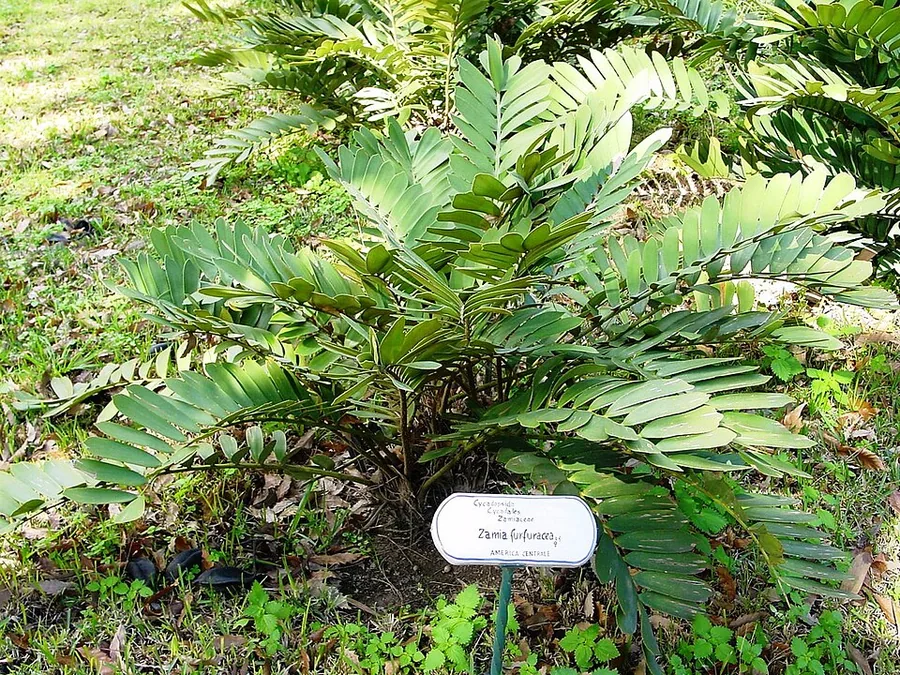
The cardboard palm takes its name from stiff, fuzzy leaflets with the heft of thick paper, but it sits well outside the palm family. It is a cycad, a lineage of plants far older than flowering species and more closely allied to conifers, with a native range in Veracruz in eastern Mexico. Kept as a houseplant it holds a low, wide form, pushing arching fronds from a squat trunk season after season.
Much of its charm lies in how little it requires. A tuberous underground stem banks its own water supply, which is why the plant shrugs off both drought and salt spray and needs only bright light over fast-draining soil. The cost of that toughness is time, since it is a slow grower that produces new fronds at an unhurried pace and dislikes being relocated.
The decisive point before bringing one home is the hazard it carries. Every part is laced with cycasin, and the bright seeds concentrate the most of all, enough that one or two can kill a dog. It suits a household able to keep it firmly out of reach of pets and children.
Care
The short version: bright light, ideally full sun, in sandy, fast-draining soil that you let dry out between waterings, with only sparing feeding in the growing season and a careful eye on where it sits so no pet or child can reach it.
Light
Offer it the most light you can manage, with full sun as the target. It will cope in partial sun, partial shade, or bright indirect light, but starve it of light and the fronds draw out pale and weak as the plant tilts toward the window.
Water
Let the soil dry out completely between waterings, because the tuberous stem keeps its own reserve and will rot if held wet. Water on a regular cadence through the growing season, then pull back and keep it dry during the winter rest. Overwatering is the surest way to lose it.
Soil
Set it in sandy, coarse, fast-draining soil along the lines of a well-drained sandy loam. Sharp drainage matters above all else, since saturated roots are exactly what trigger rot.
Temperature
It performs best between 50°F and 84°F (10°C to 29°C) and will not survive a hard frost. In a cold region that means treating it as an indoor plant or bringing it inside well ahead of the first freeze.
Humidity
Ordinary household humidity serves it well, so there is no figure to chase. Adapted to a dry Mexican habitat, it takes standard indoor air in stride.
Feeding
Feed sparingly with a balanced general-purpose fertilizer through spring and summer. Being a slow grower, it draws on very little, and an over-generous dose causes more harm than benefit.
Pruning
There is barely anything to attend to here. Remove only dead, damaged, or yellowed fronds at the base, and keep gloves on throughout, since every part is toxic and contact with the seeds is best avoided.
Repotting
Repot only every few years, because this slow grower resents disturbance and is content sitting slightly pot-bound. Step it up a size when roots crowd the container or the plant grows top-heavy, and work the toxic tissue in gloves.
Size & spacing
Indoors it climbs to roughly 2 to 5 feet (61 to 152 cm) tall yet spreads considerably wider, around 5 to 8.5 feet (152 to 259 cm) across. Allow it generous room so the broad arching fronds can spread out fully.
Troubleshooting
The cardboard palm seldom causes concern, and the two faults it does develop are simple to diagnose. One traces back to overwatering, the other to too little light. Find the match below and correct course before the plant slips into decline.
Mushy base, yellowing fronds, and a plant that topples
What you are seeing is root and caudex rot, the predictable result of excess moisture in a mix that holds water. Because the tuberous stem already banks its own reserve, sitting in wet soil leaves that swollen tissue saturated and it breaks down quickly. Stop watering, ease the plant out of its pot, pare back every brown, foul-smelling section, and reset it in fresh sandy, fast-draining medium in a container with drainage holes.
Fix:
- Reduce watering immediately
- Remove from soil and cut away rotted tissue
- Repot into fresh sandy, fast-draining mix in a pot with drainage holes
Pale, drawn-out fronds tilting toward the glass
This is etiolation, the response of a plant starved of light and stretching to find it. Instead of stiff and tightly held, the fresh fronds emerge thin, overlong, and few in number. Shift it to a brighter spot, anywhere from full sun to partial shade, and rotate the pot a quarter turn from time to time so growth fills out evenly and the plant stops leaning to one side.
Fix:
- Move to a brighter location with full sun to partial shade
- Rotate the plant periodically for even growth
Toxicity
This ranks among the most dangerous houseplants you can keep. It is a cycad rather than a true palm, and every part holds cycasin, a toxin that targets the liver. The brightly colored seeds are the most potent, and just one or two can be fatal to a dog. Keep it well beyond the reach of pets, livestock, and children, wear gloves whenever you handle it, and treat any swallowed piece as an emergency.
Toxic to
Cats · Dogs · Horses · Rabbits · Livestock · Birds · People
Cats Severe
Even a single nibble carries real risk. Look for vomiting that can become bloody, dark stools, a marked rise in thirst, and the yellow cast of jaundice as liver function gives way. Left untreated, the outcome is frequently fatal.
Dogs Severe
Dogs are often tempted by both the plant and its seeds, and one or two seeds is enough to be lethal. Bloody vomit, bloody diarrhea, bruising, and jaundice all signal that liver damage is already in progress, so reach an emergency vet at the earliest hint.
Horses Severe
The cycasin that harms small pets goes after the equine liver in the same way. Anticipate vomiting, dark stools, jaundice, and weakness, with liver failure and death in the more serious cases.
Rabbits Severe
A rabbit has no way to vomit a toxin back up, which makes any amount swallowed especially perilous. The cycasin drives the same liver injury recorded in other animals, so the plant must be kept entirely beyond reach.
Livestock Severe
Grazing cattle, goats, and sheep all face genuine danger, and cattle contend with an added unidentified neurotoxin alongside the cycasin. Liver failure and death may follow, so never permit stock to browse the fronds or any dropped seeds.
Birds Severe
A curious bird pecking at a frond or a bright seed ingests the very same liver toxin. Given their small body mass, even a trace counts for a great deal, so site cages and perches well away from the plant.
People Caution
This is not a plant for eating. Children face the greatest hazard from the colorful seeds, and swallowing any part can produce severe liver damage, so handle it in gloves and respond to any ingestion as a medical emergency.
Keep well out of reach of pets and children; wear gloves when handling, pruning, or repotting, and avoid contact with the brightly colored seeds. Dispose of trimmings and fallen seeds where animals cannot reach them.
Helpline numbers

United States
ASPCA Animal Poison Control: (888) 426-4435 (fee applies)
Poison Control: (800) 222-1222



Canada
Poison Centres: 1-844-764-7669
Varieties
Cardboard palm is grown almost entirely as the wild species, and the female plant is the form most people have in mind.
Zamia furfuracea (species, female)
The female plant is the one most often pictured, marked by a showy reddish-orange seed cone dense with bright fleshy seeds, while the stiff arching fronds carry the coarse, fuzzy, cardboard-textured leaflets that lend the species its common name.
How to propagate
Two routes exist for raising more cardboard palms, both slow and both calling for caution because the seeds and tissue are toxic. Neither moves quickly, which makes this a pursuit for a patient grower.
SeedModerate
When ripe seed is available, sown in a warm, well-draining medium · Several months to over a year; germination and growth are slow
Fresh plants will come from ripe seed pressed into a warm, well-draining medium, though the process rewards patience above all, with germination and early development inching forward over several months to more than a year. Keep in mind that the seeds hold the highest concentration of cycasin of any part, so sow in gloves and store them well clear of pets and children.
Offsets & pupsModerate
Growing season, by separating offsets from the parent · Several months as a slow grower
Within the growing season you can occasionally detach offsets, the small pups that arise around the base, and grow them on individually. They take their time, settling in across several months, so disturb the roots only as much as you must, since this slow grower resents being moved.
Myths
The cardboard palm is a true palm and just as harmless as other palms.
The name misleads. This is a cycad, not a palm, and the difference is far from academic. Cycasin runs through every part, and a pet or child that swallows even a seed or two can develop fatal liver failure. Handle it with the same care you reserve for a sago palm.