Shrub · Rhamnaceae
California Lilac
Ceanothus thyrsiflorus
Site it in full sun, sharp drainage, and almost no water, and California lilac answers with a wall of blue every spring.
Full sun
Every 15–30 days
365–730 days
USDA 8–10
Overview
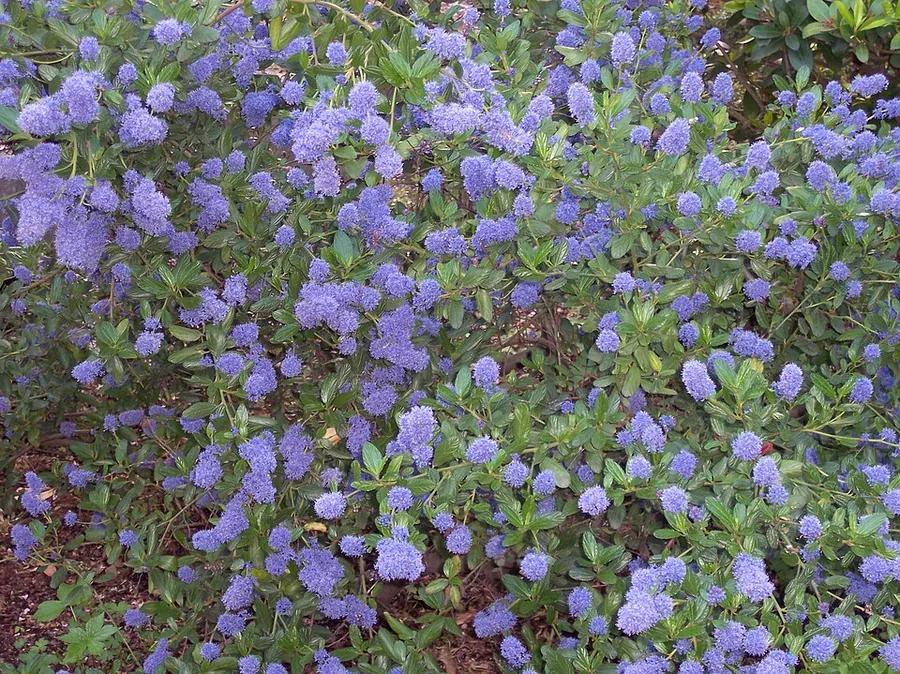
California lilac is the common name applied to Ceanothus, a fast-growing evergreen shrub of West Coast origin. Its spring display consists of dense clusters of minute flowers, predominantly a clear sky blue and occasionally white or pink, that open across the canopy. The bloom is heavily worked by bees and other pollinators from morning until dusk.
Taxonomically it sits in the buckthorn family and bears no relationship to the true lilac for which it is named. Its defining horticultural trait is an extremely low demand on the gardener. Because Ceanothus fixes its own nitrogen and is adapted to lean, dry, sun-baked ground, it occupies sites where more exacting shrubs decline.
That resilience is conditional on one non-negotiable requirement: sustained dryness. The principal cause of premature death is excess moisture, whether from summer irrigation or a poorly drained bed, rather than any deficit of care. Established correctly and then left undisturbed, a Ceanothus delivers years of dependable blue.
Care
The short version: full sun and a sharp, lean, fast-draining root zone govern success more than any other factor. Irrigate only through the first year to establish the roots, then withhold water almost entirely, omit fertilizer, and restrict pruning to a light touch.
Light
Provide full sun, which drives the heaviest flowering and the most compact, vigorous habit. The plant accepts partial sun or light shade, but flowering diminishes and the canopy opens up in proportion to the shade it receives.
Water
Irrigation is the most common point of failure. Water through the first year to establish the root system, then reduce almost to nothing, since a mature Ceanothus requires little to no summer water. Excess moisture, not drought, accounts for most deaths, so keep the plant well outside the reach of any irrigation.
Soil
Use a lean, fast-draining sandy or rocky soil. The species tolerates infertile ground but will not endure waterlogging, so on heavy clay establish it on a raised mound to shed water from the crown. It performs across a pH range of 6.0 to 7.5.
Temperature
Ceanothus withstands a broad thermal range of roughly 19°F to 100°F (-7°C to 38°C). It is suited to hardiness zones 8 through 10 and endures both pronounced heat and a light frost.
Humidity
Low atmospheric humidity is optimal, so no target value applies. Adapted to sun-exposed western slopes, the plant gains nothing from humid, stagnant air, which instead favors fungal disease.
Feeding
Withhold fertilizer entirely. Ceanothus fixes its own nitrogen via root-associated symbionts, and added fertilizer or enriched soil can shorten its lifespan and disrupt the beneficial microbial community at the roots.
Pruning
Keep all intervention minimal. The shrub accommodates light tip pruning and interior thinning for shape, but a cut into bare old wood induces dieback that will not regenerate. Time any cut to a warm, dry midsummer day to limit disease entry.
Repotting
Most California lilac is established directly in the ground and seldom remains containerized. Where it is potted, regard roots circling the container, water passing straight through without uptake, or growth that stalls as indications it has exhausted the container.
Size & spacing
Allow for a sizable shrub. Mature specimens attain 4 to 10 feet (1.2 to 3 m) in height and 5 to 10 feet (1.5 to 3 m) in spread, so allocate generous open space at planting.
When to plant
California lilac is keyed to a Mediterranean dry-summer regime. Establish young plants in fall or early spring while soil moisture is still ample, allowing the root system to develop before the onset of summer heat and drought, after which the shrub flowers from roughly March to May.
Northern hemisphere
Southern hemisphere
Typical months for a temperate climate: start earlier in warm zones, later where spring frosts linger.
- Sow: Late winter to early spring after scarifying and heat-treating seed
- Plant: Fall or early spring while soil is moist so roots establish before summer heat
- Harvest: Spring (about March to May), dense clusters of tiny blue, sometimes white or pink, flowers
Hardiness
USDA hardiness zones: 8–10
Temperature: down to -12°C
Troubleshooting
The overwhelming majority of Ceanothus failures resolve to a single underlying factor: excess water. Direct your attention to the roots and the crown, where decline originates. Identify the symptom below and intervene early, because the progression from first signs to plant death can be swift.
Abrupt wilt, yellowing, and crown dieback ending in collapse
A rapid decline of this kind points to Phytophthora root and crown rot, a water mold that thrives where excess moisture or impeded drainage saturates the root zone and starves the roots of oxygen. Armillaria, the oak root fungus, produces an indistinguishable picture. Withdraw all supplemental water at once to halt the pathogen, correct the drainage, and decline to replant Ceanothus into the contaminated ground, since the inoculum persists.
Fix:
- Stop all supplemental irrigation immediately
- Improve drainage; remove mulch piled against the crown
- Avoid replanting Ceanothus in the same infected spot
Branch dieback traced to cuts into mature wood
Ceanothus carries few dormant buds on aged, leafless stems, so a cut into bare old wood leaves no growing point to break and the branch dies back. Pruning while foliage is wet compounds the loss, because moisture on the open wound favors fungal entry. Remove dead material only to the point of living tissue, and confine all subsequent work to light tip pruning and thinning during dry conditions.
Fix:
- Remove only dead wood back to live tissue
- Limit future cuts to light tip pruning and thinning
Honeydew, sooty mold, and deformed new growth
Phloem-feeding insects underlie these symptoms, generally aphids, scale, or mealybugs colonizing the succulent new shoots they prefer. The sugary honeydew they excrete recruits ants and serves as a substrate for black sooty mold. A forceful spray of water dislodges minor colonies, and resident predators and parasitoids regulate the remainder once they build.
Fix:
- Hose off light infestations with water
- Tolerate minor populations as natural enemies usually control them
- Spot-treat persistent scale or mealybugs
Toxicity
For households with pets and children the assessment is favorable: California lilac is non-toxic. It does not appear on the ASPCA lists of plants hazardous to cats or dogs, and no toxic principle is recognized in the plant. As with any foliage, ingestion of a large quantity may produce a transient digestive upset, but no greater effect.
Safe for
People · Cats · Dogs · Horses · Rabbits · Livestock · Birds
Cats None
The species poses no toxic threat to cats. A cat that samples a leaf should experience no more than the transient, mild gastric upset that any plant material can provoke.
Dogs None
Dogs face no toxicological concern from this shrub. A dog that ingests a few leaves is unlikely to develop anything beyond a brief, self-limiting bout of stomach upset.
Horses Safe
Horses may graze in proximity without risk, as the plant contains no compound documented to harm them.
Rabbits Safe
Rabbits tolerate the foliage well, and an incidental mouthful of leaf presents no meaningful hazard.
Livestock Safe
Cattle, goats, and sheep can browse the shrub safely, since it harbors no toxin known to affect grazing stock.
Birds Safe
Birds forage the flowers and seeds without injury, and the plant sustains pollinators throughout the spring bloom.
People Safe
The plant is safe to handle and to site near children, carrying no recognized toxin, though it is not cultivated as an edible.
No special handling required; as with any plant, ingestion of large amounts may cause mild stomach upset.
Varieties
The genus includes dozens of named selections spanning prostrate groundcovers to small trees. A few are distinguished by their flower color, mature size, or environmental tolerance.
Skylark
A compact 4 to 5 foot selection notable for greater tolerance of clay and cold than the species norm, bearing deep blue flowers that emerge later in the season.
Concha
A vigorous and adaptable hybrid whose reddish buds open to dark blue flowers.
Snow Flurry
A white-flowered selection of C. thyrsiflorus for situations calling for the form without the characteristic blue.
Companions
Ceanothus thrives beside other dry-loving natives that share its taste for sun and sharp drainage, and struggles next to anything that needs regular water.
Plant near
Manzanita (Arctostaphylos): Shares the same full-sun, fast-draining, low-water native conditions
California poppy (Eschscholzia californica): Drought-tolerant native that thrives in the same lean dry soil and supports pollinators
Keep apart
Lawn or thirsty bedding plants: Regular irrigation needed by turf and annuals causes root rot and early death in Ceanothus
How to propagate
California lilac can be propagated by cuttings, by seed, or by layering, with the methods differing markedly in reliability and in the effort each demands.
Stem cuttingsModerate
Summer to early fall · 4 to 8 weeks to root
Semi-hardwood cuttings of the current season's growth, taken in summer or early fall, give the most dependable yield because that partly lignified wood roots readily. Inserted into a free-draining medium, the majority strike in 4 to 8 weeks and reproduce the parent genotype exactly.
SeedDemanding
Late winter to spring · Several weeks to months
Raising plants from seed sown in late winter to spring is the exacting route. The impermeable seed coat enforces physical dormancy, so scarification plus a heat or hot-water treatment is required to admit water, after which germination still extends over several weeks to months.
LayeringModerate
Spring · Several months
Layering in spring exploits the plant's capacity to root while still attached to the parent. Anchor a low branch in contact with the soil and allow adventitious roots to form over several months before severing the new plant.
Myths
California lilac is a kind of true lilac.
The vernacular name and the superficially lilac-like inflorescences invite the error, yet the two genera are unrelated. Ceanothus is placed in the buckthorn family, whereas true lilac is classified with the olives in an entirely separate family.
Like most shrubs, it does better with regular water and feeding.
This assumption accounts for more losses than any other. Ceanothus is adapted to nutrient-poor, dry substrates, and enriching the soil, fertilizing, or watering through summer abbreviates an already short lifespan and predisposes the roots to rot. Through symbiotic nitrogen fixation it meets its own needs, so supplemental feeding is superfluous.
Sources
- UC Master Gardeners of San Mateo and San Francisco Counties (UC ANR)
- UC Master Gardener Program of Sonoma County (UC ANR)
- UC IPM (UC ANR)
- Missouri Botanical Garden Plant Finder
- USDA Forest Service (Pacific Southwest Research Station)
- ASPCA Animal Poison Control
- ASPCA Animal Poison Control
- UC Master Gardener Column, Napa County (UC ANR)