Houseplant · Pteridaceae
Button Fern
Pellaea rotundifolia
Built for rocky, well-drained ground, the button fern wants bright shade and restrained watering to thrive indoors.
Bright indirect
Every 5–10 days
50–77°F · 10–25°C
USDA 9–11
Overview
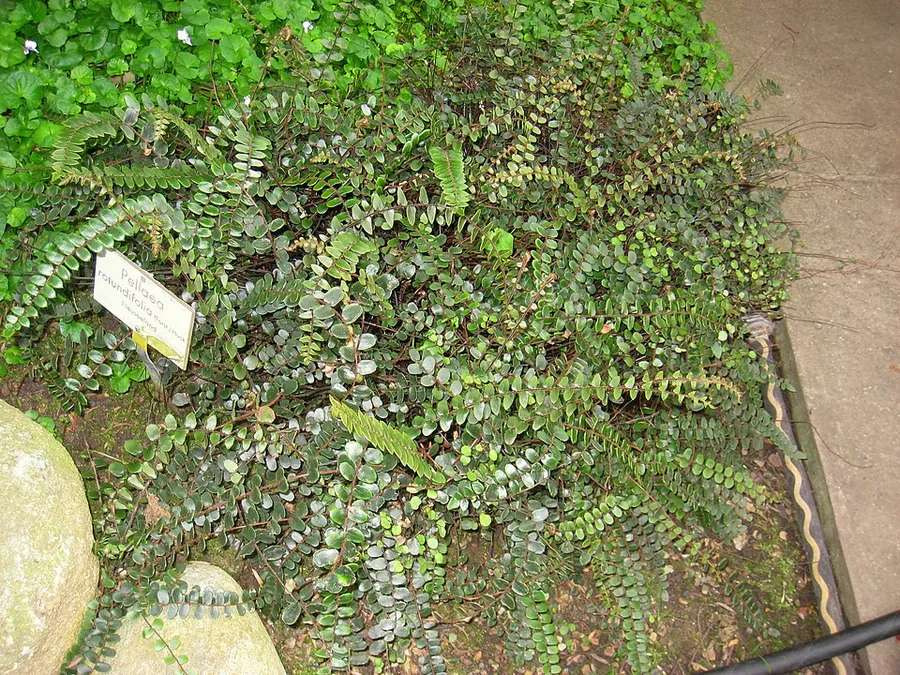
Among a family with a reputation for fussiness, Pellaea rotundifolia stands out as the undemanding member. The common name traces to the rows of small, round, glossy leaflets arranged like little buttons along each arching frond, carried on dark, almost black stems. Its mature size stays modest, rarely exceeding a foot, which suits it to a shelf, a desk, or a bathroom windowsill.
Its drought tolerance separates it from typical ferns, and the reason lies in its origin on rocky, well-drained ground. That habitat conditioned it to withstand the occasional missed watering where moisture-dependent ferns decline. Combined with its acceptance of ordinary room conditions, this resilience ranks it among the easiest ferns to maintain indoors.
Supply bright, filtered light and a freely draining medium, and the plant largely sustains itself. The two failure modes are opposites: allowing the rootball to desiccate completely, or leaving the roots in standing water that excludes oxygen. Hold the middle ground and it grows slowly but consistently over many years.
Care
The short version: provide bright indirect light, a freely draining medium, and water once the top of the mix has dried slightly. Average room warmth and humidity meet its needs, and a half-strength feed through spring and summer maintains foliage color.
Light
Provide bright but indirect light, such as an east-facing exposure or a position a few feet back from a brighter window. It persists in medium light and even a low-light corner, though photosynthesis and growth slow accordingly. Exclude harsh direct sun, since the unfiltered radiation bleaches and scorches the fronds.
Water
Allow the top of the soil to dry slightly before rewatering, which translates to roughly every 5 to 10 days as seasonal demand shifts. Its drought tolerance exceeds that of most ferns, yet complete desiccation of the rootball causes the tips to brown irreversibly. Discard any water that collects in the saucer to prevent prolonged root saturation.
Soil
Use a well-drained, peat- or humus-based mix amended with perlite or sand to maintain aeration around the roots. It accommodates a broad pH range of 6.0 to 7.5, so most general potting soils are suitable provided drainage is rapid and free.
Temperature
Hold it within ordinary room warmth, from 50°F to 77°F (10°C to 25°C). Cold drafts and the hot, dry output of a radiator or heating vent both impose moisture stress on the fronds, so position it clear of each.
Humidity
Target 40% to 60% relative humidity, a band most homes already maintain. It tolerates average air better than moisture-demanding ferns, but in a dry interior a humid room such as a kitchen or bathroom, or a pebble tray beneath the pot, sustains optimal condition.
Feeding
Apply a balanced water-soluble fertilizer at half strength monthly through spring and summer. A slow grower requires little nitrogen, and feeding during the low-light dormant months is unnecessary and offers no benefit.
Pruning
No structural pruning is required. Remove faded, browned, or damaged fronds at the base to maintain appearance and free resources for emerging growth.
Repotting
Repot every 2 to 3 years in spring, or earlier when roots emerge from the drainage holes, the medium dries unusually fast, or fronds crowd the pot rim. Increase the pot by a single size and replace with fresh, free-draining mix.
Size & spacing
Its mature dimensions remain compact, reaching only 6 to 12 inches (15 to 30 cm) in height with an equivalent spread. This restricted footprint accounts for its suitability on a shelf or tabletop.
Troubleshooting
Nearly every disorder in a button fern resolves to a moisture imbalance, either toward desiccation or toward saturation, and the fronds register which has occurred. Match the symptom below and correct the watering regime before the stress reaches the whole plant.
Yellow fronds with soft, mushy stem bases
Yellowing fronds with soft bases signal overwatering and root rot, the failure this fern does not tolerate. Saturated, poorly drained soil excludes oxygen and the roots blacken and collapse. Let the medium dry further, discard water standing in the saucer, and where roots already feel mushy, repot into fresh well-draining mix and excise the rotted tissue.
Fix:
- Allow the soil to dry further before the next watering
- Repot into fresh well-draining mix and trim away rotted roots
- Ensure the pot has functioning drainage holes
Fronds turning brown and crispy
Brown, crispy fronds indicate that available moisture fell too low. The button fern endures a missed watering more readily than most ferns, but complete drying of the rootball removes the water the fronds depend on, and they desiccate. Dry air from a nearby radiator or vent accelerates the same loss, so relocate it away from the heat and rewater before the medium fully parches.
Fix:
- Rehydrate thoroughly, including bottom-watering if the rootball has dried out
- Move away from radiators, vents, and direct sun
- Maintain a more consistent watering schedule
Pale, bleached, or scorched fronds
Faded, dry patches on the window-facing side reflect direct sun scorching the fronds, since unfiltered light overwhelms tissue adapted to shade. This fern requires bright but filtered exposure rather than harsh midday radiation. Move it back from the glass into bright indirect light and remove fronds too damaged to recover.
Fix:
- Relocate to a spot with bright indirect light
- Remove badly scorched fronds
Toxicity
For households with animals, the button fern is safe around cats, dogs, and other pets. The ASPCA classifies it as non-toxic, and no plant part contains a recognized poisonous compound. Ingestion may cause mild gastric upset, as any fibrous plant material can, but no toxic mechanism is at work.
Safe for
People · Cats · Dogs · Horses · Rabbits · Livestock · Birds
Cats None
The ASPCA classifies the button fern as non-toxic to cats, so an exploratory nibble carries no poisoning risk. A cat that consumes a large quantity of any plant may regurgitate a hairball or undigested material, but that reflects volume in the stomach rather than any toxin.
Dogs None
Dogs are equally unaffected, as the fronds contain no toxic compounds. A dog that chews a frond remains safe, though a large quantity of any houseplant may produce transient gastric upset.
Horses None
No constituent of this fern is known to harm horses. It is not a forage species, but an incidental taste presents no real hazard.
Rabbits None
Rabbits may browse the fronds without any toxicity concern. As with any unfamiliar green, introduce only a small amount so the digestive system adjusts gradually.
Livestock None
Goats, sheep, and other livestock face no recognized toxic threat from this fern, which is cultivated as a small houseplant rather than encountered in pasture.
Birds None
Pet birds may perch on or peck at the fronds without harm, as the plant contains nothing toxic to them.
People None
The button fern is harmless to people and safe around children. It is not grown for consumption, so there is no occasion to eat it, but an accidental nibble produces no adverse effect.
No special handling precautions are required.
Varieties
Commerce offers this fern almost entirely as the straight species, so no extended roster of named cultivars exists to differentiate. The plant on the shelf is the one described here.
Pellaea rotundifolia (species)
The true species is recognized by arching fronds bearing small, glossy, round leaflets resembling little buttons, borne along dark, wiry stems.
How to propagate
Propagation by division of an established clump is reliable because each section already carries roots and fronds, so it resumes growth in weeks rather than requiring the prolonged development that spores entail.
DivisionModerate
Spring, ideally at repotting · 4 to 8 weeks
Division in spring is the most dependable method, best performed while the plant is already out of its pot for repotting. Separate the rootball into clumps, retaining a substantial share of roots and several fronds on each section, and the divisions resume active growth over the next 4 to 8 weeks. Spore culture from a mature frond is also possible, but it is slow and demanding, which puts it beyond most home growers.
Myths
The button fern needs constantly soggy soil like other ferns.
This species departs from the fern norm. Its rocky origin gives it drought tolerance well beyond its relatives, and it performs best when the soil surface dries between waterings. Permanent saturation rots the roots by depriving them of oxygen.
All ferns are dangerous to cats and dogs.
Many widely grown ferns are entirely safe, and this is one. The ASPCA classifies Pellaea rotundifolia as non-toxic to both cats and dogs, which qualifies it for a household with pets.