Houseplant · Lentibulariaceae
Butterwort
Pinguicula moranensis
Supply bright light, rainwater, and a lean gritty mix, and the butterwort works through your gnats on its own.
Bright indirect
Every 2–5 days
41–86°F · 5–30°C
USDA 10–11
Overview
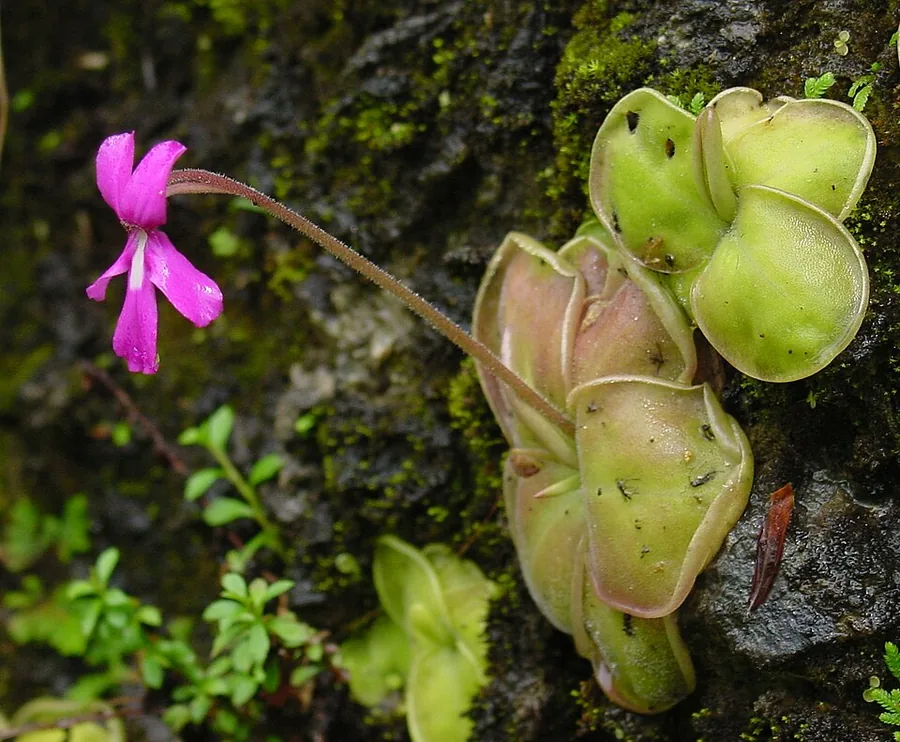
The butterwort is a carnivorous houseplant that traps prey with adhesive rather than moving parts. Its flat basal rosette of greasy, sticky leaves secretes a dew that catches fungus gnats and small flies, then digests them to recover the nutrients its lean native soil withholds. This Mexican species, Pinguicula moranensis, originates in volcanic country and adapts readily to a bright windowsill.
The same plant wears two forms across the year. From spring through autumn it produces wide, glistening carnivorous leaves and raises slender stalks of pink-violet flowers. As day length drops, it withdraws into a tight, non-sticky succulent rosette, an adaptation that lets it conserve moisture and ride out the cold on very little water.
The usual sticking point is not difficulty but expectation, because butterwort care inverts standard houseplant routine. These plants need no fertilizer, no tap water, and no rich potting mix, all of which work against roots adapted to lean, mineral-poor ground. Meet those three conditions and the plant largely tends itself.
Care
The short version: bright light, only distilled or rainwater, and a lean gritty mineral mix. Hold the medium evenly damp through the growing season, let it dry down for the winter rosette, and never feed the soil.
Light
Butterworts need bright light, ideally bright indirect with a few hours of direct sun. They tolerate conditions from full sun to partial shade, but leaves grown in dim light turn pale and stop secreting their sticky dew, since the trapping glands depend on adequate light to function.
Water
Water only with distilled, reverse-osmosis, or rainwater, never tap, because dissolved minerals accumulate in the lean mix and eventually kill the plant. Keep the gritty medium evenly damp through the growing season, often by standing the pot in a shallow water tray. The winter rosette needs far less: water lightly, and only as the medium nears dryness.
Soil
Grow it in a gritty, low-nutrient mineral mix, such as peat or long-fiber sphagnum cut with sharp sand, perlite, and a little pumice. A pH anywhere from 5.0 to 7.0 is suitable. Avoid rich potting soil entirely, since the roots are adapted to lean ground and rich media burn them.
Temperature
This Mexican species tolerates a wide band, roughly 41°F to 86°F (5°C to 30°C). That range makes it forgiving of normal household temperature swings, provided it is never exposed to freezing.
Humidity
Despite its carnivorous reputation, this plant does not require a terrarium. Average household humidity of 40% to 60% suits it well, and steady airflow does more to prevent rot than chasing a high reading.
Feeding
Do not fertilize the soil. The plant feeds itself by trapping fungus gnats and small flies on its leaves, so any feed applied to the pot only burns roots that are built for nutrient-poor conditions.
Pruning
No shaping is required. Simply remove dead, blackened, or rotted leaves and spent flower stalks as they appear, which denies fungal rot the dead tissue it needs to take hold.
Repotting
Repot every 1 to 2 years, ideally in spring as growth resumes. Move it on when the mix breaks down and holds water, when the rosette crowds the pot edge, or when new leaves stop turning sticky.
Size & spacing
This is a compact plant, reaching only 2 to 10 inches (5 to 25 cm) tall and spreading 3 to 6 inches (8 to 15 cm) wide. A single rosette sits comfortably in a small pot on a windowsill.
Troubleshooting
Almost every butterwort complaint traces to one of three things: water chemistry, feeding, or the seasonal cycle. Match the symptom against the entries below before acting, because the intuitive response, more water or a dose of fertilizer, is usually the very thing that drives the decline.
Blackened, mushy crown that collapses
A blackened, collapsing crown is crown rot, and the trigger is almost always water chemistry or excess moisture. Minerals in tap water accumulate as salts the lean mix cannot buffer, and a wet pot during the winter rosette phase deprives the crown of the air it needs to stay sound. Switch to distilled or rainwater, flush the medium to leach those salts, repot into fresh gritty mix, and cut back to clean, firm tissue.
Fix:
- Stop watering until the mix is barely moist
- Flush the medium with distilled/RO water to leach salts
- Repot into fresh gritty mineral mix and remove rotted tissue
- Increase airflow and light
New leaves lose their sticky dew
When emerging leaves come in dry and flat, the cause is usually mineral buildup or feeding. The trichomes that secrete sticky dew shut down when the roots are stressed, so fertilizer and rich soil burn them, tap water salts foul the mix, and weak light leaves the plant without the energy to invest in trapping. Stop feeding the soil entirely, flush with distilled or rainwater, and give it several hours of bright light a day.
Fix:
- Never fertilize the soil
- Switch to distilled/RO/rain water and flush the mix
- Move to a brighter spot with several hours of bright light
Leaves shrink into small succulent rosettes in autumn
Small, non-sticky leaves in autumn signal the winter succulent phase, healthy seasonal behavior rather than a fault. Shorter days cue the plant to drop its carnivorous leaves and form a tight succulent rosette that conserves water through the cold months. Cut back watering until the mix nearly dries, hold it in bright light, and let regular moisture return as growth picks up in spring.
Fix:
- Reduce watering and let the mix nearly dry
- Keep in bright light and resume normal moisture in spring
Toxicity
For households with animals, the record is reassuring: the butterwort is not toxic to pets or people. Its sticky leaves capture only gnat-sized insects and hold nothing harmful, so the main case for keeping it out of reach is to spare the fragile rosette from curious paws.
Safe for
People · Cats · Dogs · Horses · Rabbits · Livestock · Birds
Cats None
A cat that licks or paws the sticky leaves comes away with nothing worse than a tacky tongue, because the surface holds no toxin. The trapping dew is mechanical, not chemical.
Dogs None
Dogs are safe around this plant. It contains no poisonous compounds, so a chewed leaf leaves only a greasy taste behind.
Horses Safe
Safe in the presence of horses. The small rosette is far too delicate to survive a grazing muzzle, so the risk runs to the plant rather than the animal.
Rabbits Safe
Harmless to rabbits. A nibble does the animal no harm, even if it sets the plant back.
Livestock Safe
No hazard to cattle, goats, or sheep, since the plant carries nothing toxic. Grown on a tray as a houseplant, it seldom comes within their reach anyway.
Birds Safe
No chemical risk to birds from the leaves or flowers. The adhesive dew captures only gnat-sized insects, so it cannot hold anything larger.
People Safe
Safe to handle with bare hands; the leaf feels greasy and nothing more. It is not grown as food, so no part of it is intended to be eaten.
The greasy, sticky leaf surface is harmless to handle and to pets; it simply feels tacky.
Varieties
Most growers encounter the butterwort as one of a handful of common forms. The following are the ones you are most likely to find offered by name.
Pinguicula moranensis
The classic large-flowered Mexican species, with pink-violet blooms rising on slender stalks above a flat summer rosette of greasy leaves.
Pinguicula moranensis var. neovolcanica
A variety from the Mexican volcanic ranges, accepted on Kew's Plants of the World Online.
Pinguicula 'Tina'
A vigorous hybrid widely grown as an easy, gnat-catching houseplant well suited to beginners.
How to propagate
Butterworts propagate readily, and the easiest method asks for nothing more than a few leaves pulled from a plant you already grow.
Leaf cuttingsEasy
Late winter to spring, especially from the succulent winter rosette · 4-8 weeks to form plantlets
Leaf pulling is the most reliable way to multiply a butterwort. Detach whole leaves from the base in late winter or spring, while the plant sits in its succulent rosette, and lay them flat on damp gritty mix. The leaf base holds enough stored reserves to push out new rosettes within 4 to 8 weeks.
DivisionEasy
Spring at repotting · 2-4 weeks
Mature plants naturally produce offset rosettes around the parent. Lift the clump at spring repotting, tease the offsets apart, and pot each on its own; they establish within 2 to 4 weeks.
SeedDemanding
Spring on the surface of damp mineral mix · Several months to a year
Seed is the slow and least dependable route. Surface-sow the fine seed on damp mineral mix in spring, then wait, because seedlings can take several months to a year to size up. It pays off only when you want many plants at once rather than a quick result.
Myths
You have to hand-feed butterworts insects or fertilize them to keep them alive.
The sticky leaves capture their own fungus gnats and small flies, which supplies all the feeding the plant requires. Never fertilize the soil: the roots are adapted to lean ground, and concentrated nutrients burn them.
Butterworts are toxic to cats and dogs.
Pinguicula does not appear on the ASPCA toxic plant list and is treated as non-toxic to pets. The leaves trap only tiny insects and contain nothing that would harm a curious animal.
Every carnivorous plant needs a sealed, humid terrarium.
Mexican butterworts grow well in ordinary household humidity provided they get low-mineral water and bright light. A sealed case often backfires, since the trapped stale air encourages the rot this plant is prone to.