Houseplant · Lentibulariaceae
Bladderwort
Utricularia
Pure water, lean soil, bright light: this tiny carnivore feeds itself.
Bright indirect
Every 1–3 days
50–86°F · 10–30°C
USDA 9–11
Overview
An unusual carnivore in the genus Utricularia, family Lentibulariaceae, that captures its food underwater. It grows wild across every continent save Antarctica, some species rooting in soggy ground while others drift free in still water, and all of them hunt with tiny bladder traps that snap shut on microscopic prey.
Each trap is a hollow sac that pumps itself empty, setting up an internal vacuum, then springs open in a fraction of a second the moment a passing protozoan or water flea brushes a trigger hair, sweeping in water and prey together. This is how the plant gathers the nutrients its nutrient-poor home cannot provide, and it is the mechanism that explains why feeding or fertilizing does it harm.
Approach its husbandry like tending a bog rather than a houseplant: keep the medium constantly wet with mineral-free water, give it bright light, and otherwise leave it be. Get the water right and the rest is straightforward.
Care
The short version: bright light, distilled or rainwater only, a lean peat-and-sand mix kept constantly wet, never fertilized, and never allowed to dry out.
Light
Give it bright, indirect light, though it tolerates partial to full sun once acclimated. Light is what drives flowering, so a leafy plant that refuses to bloom is signaling that it needs more of it.
Water
Water makes or breaks this plant. Use only distilled, reverse-osmosis, or rainwater, because tap or mineral water kills it. Keep terrestrial types soggy in a tray holding 1 to 3 cm of pure water, grow aquatic types submerged or free-floating, and never let the medium dry out.
Soil
Plant in a lean mix of peat and silica sand, roughly half and half, with no added nutrients. A pH of 4.0 to 6.0 holds the acidic range it favors. Aquatic types need no soil at all.
Temperature
It is comfortable across 50°F to 86°F (10°C to 30°C), which spans normal room temperatures with margin to spare. Most homes suit it without any special effort.
Humidity
It prefers the air humid, around 50% to 80%. A standing-water tray beneath terrestrial types lifts the local humidity, while aquatic types already live in water.
Feeding
Do not feed it. The bladder traps catch all the nutrients the plant needs from microscopic prey, and fertilizer usually kills it.
Pruning
Keep it minimal. Remove spent flower stalks along with any dead or decomposing mat to keep the medium clean.
Repotting
Refresh it every 1 to 2 years, because peat breaks down structurally over time. Repot when the mat overgrows the pot edges, the medium decomposes, or vigor and flowering decline.
Size & spacing
This is a small plant, 2 to 12 inches (5 to 30 cm) tall, with a mat that spreads 4 to 12 inches (10 to 30 cm). A wide, shallow pot suits its creeping habit far better than a deep one.
Troubleshooting
Nearly every problem here comes back to water, light, or feeding. Match the symptom to its cause below; the remedy is usually as simple as changing the water or moving the pot. Caught early, the mat recovers.
Mat Browning And Dying Back
A browning, collapsing mat almost always traces to mineral or salt buildup carried in by tap or hard water, or to a medium that has gone dry. Move to distilled, RO, or rainwater and flush the peat to leach the accumulated salts away. Keep the tray topped up, because even a single dry spell sets the plant back hard.
Fix:
- Switch to distilled, RO, or rainwater immediately
- Flush the medium thoroughly with pure water
- Keep the tray topped up so the medium stays soggy
Soft Mushy Growth Turning To Rot
Mushy, rotting tissue typically follows fertilizer or nutrient-rich water, or, for aquatic types, warm stagnant water with no movement. These carnivores are built for lean conditions, so stop all feeding at once. Repot into fresh nutrient-poor peat and sand and flush with pure water to clear the excess.
Fix:
- Stop all fertilizing
- Repot into fresh nutrient-poor peat/sand mix and flush with pure water
Healthy Mat That Refuses To Bloom
Lush green growth with no flower stalks points to too little light reaching the plant, or minerals working their way into the water. Relocate it to a brighter window or add a grow light, and flush the medium with distilled or RO water. Once light levels and water purity are corrected, flower stalks follow.
Fix:
- Move to a brighter location or add supplemental light
- Flush the medium with distilled/RO water to remove accumulated minerals
Algae Smothering Aquatic Plants
On aquatic types, algae takes hold wherever nutrients run high or light is strong. Run partial water changes with pure water and pull out any decaying organic matter feeding the bloom. Easing the light intensity keeps the green film from returning.
Fix:
- Perform partial water changes with pure water
- Reduce light intensity and remove decaying organic matter
Toxicity
Bladderwort is safe all around. The ASPCA does not list it as toxic to cats or dogs, and no extension or botanical source flags any danger to people or other animals; its traps catch nothing larger than a water flea.
Safe for
People · Cats · Dogs · Horses · Rabbits · Livestock · Birds
Cats None
A taste of the wet mat will not poison a cat, though the soggy peat may briefly unsettle the stomach.
Dogs None
No poisoning results if a dog samples the foliage or laps from the water tray.
Horses Safe
No toxicity is on record, and this small bog plant is far too little to make a meaningful mouthful.
Rabbits Safe
Harmless; the leaves and stems hold no toxins, and the traps capture only microscopic prey.
Livestock Safe
Cattle, goats, and sheep face no risk; it grows in bogs they seldom browse.
Birds Safe
Safe, with nothing harmful present; the traps are too small to trouble anything larger than a water flea.
People Safe
Not toxic; the traps take only microscopic aquatic prey, so it is safe to handle and keep at home.
No special handling precautions; the bladder traps capture only microscopic aquatic prey and pose no risk to pets or people.
Varieties
Hundreds of species exist, from bog-dwellers to free-floaters. These are the ones a grower is most likely to cultivate or come across.
Utricularia sandersonii
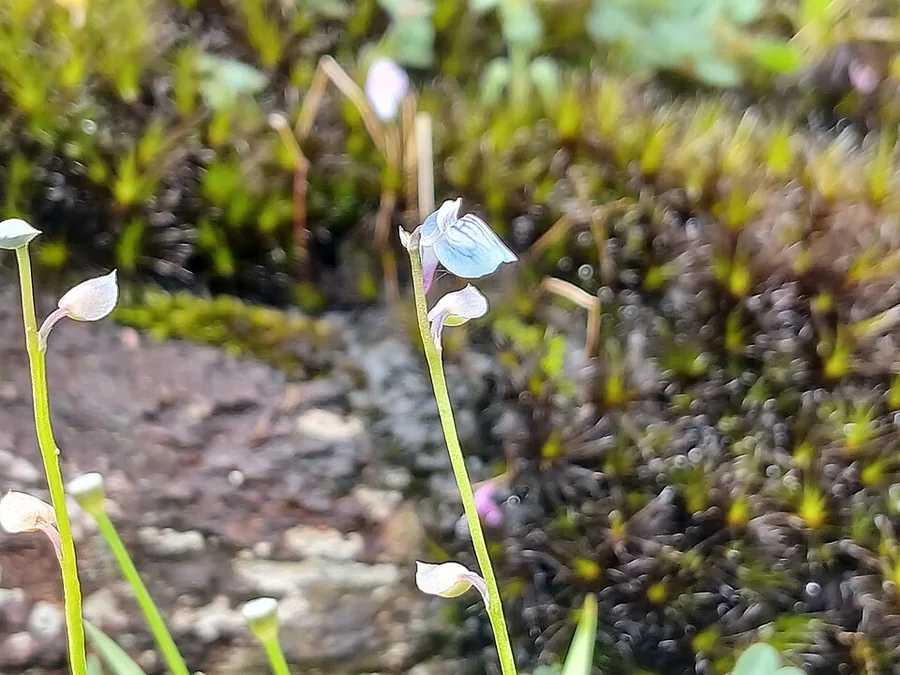
A popular, forgiving terrestrial species; its pale blue-white blooms recall little snapdragons marked with violet veining.
Utricularia livida
An especially tolerant species from Africa and Mexico that builds dense mats studded with small lilac-and-white flowers.
Utricularia vulgaris
A free-floating aquatic species whose feathery submerged stems carry abundant bladder traps, topped by bright yellow flowers held above the water.
Utricularia graminifolia
A grass-like terrestrial to semi-aquatic species that aquarists favor as a low carpeting plant.
Utricularia subulata
A tiny cosmopolitan terrestrial species bearing yellow flowers; it often turns up uninvited in bog-plant pots.
How to propagate
Once established it multiplies readily, either by dividing the mat or by sowing dust-fine seed, the latter for the patient.
DivisionEasy
Spring or early summer during active growth · A few weeks to a couple of months
The simplest route is splitting the mat in spring or early summer while it is in active growth. Lift a section, settle it into fresh nutrient-poor peat and sand, and keep it constantly wet with pure water; it settles in over a few weeks to a couple of months.
SeedDemanding
Spring · Several months to over a year
Raising it from seed is a patient gardener's project. Surface-sow the fine seed onto damp peat and sand in spring, then wait, since germination is slow and the seedlings emerge tiny and delicate; allow several months to over a year.
Myths
That bladderworts must be fed meat or insects the way a Venus flytrap is.
The traps are scaled for microscopic prey such as protozoa and water fleas, not for chunks; meat or insects dropped in simply rot in the medium. The plant feeds itself from the water and needs no help from you.
That carnivorous plants need fertilizer to grow well.
These plants evolved in nutrient-poor bogs and pull what they require straight from the water. Fertilizer or mineral-rich water usually kills them, the reverse of standard feeding advice.