Houseplant · Araceae
ZZ Plant
Zamioculcas zamiifolia
Glossy, drought-proof, and at ease in a shaded corner, the ZZ plant demands little and rewards you season after season.
Bright indirect
Every 14–30 days
59–84°F · 15–29°C
USDA 9–11
Overview
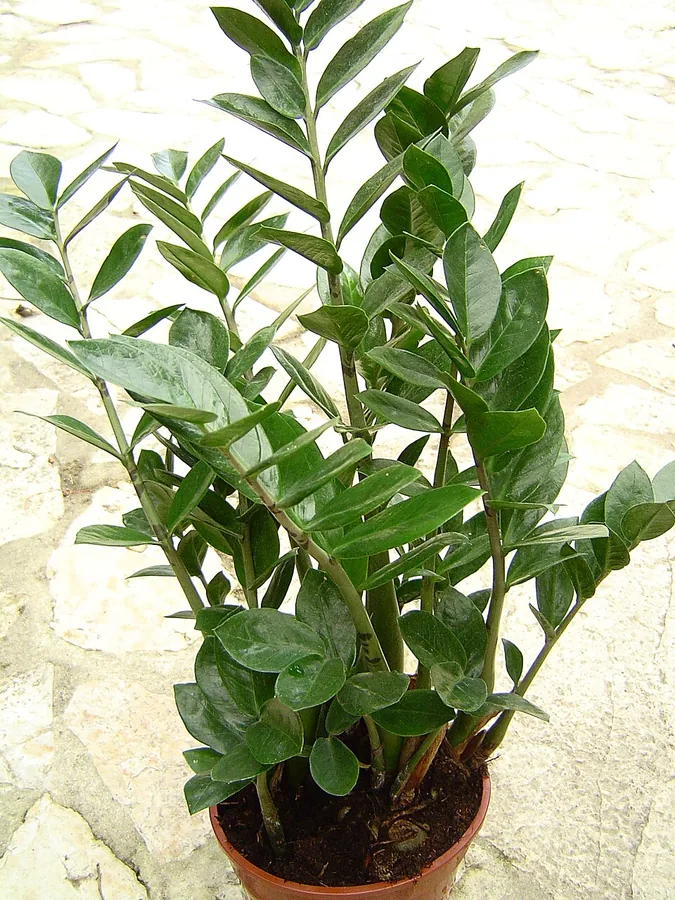
The ZZ plant has earned its standing as the houseplant most growers struggle to kill. A native of eastern Africa, it banks moisture in thick underground rhizomes, the adaptation that lets it ride out a skipped watering or a position far from any window. Waxy, deep-green leaflets sit in even ranks along arching stems, each one catching light as though it had been buffed.
Its appeal as a low-demand specimen comes down to restraint. The plant adds growth slowly and holds a clean form on its own, settling at a manageable 2 to 4 feet (61 to 122 cm) tall without sprawling. Left untended for weeks it stays presentable, which explains its constant presence in offices and dim corridors.
The qualification is that all tissue carries calcium oxalate crystals, which rules it out where pets or small children might chew on it. Sited out of reach and otherwise left alone, it returns years of quiet, glossy growth.
Care
The short version: site it in bright indirect light, water only once the soil has dried through, pot it in a fast-draining mix, and hold it warm and clear of direct sun.
Light
This species performs best under bright indirect light, yet it withstands low and medium light better than nearly any houseplant. Shield it from direct sun, which scorches the foliage. In a dim corner the cost is slower growth and a more stretched habit.
Water
Water only once the mix has dried out completely, which generally falls every 2 to 4 weeks. The rhizomes carry their own reserve, so the plant copes with a missed watering far more readily than with a waterlogged pot. The quickest way to lose it is overwatering.
Soil
Grow it in a well-drained potting mix built on peat or bark and amended with perlite or sand. The target is a substrate that empties quickly and never stays sodden, since standing moisture is exactly the condition that rots the rhizomes.
Temperature
Hold it within a comfortable 59°F to 84°F (15°C to 29°C), the same range that suits most indoor rooms. It carries no cold tolerance, and any dip below 60°F (15°C) yellows the leaves or sheds them.
Humidity
Average household humidity is entirely sufficient, so there is no figure to target. It accepts the dry air of most homes with no misting or special handling.
Feeding
Apply a balanced, diluted fertilizer sparingly across the spring and summer growing season, only once or twice a year. As a slow grower it draws little, and overfeeding causes more harm than going without.
Pruning
Little pruning is called for. Cut off yellowing or damaged leaflets whenever they show up, which is enough to keep the plant tidy.
Repotting
Repot every 2 to 3 years, or earlier if the plant fills its container. The signals are clear: the thick rhizomes press against the pot walls, roots escape the drainage holes, or growth stalls. Step it up a single pot size into fresh, fast-draining mix.
Size & spacing
Indoors the plant reaches roughly 2 to 4 feet (61 to 122 cm) in height and spreads to about the same width. Allow space for the arching stems to fan out without pressing against neighboring plants.
Troubleshooting
Problems on a ZZ plant are infrequent, and when they surface the diagnosis is usually straightforward. Almost every issue resolves to a watering or light error, expressed through the leaves and stems. Match your symptom to the entries below and you can correct the cause before it advances.
Chlorotic foliage with softened, decaying rhizomes
Yellowing foliage paired with soft, foul-smelling rhizomes points to root and rhizome rot, a disorder driven by excess moisture rather than drought. Because the swollen rhizomes already hold their own reserve, saturated soil starves the roots of oxygen and the tissue collapses. Halt watering, lift the plant clear of its pot, excise every soft section, and reset it in a dry, fast-draining medium.
Fix:
- Stop watering
- Unpot and cut away rotted rhizomes
- Repot in dry well-draining mix
Leaflets shriveling and dropping off
Held in dry soil past its tolerance, the plant abscises leaflets to conserve its stored water, so the petioles shrink and the canopy thins. This is a protective response to prolonged drought, not disease. Saturate the rootball once, then return to the standard regime of watering only after the medium dries through.
Fix:
- Water thoroughly
- Resume regular watering once soil dries
Small brown bumps stuck to the stems
Waxy brown bumps fixed to the stems and petioles are armored scale, the single pest of any consequence on this species. The insects feed on sap and often leave a sticky residue behind them. Scrape them off by hand, follow with horticultural oil or insecticidal soap, and quarantine any incoming plant before it reaches the rest of the collection.
Fix:
- Wipe off scale
- Treat with horticultural oil or insecticidal soap
Foliar yellowing or sudden collapse following chilling exposure
This is a warmth-dependent species, and any exposure below 60°F (15°C) yellows the foliage or causes it to collapse as the tissue chills past its limit. Return it to a warmer position without delay. Through winter, hold it away from drafty glass, and bring any plant that summered outdoors back inside before night temperatures fall.
Fix:
- Move to a warmer spot above 60°F (15°C)
Scorched, discolored patches concentrated on the light-facing side
Pale or brown patches concentrated on the window-facing surface signal leaf scorch, the result of direct sun overwhelming foliage adapted to indirect light. The exposed cells bleach and then die back. Set the plant away from the glass under bright indirect light, and subsequent growth emerges undamaged.
Fix:
- Move to bright indirect light
Etiolated, elongated petioles with minimal fresh growth
The plant persists in a dim location, but the petioles elongate as they reach for a stronger source and fresh growth nearly halts. This stretching traces directly to insufficient light. Relocate it to a brighter position clear of direct sun, and the growth rate recovers.
Fix:
- Move to brighter indirect light
Toxicity
Treat this species as off-limits to animals. Every part is charged with needle-like calcium oxalate crystals, which inflame oral tissue and provoke salivation and emesis when an animal chews them. The sap is a skin and eye irritant as well, and no portion is edible, so position the plant beyond reach and rinse your hands once you have worked with it.
Toxic to
Cats · Dogs · Horses · Rabbits · Livestock · Birds · People
Cats Toxic
A bite into the foliage releases needle-like crystals into the mouth, which provokes drooling, pawing at the muzzle, and vomiting. The immediate sting tends to deter a cat from consuming much.
Dogs Toxic
Chewing triggers profuse salivation, oral discomfort, and digestive upset. A dog that ingests a larger quantity may also retch or turn away from food for a time.
Horses Toxic
The same crystals inflame the equine mouth and gut, producing drooling and a loss of appetite. Position the plant well away from stalls and paddocks.
Rabbits Toxic
It should never be offered to a rabbit. The oxalate crystals scald the mouth and stomach lining, driving drooling and refusal of feed.
Livestock Toxic
In goats, sheep, and cattle the crystals cause oral irritation, salivation, and digestive distress, so keep it fenced off from grazing stock.
Birds Toxic
A bird that pecks the leaves takes the same stinging crystals into its mouth and throat. Pet birds should have no access to the foliage at all.
People Caution
No part is edible, and contact with the sap can redden and sting skin or eyes. Rinse your hands once you have handled it and keep young children from putting the leaves in their mouths.
Wash hands after handling; crystals can irritate skin
Helpline numbers

United States
ASPCA Animal Poison Control: (888) 426-4435 (fee applies)
Poison Control: (800) 222-1222



Canada
Poison Centres: 1-844-764-7669
Varieties
Past the standard glossy green form, breeders have released several distinct ZZ cultivars worth recognizing.
'Raven' (Dowon)
Fresh foliage emerges lime-green and matures to a glossy, almost black-purple shade.
'Zenzi'
A compact dwarf reaching only 10 to 12 inches, with short stems and dark leaves crowded close together.
'Dark Zamicro'
A second dwarf form, holding under 2 feet, distinguished by leaflets smaller than those of the species.
Variegated
Cream and white markings break up the foliage rather than the usual uniform green.
'Chameleon'
Emerging shoots open a golden-yellow that deepens to dark green with maturity.
'Lucky'
Each leaflet is broader and green, finished with a gently rounded tip.
How to propagate
Two methods increase a ZZ plant, one quick and dependable, the other a long exercise in patience.
DivisionEasy
Spring, at repotting · Weeks to months
Division is the surest route to new plants. During a spring repot, with the rootball already out of the pot, separate the rhizome clumps so every section retains its own roots and at least one shoot. Pot each piece on, and the divisions take hold over the following weeks to months.
Leaf cuttingsDemanding
Anytime; very slow · Several months to form a rhizome
Single leaflets will also root, though the method demands real patience. Insert a sound leaflet into moist medium at any point in the year, then wait, because forming even a small rhizome can take several months, with a new shoot arriving later still.
Myths
A ZZ plant thrives in no light at all.
Few houseplants endure a dim corner as well, which is the root of the claim. Yet photosynthesis still requires light, and a genuinely dark spot brings growth to a standstill. Bright indirect light is where it actually does well.
One watering per growing season is sufficient for a ZZ plant.
Its water-storing rhizomes do make it genuinely drought-tolerant, yet one watering per season exceeds even that buffer. Water it when the mix has fully dried, roughly once or twice a month. Pushed past that point, the plant starts to drop leaflets.
A potted ZZ plant provides measurable indoor air purification.
The notion rests on sealed-chamber experiments that scale poorly to a furnished room. A peer-reviewed review concluded that potted plants don't measurably improve indoor air, since normal ventilation outpaces anything a houseplant contributes.
Skin contact with a ZZ plant is carcinogenic or seriously toxic.
The calcium oxalate in its leaves and sap acts as an irritant, not a lethal toxin, and there is no link to cancer. Contact may leave skin or eyes stinging, so wash your hands afterward, and although the plant is unsafe to eat, the outcome is irritation rather than grave injury.
The ZZ plant is safe around pets.
It is not. The ASPCA lists it as toxic to cats and dogs, owing to the insoluble calcium oxalate crystals distributed through every part, which inflame oral tissue and trigger salivation and emesis once an animal chews them.
Sources
- ASPCA Animal Poison Control
- NC State Extension Gardener Plant Toolbox
- Missouri Botanical Garden Plant Finder
- Missouri Botanical Garden Plant Finder
- Clemson Cooperative Extension HGIC
- UF/IFAS Extension Santa Rosa County
- UF/IFAS Extension (ENH1375/EP639)
- Journal of Exposure Science & Environmental Epidemiology (Cummings & Waring 2020)