Ornamental · Poaceae
Zoysia Grass
Zoysia japonica
Dense and drought-tolerant once its stolons and rhizomes knit, zoysia trades slow establishment for wear-resistant turf.
Full sun
Every 5–10 days
365–1095 days
USDA 5–11
Overview
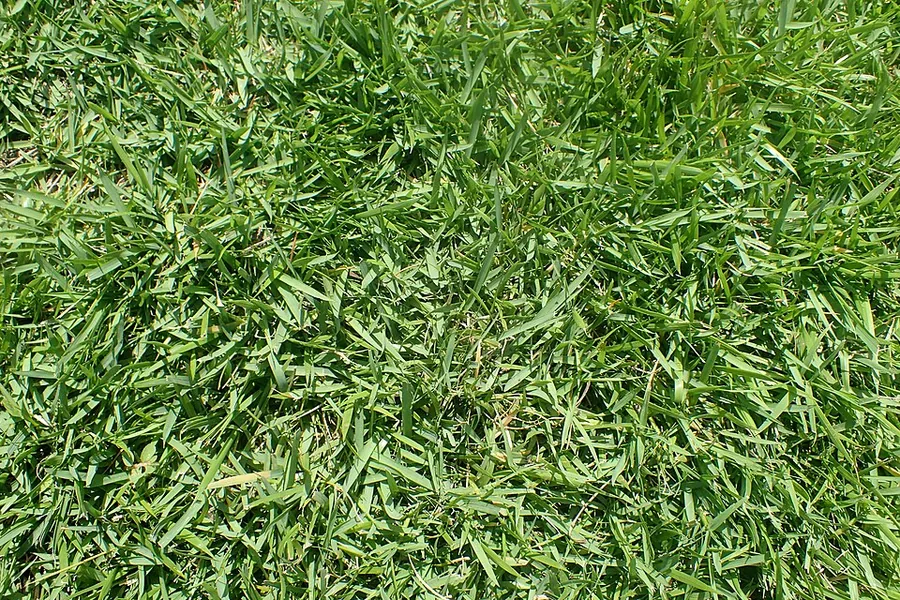
Zoysia is a warm-season turfgrass native to East Asia that develops a dense, fine canopy able to withstand foot traffic. It expands laterally through above-ground stolons and below-ground rhizomes, and that dual spreading habit is what lets a mature stand form a thick mat that excludes most weeds. Growers select it where wear tolerance and heat performance matter.
Its defining limitation is establishment speed. Because zoysia advances only as fast as its runners extend, a planting of plugs or sprigs commonly needs two or more seasons to close in, and as a warm-season species it enters dormancy after frost, browning until soil temperatures rise again in late spring. That same conservative growth underlies its strengths: an established stand demands little irrigation and outperforms most lawn grasses under wear, salinity, and drought.
Its adaptation spans a broad climatic range, persisting from the cold margin of USDA zone 5 through zone 11. Cold hardiness tracks with species: Zoysia japonica holds the coldest sites, while finer-textured types concede some winter hardiness in exchange for a smoother canopy.
Care
The short version: site it in full sun, mow low with a sharp reel mower, and irrigate deeply only once the blades signal stress by folding. Apply modest nitrogen through summer, dethatch every year or two, and allow winter dormancy rather than forcing green-up.
Light
Zoysia performs best under full sun, where the canopy reaches maximum density; in deep shade it thins because reduced light limits growth. It tolerates partial sun or light shade better than many warm-season grasses, but density always tracks with available light, so the brightest site yields the strongest turf.
Water
An established stand is genuinely drought-tolerant, so irrigation is warranted only at visible stress. Wait until the blades fold, wilt, or take on a blue-gray cast, then apply about 0.5 to 0.75 inches deeply to recharge the root zone. Permitting summer dormancy during drought is a legitimate water-conserving strategy, since the crowns survive and recover.
Soil
The grass adapts to most textures provided drainage is adequate, from loam to sandy soil. Target a pH of 6.0 to 6.5, mildly acidic, where nutrient availability suits it and establishment proceeds reliably.
Temperature
As a warm-season species it is physiologically suited to heat and tolerates summer highs near 100°F (38°C). It survives winter to roughly 10°F (-12°C) by retreating into crown dormancy, and hardiness varies by strain, so the most cold-tolerant selections belong on the coldest sites.
Humidity
Ambient outdoor humidity meets its needs, so no target range applies. The more consequential factor is canopy drying and airflow, because prolonged leaf wetness in dense, poorly ventilated turf is the precondition for large patch.
Feeding
Fertilize during active growth, roughly May through August, supplying moderate nitrogen at about 2 to 4 pounds per 1,000 square feet annually in split applications to match uptake. Withhold heavy nitrogen in fall, since late-season nitrogen fuels thatch accumulation and predisposes the stand to disease.
Pruning
Mow low, near 1 to 2.5 inches (2.5 to 6 cm), preferably with a sharp reel mower, because the stiff, tough blades dull rotary units and lead to scalping. Dethatch every year or two whenever the thatch layer exceeds roughly half an inch, as accumulated thatch impedes water and gas exchange.
Repotting
none
Size & spacing
Maintained as turf, the leaves sit at 1 to 2 inches (3 to 6 cm). Individual plants extend laterally by runners across roughly 1 to 10 feet (30 cm to 3 m), which is the mechanism by which a limited number of plugs eventually colonizes an entire area.
When to plant
As a warm-season grass, zoysia establishes only after soil warms, and its rhizomatous spread proceeds slowly from there. Install sod, plugs, or sprigs from late spring into early summer, and confine seeding of Zoysia japonica to April through July. In every case, expect two or more seasons before full coverage.
Northern hemisphere
Southern hemisphere
Typical months for a temperate climate: start earlier in warm zones, later where spring frosts linger.
- Plant: Sod, plug, or sprig in late spring to early summer once soil is warm; seed (Z. japonica only) April-July
- Harvest: Inconspicuous spikelike seedheads in late spring to summer; grown for turf, not bloom
Hardiness
USDA hardiness zones: 5–11
Temperature: down to -29°C
Troubleshooting
Most complaints about zoysia arise from its slow growth rate and its warm-season dormancy rather than from pathology. The practical skill is distinguishing normal dormancy and gradual fill-in from genuine disorders such as thatch accumulation and large patch. Confirm the diagnosis below before applying any treatment.
Expanding brown rings of thinning turf in cool, wet seasons
The pathogen is large patch, a Rhizoctonia fungus that becomes active in cool, wet soil and is promoted by excess nitrogen. Rings enlarge while soil holds around 65°F to 75°F (18°C to 24°C), and infected outer leaves detach at orange-brown rotted sheaths. Apply a labeled fungicide preventively as soil cools toward 70°F (21°C) in fall, correct drainage, reduce thatch, and avoid fall and early-spring nitrogen.
Fix:
- Apply a labeled fungicide preventively in fall when soil cools to about 70 degrees F
- Improve drainage and reduce thatch
- Avoid fall and early-spring nitrogen and over-watering
- Water early in the day so turf dries quickly
Plugs and sprigs that require multiple seasons to coalesce
The cause is slow establishment, an inherent trait of zoysia rather than a failure. Lateral spread is limited by the rate at which runners extend, so plugs placed too far apart or installed late in the season leave gaps that persist. Maintain irrigation and weed control on the young stand, reduce plug spacing or install sod for rapid cover, and apply light fertility through the growing season to accelerate closure.
Fix:
- Be patient; keep newly planted area watered and weeded
- Space plugs closer (e.g. 6 in centers) or use sod for faster cover
- Control weeds while turf fills in
- Apply light, regular fertility during the growing season to speed spread
Spongy canopy with excessive thatch and scalping
The disorder is thatch, an organic layer that accumulates beneath zoysia's dense growth and is aggravated by excess nitrogen. It produces a spongy surface, and mowing low after the canopy has grown tall removes too much leaf at once and scalps to brown. Dethatch every year or two, mow frequently with a sharp reel mower so no more than a third of the leaf is removed, and reduce nitrogen inputs.
Fix:
- Dethatch with a vertical mower or power rake every year or two
- Mow regularly at the recommended height with a sharp reel mower
- Avoid excess nitrogen that drives thatch
- Keep mower blades sharp and mow frequently enough to remove only one-third of the leaf
Fall straw-browning with delayed spring green-up
This reflects winter dormancy, the expected response of a warm-season grass to frost. The foliage browns while the crowns and runners remain viable and resume growth once soil warms, and cool spring soils simply extend the dormant interval. Withhold fertilizer aimed at forcing green-up, and if patches remain brown with basal rot into spring, evaluate instead for large patch disease.
Fix:
- Expect dormant brown color from first frost until warm spring weather; no treatment needed
- Avoid heavy traffic on dormant turf
- Do not over-fertilize to force green-up; wait for warm soil
- If patches stay brown and rot at the base in spring, check for large patch disease
Toxicity
Zoysia presents no toxicological concern: it is a turfgrass with no recognized poisonous principle. Cats, dogs, horses, rabbits, livestock, and birds may graze the foliage without risk. The only relevant exposure is grass pollen, which can provoke allergic rhinitis in sensitized individuals.
Safe for
People · Cats · Dogs · Horses · Rabbits · Livestock · Birds
Cats None
No toxic principle is present, so proximity poses no hazard. A cat that ingests a few blades may occasionally regurgitate, but this reflects hairball behavior rather than poisoning.
Dogs None
The grass contains no toxin, so a dog may graze and play on it freely. Intermittent grass-eating with mild vomiting is a normal, benign behavior.
Horses None
This turfgrass falls among the ordinary forage species horses graze and carries no poisonous compound.
Rabbits None
Rabbits may consume the blades without risk, as the grass holds no harmful constituent.
Livestock None
Cattle, goats, and sheep can graze the foliage safely; it belongs among the common pasture grasses.
Birds None
Poultry and wild birds forage through the turf without hazard from the grass itself.
People None
The grass poses no poisoning risk to children or adults. The single caveat is grass pollen, which can elicit hay fever in predisposed individuals.
The grass itself is not poisonous. Grass pollen can trigger hay-fever allergies in sensitive people, and pets that nibble grass may occasionally vomit, but this is not a sign of poisoning. Rarely, grass awns can cause mechanical irritation.
Varieties
The commercial zoysias divide into a few species and hybrids that differ in leaf texture, shade tolerance, and cold hardiness. These are the taxa encountered when sourcing sod, plugs, or seed.
Zoysia japonica (e.g. Meyer, Zenith, Compadre)
It is the coarsest and most cold-hardy species, the only zoysia available as seed, and the origin of Meyer, the selection formerly promoted as a miracle grass.
Zoysia matrella (manilagrass)
Finer in leaf and more shade-tolerant than Z. japonica, though slower to grow and less cold-hardy.
Emerald (Z. japonica × Z. tenuifolia)
A fine-textured interspecific hybrid valued for dense, attractive turf, but less winter-hardy than Meyer.
How to propagate
Zoysia is propagated almost entirely by vegetative means rather than seed, and even where seed is viable, establishment is protracted. The mechanics of each method follow.
DivisionModerate
Late spring to early summer once soil is warm · 2 or more growing seasons to fully fill in
Nearly all zoysia is propagated vegetatively, and the hybrids can be reproduced no other way. Install sod for immediate cover, set plugs about 6 to 12 inches apart, or broadcast sprigs in late spring once soil is warm. Regardless of method, anticipate two or more growing seasons before the stand fully coalesces.
SeedModerate
April to July · Germinates in about 2-3 weeks, then 6-8+ weeks to establish; slow overall
Seed is viable only for Zoysia japonica, such as Zenith or Compadre. Sow from April through July and expect germination in about 2 to 3 weeks, followed by another 6 to 8 weeks or more to establish. A seeded stand closes more slowly and less uniformly than sod, so plan accordingly.
Myths
Zoysia is a no-care miracle grass that stays green all year, never needs mowing, and eliminates every weed overnight.
Zoysia does form a fine, tough, drought-tolerant lawn, but the miracle characterization is unsupported. It may take two or more seasons to establish from plugs, browns into dormancy each winter, accumulates thatch, and still requires mowing, fertility, and disease management. It is a sound turfgrass, not a maintenance-free one.