Tree · Rosaceae
Yoshino Cherry
Prunus × yedoensis
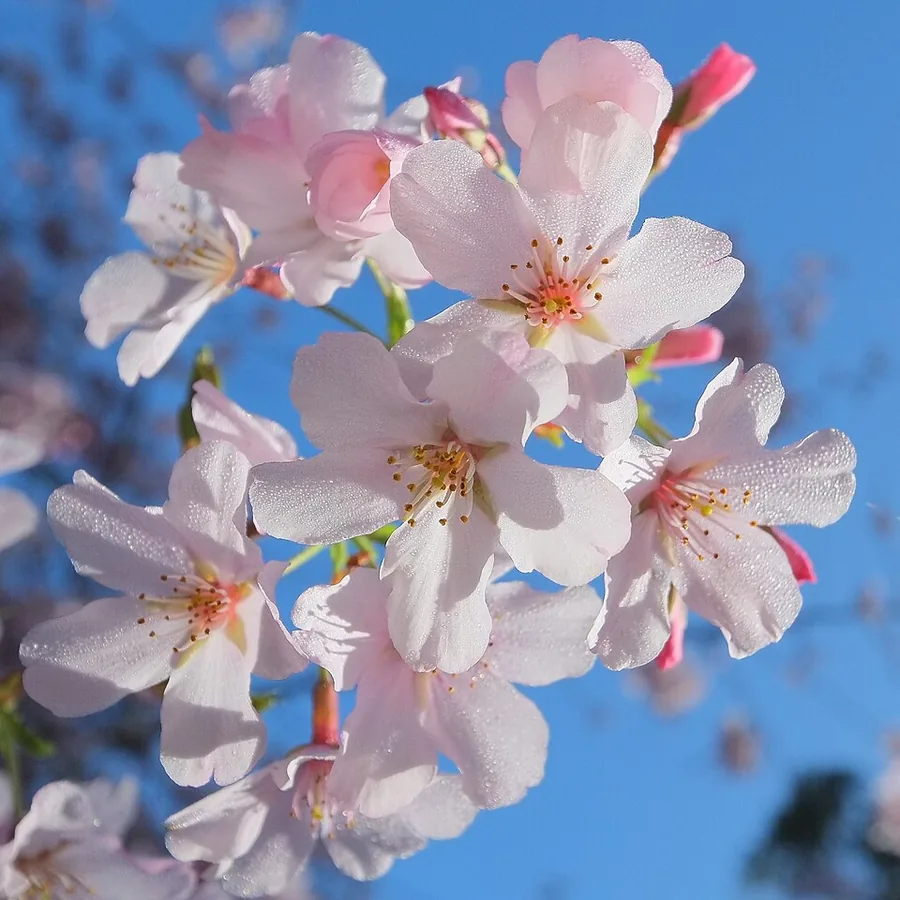
A Yoshino cherry exists for one horticultural set piece: clouds of white-to-pink spring blossom that hold the whole yard for two weeks.
Full sun
Every 5–10 days
USDA 5–8
30–40 ft · 9.1–12.2 m
Overview
Prunus x yedoensis is the flowering cherry behind the great spring displays, among them the plantings that ring the Tidal Basin in Washington. Its fragrant white to pale-pink flowers open in early spring, usually ahead of the leaves, and the massed bloom reads as snow across the canopy for about two weeks. Pollinated flowers set small black drupes that birds strip through summer.
This is a hybrid, Prunus x yedoensis, in the family Rosaceae, and its fast growth builds a broad, rounded crown of 30 to 40 feet. That vigor trades against longevity, since the species is short-lived at about 15 to 20 years before borers and canker overtake it. The brief floral display is the reason growers accept the tradeoff.
Sited in full sun on moist, well-drained soil with space to develop, a Yoshino is largely self-sufficient. The tree concentrates its ornamental value into one brief flowering, then reads as a clean green canopy that colors to gold in fall.
Care
The short version: full sun drives the bloom, deep well-drained soil kept evenly moist supports the fast growth, and steady water offsets its poor drought tolerance. Prune only just after flowering to protect the buds, allow the full mature spread, and shield the thin bark from mowers.
Light
Full sun yields the densest, most uniform flowering, since flower-bud formation depends on high light. In partial shade the tree tolerates the conditions but flowers less and grows toward the brightest aspect.
Water
Hold the soil consistently moist, roughly every 5 to 10 days and more frequently under heat, because the species pairs good heat and humidity tolerance with poor drought tolerance. Sustained dry soil stresses the tree quickly, so irrigate through any extended dry spell.
Soil
Grow it in average, medium-moisture, well-drained loam near a pH of 6.0 to 7.0, slightly acidic to neutral. It adapts broadly provided drainage is sound, because standing water around the roots invites rot.
Temperature
The species is cold-hardy across USDA zones 5 to 8, tolerating the range from -20°F to 100°F (-29°C to 38°C). The vulnerability lies in its timing, since flowers opening early in the season can brown when a late frost strikes the exposed petals overnight.
Humidity
Ambient outdoor humidity meets its needs, so no adjustment applies. The tree tolerates humid summers, though still air in a dense canopy keeps foliage wet and favors leaf spot and canker infection.
Feeding
Fertilize conservatively, because an established tree in reasonable soil is essentially self-supplying. A balanced slow-release tree fertilizer in early spring is warranted only when growth is visibly poor.
Pruning
Prune crossing or rubbing branches immediately after flowering, since the tree sets next year's flower buds during the following season and later cuts remove them. Excise dead or diseased wood whenever it appears, cutting 4 to 8 inches below black knot swellings to clear the fungal margin, and remove tent caterpillar egg masses in winter.
Repotting
No repotting applies, since this is a landscape tree rather than a container subject. A young tree held too long in its nursery pot can form circling or girdling roots, so inspect the root ball and tease them straight before planting.
Size & spacing
Expect fast growth to roughly 30 to 40 feet (9 to 12 meters) in height with an equal spread, so allot wide, open ground. Position it clear of buildings, walks, and neighboring trees to let the rounded crown reach its full form.
When to plant
Establish a Yoshino during dormancy, in early spring or fall, so the root system extends before the canopy places its demand on it. The display follows in early spring, as fragrant white-to-pink flowers open on bare wood through March or April, with small black drupes developing over summer.
Northern hemisphere
Southern hemisphere
Typical months for a temperate climate: start earlier in warm zones, later where spring frosts linger.
- Plant: Plant balled-and-burlapped or container trees in early spring or fall while dormant.
- Harvest: Fragrant white to pale-pink flowers in early spring (March-April) before or with emerging leaves; small black drupes follow in summer.
Hardiness
USDA hardiness zones: 5–8
Temperature: down to -29°C
Troubleshooting
Yoshino problems concentrate on the bark, twigs, and foliage, and the most serious develop internally where they escape early notice. Reading the first symptoms lets you excise a disorder before it advances through the wood. Match the presentation below, then intervene while intervention still changes the outcome.
Frass, gummy exudate, and holes low on the trunk
Sawdust-like frass and gum near the soil line signal borers mining the trunk and limbs as branches decline. No reliable spray exists, so the operative defense is tree vigor, which lets the cambium wall off the larvae. Protect the bark from mowers and trimmers, mulch beneath the canopy, and water through drought, recognizing that the species is naturally short-lived at about 15 to 20 years.
Fix:
- Keep trees vigorous so they can resist and wall off borers
- Protect bark from mowers and string trimmers with mulch
- Follow extension timing for borer management on confirmed infestations
Sunken, gummy cankers with associated branch dieback
Weeping, sunken lesions indicate brown rot and canker fungi, which also rot the small fruit and blight the twigs. Excise infected wood well below each canker and disinfect tools between cuts to avoid inoculating fresh wounds. Remove mummified fruit and fallen debris, since that tissue harbors the overwintering inoculum.
Fix:
- Prune out and destroy infected wood well below the canker, disinfecting tools between cuts
- Remove mummified fruit and fallen debris to reduce inoculum
- Improve air circulation and avoid wetting foliage when watering
Hard black galls encircling twigs and branches
The rough, coal-black swellings are black knot, a fungal disease of cherries and plums that is most conspicuous in winter once the canopy is bare. Prune the galls in late winter before growth resumes, cutting at least 4 to 8 inches below each to reach clean wood, then destroy the prunings by burning or burying. Eliminate nearby wild cherry or plum, which serve as reservoirs that reinfect the tree.
Fix:
- Prune out knots in late winter before growth starts, cutting at least 4-8 inches below each knot
- Destroy pruned material by burning or burying
- Disinfect pruning tools between cuts
Silk tents in the branch crotches with defoliation
Spring webbing is the work of Eastern tent caterpillars, while Japanese beetles skeletonize foliage in summer and aphids or scale deposit honeydew that blackens into sooty mold. Remove tents and egg masses by hand and collect the beetles into soapy water. A vigorous, well-watered tree compensates for the feeding, since the injury is essentially cosmetic.
Fix:
- Remove and destroy tent caterpillar tents and egg masses by hand
- Hand-pick Japanese beetles into soapy water
- Wash off aphids or treat heavy scale/aphid infestations per extension guidance
Toxicity
Only the flowers are safe to enjoy, because the remaining tissues are genuinely hazardous. The leaves, twigs, bark, and seed pits contain cyanogenic glycosides that release cyanide, and cyanide release climbs once leaves wilt after pruning, storm damage, or frost, sharply raising the dose. Keep pets, horses, and livestock away from clippings and fallen debris, and treat the bitter fruit and its pits as inedible.
Toxic to
Cats · Dogs · Horses · Rabbits · Livestock · Birds · People
Cats Toxic
A cat ingesting wilted leaves, twigs, or seed pits may present with brick-red gums, dilated pupils, and labored, panting respiration. Such cases are uncommon, but cyanide acts rapidly, so any respiratory distress warrants emergency treatment.
Dogs Toxic
A dog chewing fallen twigs or fracturing the pits incurs the same cyanogenic exposure. The signs to expect are heavy salivation, bright-red gums, dilated pupils, and abrupt distress, and they warrant immediate veterinary care.
Horses Severe
Horses face the most serious risk, as wilted leaves from a pruned or storm-downed branch can prove rapidly fatal. Clinical signs include bright-red mucous membranes, accelerated breathing, weakness, and collapse within minutes.
Rabbits Toxic
The foliage, twigs, and pits contain the same cyanide-releasing compounds, so none of the material is safe for a rabbit. Exclude all clippings and fallen debris from any area the animal can reach.
Livestock Severe
Cattle, sheep, and goats are highly susceptible to wilted cherry leaves, which can be lethal within 15 to 20 minutes. Expect slobbering, rapid respiration, a weak pulse, bright-red membranes, and convulsions, so prunings must never enter a pasture.
Birds Caution
Wild birds consume the ripe black drupes and void the intact pits, dispersing the seed in the process. The pits and foliage remain off-limits, since a fractured seed liberates cyanide.
People Caution
The plant is an ornamental, not a fruit crop. The bitter drupes hold no culinary value and the leaves, twigs, and seed pits contain cyanogenic compounds, so children should be kept from chewing any part.
Do not leave pruned or storm-downed branches where livestock or horses can browse the wilting leaves; keep fallen twigs and fruit pits away from pets.
Helpline numbers

United States
ASPCA Animal Poison Control: (888) 426-4435 (fee applies)
Poison Control: (800) 222-1222



Canada
Poison Centres: 1-844-764-7669
Varieties
Yoshino is sold under several named selections, and two trees frequently shelved beside it are near relatives rather than true Yoshinos.
'Akebono' (Daybreak)
'Akebono' represents the pinker expression of Yoshino, its blooms opening soft pink and lightening toward white, unlike the near-white flowers of the straight species.
'Snow Fountains' (weeping Higan cherry, Prunus 'Snofozam')
'Snow Fountains' is taxonomically a weeping Higan-type cherry rather than a true Yoshino, its branches cascading into a fountain of white spring bloom.
Kwanzan (Prunus 'Kanzan')
Kwanzan is an allied Japanese flowering cherry that substitutes Yoshino's single white-to-pink flowers with double pink blooms of 20 to 30 petals.
How to propagate
Because Yoshino is a hybrid, seed does not reproduce the parent, so every specimen is a clone, and that confines propagation largely to the nursery trade.
GraftingDemanding
Late winter to early spring (bench grafting) or summer (budding) · 1-2 seasons to a sellable grafted tree
As a hybrid, Yoshino does not come true from seed, so it is propagated clonally. The standard method is grafting or budding onto cherry rootstock, executed as bench grafts in late winter to early spring or as summer budding, and it requires 1 to 2 seasons to yield a saleable tree. The work is exacting and best left to specialist nurseries.
Stem cuttingsDemanding
Early summer (softwood) · Several weeks to root, then 1-2 seasons to establish
Softwood cuttings taken in early summer and rooted under mist with a rooting hormone offer a secondary route. They take several weeks to root and a further 1 to 2 seasons to establish, and their low reliability relative to grafting explains why few propagators depend on them.
Myths
The small black cherries are an edible fruit.
Birds take the small black drupes, but the fruit is bitter and effectively inedible for people. The seeds hold the same cyanogenic compounds present throughout the tree, which places the plant firmly in the ornamental category rather than the orchard.
Intact green leaves are as toxic as any other part of the tree.
Sound green foliage on the tree carries comparatively low risk. The hazard concentrates in wilted or damaged leaves, whether from a broken limb, a pruning cut, or frost, because the declining tissue releases the cyanide that poisons horses and livestock.