Bulb · Ranunculaceae
Winter Aconite
Eranthis hyemalis
Among the earliest bulbs to bloom, winter aconite raises golden cups from frozen ground while the snow still lingers.
Full sun
Every 5–10 days
USDA 3–7
3–6 in · 8–15 cm
Overview
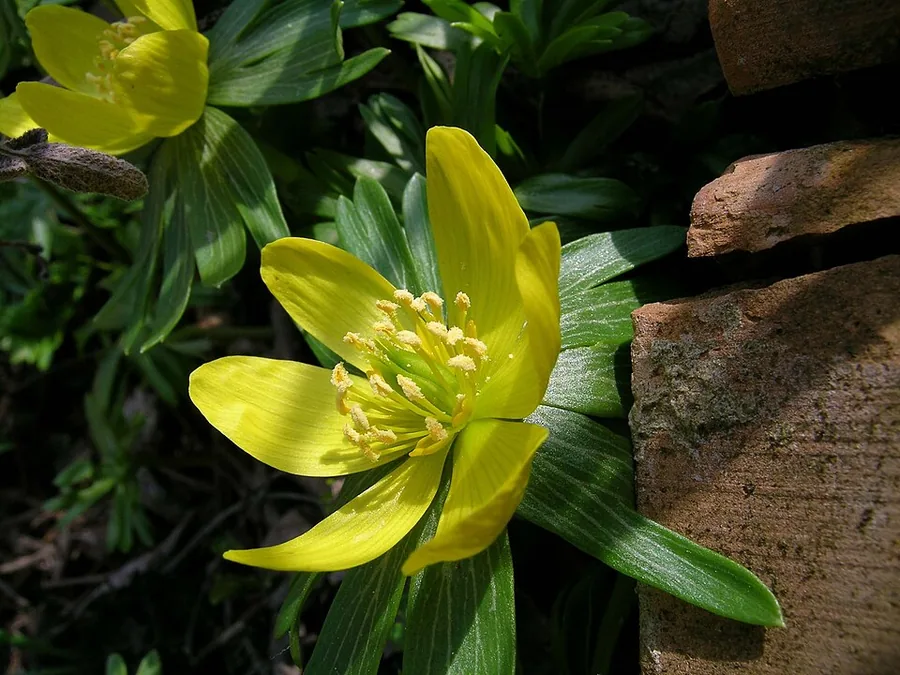
Winter aconite, Eranthis hyemalis, is a small tuberous geophyte in the buttercup family that exploits the narrow window before the tree canopy closes. Its bright yellow, cup-shaped flowers emerge through cold, bare soil in late winter, each subtended by a green ruff of leafy bracts, on a plant no more than 3 to 6 inches tall. Because it flowers ahead of crocus and snowdrops, a colony signals the earliest stirring of the growing season.
The plant grows from a small, knobby tuber that remains dormant underground through summer and resumes growth only after winter chilling. Sited once in humus-rich, well-drained soil beneath deciduous trees, it captures full late-winter sun before leaf-out and then needs little intervention. Undisturbed, it self-sows and knits into broad golden colonies, occasionally more freely than intended.
One caveat governs its use. Every part of winter aconite is poisonous, the tuber most concentrated, so it belongs where it can be viewed but not handled or ingested. Keep it beyond the reach of children and pets inclined to chew plant material.
Care
The short version: plant the tubers in fall in rich, well-drained soil beneath deciduous trees, maintain soil moisture through the late-winter-to-spring growing period, and then allow the plants to enter dormancy and colonize on their own.
Light
Winter aconite requires full sun during its growth phase, a need it satisfies by flowering in late winter before deciduous trees leaf out. Planting it beneath those trees is therefore ideal: the canopy is bare when the plant photosynthesizes, and the resulting summer shade coincides with dormancy, when light is irrelevant.
Water
Keep the soil evenly moist from late winter into spring while foliage is active, roughly every 5 to 10 days when rainfall is insufficient, because this is the only window in which the plant builds reserves. Once the leaves senesce and the tuber goes dormant, it prefers drier ground and is intolerant of standing summer moisture.
Soil
Use rich, humus-rich, well-drained soil amended with leaf mold or compost. The species favors alkaline conditions, a pH of 7.0 to 8.0, but drainage outweighs pH, since saturated soil rots the tuber, the organ from which the entire plant regenerates.
Temperature
This is a cold-adapted geophyte, hardy to about -29°F (-34°C) and reliable across zones 3 through 7. Winter chilling is a requirement for flowering, not merely a tolerance, which is why it declines where summers are hot and performs best where temperatures peak near 75°F (24°C).
Humidity
Atmospheric humidity is not a management concern, since ordinary outdoor air suffices and no target range applies. The relevant variable is soil moisture during the brief active season, which governs reserve accumulation far more than air conditions do.
Feeding
Nutrient demand is low. A seasonal top-dressing of leaf mold or compost from fall to early spring releases nutrients slowly to the tuber and sustains soil organic matter, which makes stronger, faster-release fertilizer unnecessary and potentially wasteful.
Pruning
No pruning is warranted. Allow the foliage to yellow and die back after flowering, because the senescing leaves are translocating reserves to the tuber; premature removal interrupts that process and reduces next season's performance.
Repotting
The tubers are best left undisturbed and rarely require lifting. Intervention is indicated only when clumps become congested, flowering declines, and tubers crowd toward the surface, at which point division, not repotting, restores vigor.
Size & spacing
Mature dimensions are small, 3 to 6 inches (8 to 15 cm) in both height and spread, so mass plantings read best. Setting tubers about 3 inches apart allows a colony to close into a continuous sheet as self-seeding fills the gaps.
When to plant
Winter aconite runs on a reversed schedule relative to most garden subjects. The dormant tubers go out in fall, from late summer through November, and the plant flowers in the depth of late winter, often February through April, exploiting light and moisture before competitors break dormancy.
Northern hemisphere
Southern hemisphere
Typical months for a temperate climate: start earlier in warm zones, later where spring frosts linger.
- Plant: Plant tubers in late summer to early fall (September to November), 2-3 inches deep and 3 inches apart.
- Harvest: Late winter to early spring (February to April), often before crocus and snowdrops.
Hardiness
USDA hardiness zones: 3–7
Temperature: down to -40°C
Troubleshooting
Winter aconite is undemanding, and its few failures stem from establishment and phenology rather than pathogens or pests. The signs below distinguish a genuine problem from the plant's normal seasonal cycle.
Tubers that fail to break dormancy after fall planting
The dominant cause is a desiccated tuber planted without rehydration, because winter aconite tubers dry to a hard knot in storage and lose the moisture needed to resume growth. Shallow planting or impeded drainage compounds the failure. Rehydrate shriveled tubers overnight in damp sand or peat, then set them 2 to 3 inches deep in rich, well-drained soil.
Fix:
- Soak shriveled tubers overnight (or in moist sand or peat moss) before planting
- Replant 2-3 inches deep in organically rich, well-drained soil
Foliage that disappears as summer approaches
In most cases this is summer dormancy, the plant's normal completion of its cycle by late spring, after which the leaves yellow, abscise, and the tuber rests until the next thaw. A true decline, marked by clumps that fail to return over successive years, usually reflects soil that dried excessively during active growth. Maintain moisture from late winter through spring and leave the dormant tubers undisturbed.
Fix:
- Allow foliage to die back naturally and do not disturb dormant tubers
- Keep soil moist during the late-winter-to-spring growing season
Toxicity
This is a decidedly toxic species. All tissues contain cardiac glycosides alongside the ranunculin characteristic of the buttercup family, with the tuber holding the highest concentration. Ingestion produces drooling, oral irritation, and vomiting, and a substantial dose can disturb cardiac rhythm and respiration, so keep the plant clear of pets, livestock, and children, and glove up when handling tubers.
Toxic to
Cats · Dogs · Horses · Rabbits · Livestock · Birds · People
Cats Severe
A cat that ingests leaf tissue or excavates a tuber develops drooling, vomiting, abdominal pain, and diarrhea. The more serious effect is cardiac: the cardiac glycosides can impair vision and induce a slow, irregular heart rhythm.
Dogs Severe
Because the tuber holds the greatest toxin concentration, a dog that chews one typically shows pronounced vomiting, diarrhea, and colic. A slowed, irregular heartbeat can follow a large dose, so any substantial ingestion warrants emergency care.
Horses Severe
Foliage ingestion causes abdominal pain, nausea, and diarrhea in grazing horses. At sufficient dose the same cardiac glycosides depress heart rate and disturb its rhythm.
Rabbits Toxic
This is not safe forage. The ranunculin in the foliage blisters the oral and gastrointestinal lining, and the cardiac glycosides pose a disproportionate risk to an animal of small body mass, so rabbits should be excluded from any planting.
Livestock Toxic
Cattle, sheep, and goats develop salivation, oral irritation, and digestive upset from the foliage, with cardiac effects contributing at higher intake. The bitter, acrid taste ordinarily limits consumption before serious quantities are eaten.
Birds Toxic
The whole plant contains enough cardiac glycoside to injure a bird, and low body mass means a small dose can be significant. Poultry and pet birds should be kept away from both tubers and foliage.
People Caution
No part of winter aconite is edible, so it is a plant to observe rather than sample. Ingestion produces oral irritation, drooling, vomiting, and abdominal pain, and a large quantity can disturb cardiac rhythm and breathing, which is why gloves are advised for handling tubers and children should be kept clear.
Wear gloves and protective clothing when handling; keep tubers and plants away from children and pets.
Helpline numbers

United States
ASPCA Animal Poison Control: (888) 426-4435 (fee applies)
Poison Control: (800) 222-1222



Canada
Poison Centres: 1-844-764-7669
Varieties
Winter aconite offers only a few forms, since most gardens grow the wild species. Two are worth recognizing.
Cilicica Group
The Cilicica Group is distinguished by more finely dissected, bronze-tinted bracts and somewhat larger flowers than the typical species.
Eranthis hyemalis (species)
The species itself produces bright yellow, cup-shaped buttercup flowers above a green ruff of bracts on a plant of just 3 to 6 inches.
How to propagate
Winter aconite increases on its own once established, but you can direct that increase by dividing clumps, sowing fresh seed, or planting additional tubers.
DivisionEasy
Right after flowering while plants are still in leaf ('in the green'), in early to mid-spring · 1 to 2 seasons
Division is the most dependable method: lift and separate congested clumps immediately after flowering, while the plants remain green and actively rooting, so the divisions re-establish quickly. Replant them at once at the original depth, and expect them to consolidate over the next 1 to 2 seasons.
SeedModerate
Collect and sow fresh seed in fall · 2 to 4 years to flowering
Left undisturbed, the plant self-sows prolifically and drifts into extensive colonies. To direct that increase, collect ripe seed and sow it fresh in fall, since viability drops as the seed dries, then anticipate 2 to 4 years before the seedlings reach flowering size.
Bulbs & cormsModerate
Plant dormant tubers in late summer to early fall · 1 season
Set dormant tubers in late summer to early fall at 2 to 3 inches deep and 3 inches apart. Rehydrate any that arrive shriveled with an overnight soak, and a planting typically breaks dormancy and flowers within a single season.
Myths
Winter aconite is the same plant as monkshood and toxic to the touch.
Taxonomy separates them: winter aconite is Eranthis, monkshood is Aconitum, and the two share only the buttercup family, Ranunculaceae. Early herbalists conflated them on the basis of leaf morphology, but they are distinct genera. Winter aconite is toxic by ingestion rather than contact, and its harsh, bitter taste generally deters animals before a dangerous quantity is consumed.