Ornamental · Ranunculaceae
Delphinium
Delphinium elatum
Tall spires of true blue built on hollow stems, demanding staking, steady moisture, and caution around children and pets.
Full sun
Every 2–4 days
USDA 3–7
3–7 ft · 0.9–2.1 m
Overview
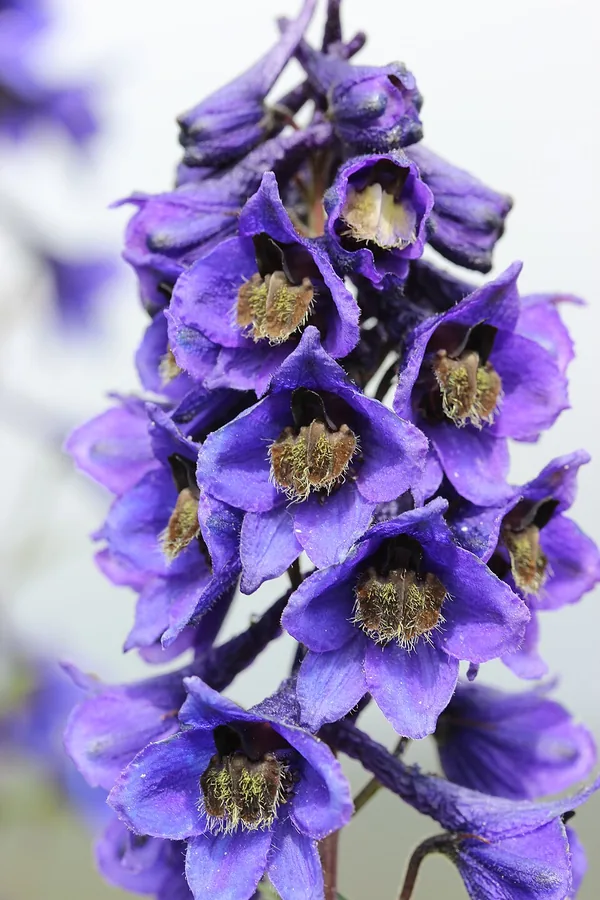
Delphinium elatum produces some of the tallest flower spikes in the perennial border, often reaching 6 feet (180 cm) or more in blue, purple, white, and pink. It sits in the buttercup family, Ranunculaceae, and its preference for cool summers explains why it performs best in cottage and country gardens through the cooler hardiness zones, where temperatures stay within its comfort range.
This is a plant that rewards attentive culture. Because delphiniums are short-lived perennials that often persist only 3 to 5 years, and because their tall stems are hollow and therefore weak in wind and rain, early staking is not optional but structural. Their status as heavy feeders follows from the volume of growth they push, which is why rich, moist, well-drained ground and a cool root run translate directly into one of the most striking early-summer displays.
One characteristic governs where it may be planted: every part is poisonous. The diterpenoid alkaloids that make wild larkspur lethal to range cattle are present in the cultivated forms as well, concentrated in young growth and seeds because that is where the plant lays down the most alkaloid. Site it beyond the reach of children, pets, and grazing animals.
Care
The short version: full sun and cool, rich, evenly moist soil, with sturdy staking installed early and a balanced feed maintained through the growing season.
Light
Site delphiniums in full sun, since maximum light produces the strongest stems and the heaviest bloom, though a little afternoon shade is advisable where summers run warm. In excessive shade the stems elongate and weaken as the plant reaches for light, which also raises its susceptibility to mildew.
Water
Hold the soil cool and evenly moist and prevent it from drying during active growth, when water demand is highest. Apply water at the base every 2 to 4 days in warm weather, because both waterlogged soil and wet foliage create the conditions that favor disease.
Soil
Plant in fertile, well-drained ground amended with abundant organic matter, which buffers moisture while allowing excess water to drain rather than pool around the crown. The species is tolerant of pH and performs across 6.5 to 8.0, including alkaline soils.
Temperature
This is a cold-hardy plant, surviving to -40°F (-40°C), but its physiology is poorly suited to heat. Growth and flowering decline once summer temperatures exceed the mid-80s, near 84°F (29°C), which accounts for its strong preference for cool-summer regions.
Humidity
Ambient outdoor humidity is sufficient, so no target value applies. What matters is air movement, because stagnant, humid air around crowded plants is precisely the microclimate in which powdery mildew and rot develop.
Feeding
Delphiniums are heavy feeders, a direct consequence of the rapid, bulky growth they produce. Supply a balanced fertilizer monthly through the growing season to support the dense foliage and the tall flower spikes that draw heavily on stored nutrients.
Pruning
Stake the hollow stems early, before wind and rain can fold structurally weak tissue. Deadhead spent spikes back to the basal foliage, which redirects the plant toward a second flush, then cut the plant back once the main flowering finishes.
Size & spacing
Mature plants reach 3 to 7 feet (91 to 213 cm) in bloom, so allow each one 2 to 3 feet (61 to 91 cm) of space. That spacing maintains air movement between plants and suppresses disease pressure on a notably mildew-prone species.
When to plant
Delphinium culture follows a cool-season cycle. Seed is started indoors in late winter so transplants are ready as soon as spring hard frost has passed, and the spikes open from early to midsummer. Deadheading the spent spikes diverts energy back into the crown, which is why a second flush often follows in late summer.
Northern hemisphere
Southern hemisphere
Typical months for a temperate climate: start earlier in warm zones, later where spring frosts linger.
- Sow: Late winter to early spring, 8 to 10 weeks before last frost
- Plant: Spring after danger of hard frost passes
- Harvest: Early to midsummer, sometimes reblooming in late summer if deadheaded
Hardiness
USDA hardiness zones: 3–7
Temperature: down to -40°C
Troubleshooting
Most delphinium disorders trace to one of three causes: excess soil moisture, the mechanical weakness of hollow stems, or pests feeding on the soft new growth. Because each leaves a recognizable early sign, prompt diagnosis usually prevents the loss of a plant. Match the symptom below, then intervene while the response still helps.
Wilting plant with a blackened, rotting base
Sudden wilting with a darkened, decayed crown indicates crown rot, which develops where drainage is poor or the crown was set too deep and stays wet. Because it spreads, the worst plants should be dug out and destroyed promptly. Correcting the drainage and replanting with the crown exactly at the soil line, never below it, removes the conditions it requires.
Fix:
- Remove and destroy severely affected plants
- Improve soil drainage
- Avoid planting the crown too deeply
Dusty white film over the leaves and stems
The dusty coating is powdery mildew, a fungus favored by crowding, shade, and poor air circulation, which is why it commonly appears late in the season as nights cool. Widening the spacing and growing in full sun raise the plant's resistance. Removing the most heavily coated leaves reduces the inoculum and slows its spread.
Fix:
- Improve air circulation and spacing
- Grow in full sun, which improves resistance
- Remove and discard affected foliage
Tall flower spikes that bend, flop, or snap
The spikes fail mechanically because the stems are hollow and cannot resist a strong gust or heavy rain, particularly in exposed sites. Staking each plant early, before the spikes elongate and become top-heavy, supports the tissue while it is still manageable. Siting in a sheltered position further reduces the wind load the stems must bear.
Fix:
- Stake plants early in the season
- Site in a location sheltered from strong wind
Twisted new growth, sticky leaves, and ragged holes
Mixed damage on delphiniums usually means several pests are active together. Aphids feed on the soft new shoots and excrete a sticky film, slugs and snails rasp ragged holes and leave slime trails, and leaf miners and mites contribute their own injury. Hand-picking slugs after dark, washing or treating the aphids, and removing mined leaves addresses each in turn.
Fix:
- Hand-pick slugs and snails
- Wash off aphids or treat as needed
- Remove mined leaves
Toxicity
The entire plant warrants handling as poisonous. Every part holds diterpenoid alkaloids, specifically the norditerpenoid type such as methyllycaconitine, which block nicotinic acetylcholine receptors and so cause neuromuscular paralysis, with the young shoots and seeds carrying the heaviest concentration. It can sicken or kill cats, dogs, horses, rabbits, birds, and livestock, and it is dangerous to people, so it must be kept well away from children, pets, and grazing animals.
Toxic to
Cats · Dogs · Horses · Rabbits · Livestock · Birds · People
Cats Severe
A cat that ingests any part may show heavy salivation, loss of appetite, and constipation, progressing to muscle tremors, stiffness, and weakness. In severe cases collapse and convulsions follow, and death can result from cardiac or respiratory failure.
Dogs Severe
Early signs in dogs include drooling, colic, and constipation, advancing to trembling muscles, stiff movement, and a wobbling, weak gait. Larger doses can produce convulsions and culminate in fatal cardiac or respiratory collapse.
Horses Severe
Affected horses present the characteristic neuromuscular syndrome of muscle tremors, weakness, and recumbency. They rarely consume a toxic quantity unless pasture is short and they begin to graze the plant.
Rabbits Severe
The same paralysing alkaloids occur throughout the plant, so rabbits must never be permitted to graze it. Even a small quantity can induce tremors and weakness, which is reason enough to keep it well clear of the hutch and run.
Livestock Severe
Cattle are the most affected class, and larkspur causes more range-cattle deaths in the western states than almost any other plant. Affected animals stagger, lose coordination, tremble, and bloat, then become recumbent with depressed respiration, and many die.
Birds Severe
Because the toxic alkaloids are distributed throughout the plant, both seeds and foliage pose a genuine risk to birds. Pet and backyard birds should be kept away from every part of it.
People Severe
No part of this plant is edible, and the young shoots and seeds carry the highest alkaloid load. Ingestion can cause a burning mouth, nausea, a slowed and irregular heartbeat, and muscle paralysis, so children must be kept well away.
Keep plants and especially seeds away from children and pets; keep grazing livestock off ranges where larkspur grows, particularly in spring and early summer when alkaloid levels are highest.
Helpline numbers

United States
ASPCA Animal Poison Control: (888) 426-4435 (fee applies)
Poison Control: (800) 222-1222



Canada
Poison Centres: 1-844-764-7669
Varieties
Most garden delphiniums derive from a few established strains, separated chiefly by mature height and by the strength of their stems. The following are the ones worth knowing by name.
Pacific Giant (Pacific Hybrids) series
These classic tall border hybrids reach roughly 5 to 6 feet and bear dense flower spikes across blue, purple, white, and pink.
Aurora series
A more compact and sturdier strain selected for stronger stems and reliable rebloom, offered in blue and white.
Summer Blues
An especially tall selection capable of reaching up to around 7 feet.
How to propagate
Delphiniums propagate by seed or by division of an established clump. Neither is rapid, and because named hybrids do not reproduce true from seed, division is the only method that preserves a given cultivar.
SeedModerate
Start indoors in late winter to early spring; fresh seed germinates best · Plants typically flower the first or second season after sowing
Start seed indoors in late winter to early spring, using the freshest seed available, because delphinium seed loses viability quickly. Plants generally flower in their first or second season after sowing. Since hybrids rarely come true from seed, named cultivars should be maintained by division rather than seed.
DivisionModerate
Early spring as new growth emerges · One season to re-establish
Lift and divide mature clumps in early spring as the new shoots emerge, handling the brittle crowns carefully to avoid damage. Each division requires roughly one season to re-establish. Dividing every few years also rejuvenates a plant that is inherently short-lived, persisting only 3 to 5 years.
Myths
Larkspur and perennial delphinium are the same plant and may be used interchangeably.
They are botanically distinct. Perennial delphinium comprises Delphinium elatum and its hybrids, whereas annual larkspur belongs to the separate genus Consolida, and the two differ in habit and life cycle. Both genera carry the same dangerous alkaloids, so the distinction does not lessen the hazard.
Delphinium is only mildly toxic, closer to a stomach upset than a real danger.
The toxicology says otherwise. The plant contains potent diterpenoid alkaloids that paralyse the muscles and can prove fatal. It is a notorious killer of cattle on western rangelands, a clinical reality far removed from a passing tummy ache.