Ornamental · Ranunculaceae
Meadow Rue
Thalictrum rochebruneanum
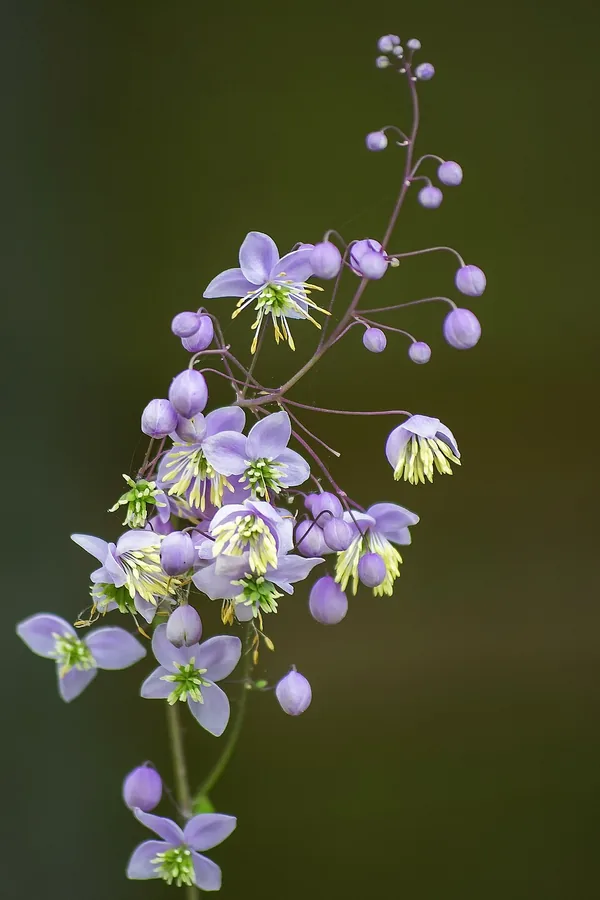
Slender stems lift a diffuse veil of bloom well above the foliage, giving meadow rue its transparent, airy structure in a part-shade border.
Partial shade
Every 5–10 days
USDA 4–7
4–6 ft · 1.2–1.8 m
Overview
Meadow rue is a clump-forming herbaceous perennial in the buttercup family, valued for the veil of small flowers it holds high above finely divided, columbine-like foliage. On the taller types the flowering stems rise well past head height, yet the airy inflorescence keeps the plant visually transparent rather than solid. That habit suits the back of a border, where the eye reads through it to the planting behind.
Its cultural needs follow directly from its native temperate conditions: part shade and consistently moist soil, with poor performance in dry, exposed sun. It grows well through USDA zones 4 to 7, favoring the cooler, damper positions in a garden. Meet those requirements and maintenance stays minimal.
One caveat governs handling. As a member of the buttercup family, meadow rue produces sap containing an irritant compound, and no part of the plant is edible despite the misleading common name. It is strictly an ornamental for viewing, not a herb, and cut tissue warrants gloved handling.
Care
The short version: site it in part shade with rich, evenly moist soil, and add afternoon shade where summers run hot. Support the tall types early, cut it to the ground in late fall, and divide the clump only once it begins to crowd itself.
Light
Meadow rue performs best in part shade and accepts full sun only where soil moisture stays high and summers remain mild. In hot regions supply afternoon shade, because intense midday radiation scorches the finely divided foliage.
Water
Hold the soil consistently moist but well drained, irrigating roughly every 5 to 10 days and more often during dry spells. Full-sun plants transpire faster and need more water than shaded ones, so a plant under heat stress is the first to scorch.
Soil
Plant it in rich, humusy, well-drained loam with medium moisture retention. It is indifferent to reaction, growing equally well in acid, neutral, or alkaline ground, so soil texture and organic content matter far more than pH.
Temperature
Meadow rue is fully cold-hardy, withstanding winter lows near -29°F (-34°C) and summer highs to about 86°F (30°C). Its true limitation is hot, humid weather rather than cold, which is precisely where afternoon shade becomes decisive.
Humidity
Ambient outdoor humidity is adequate, so no target range applies. The operative factor is air movement, since stagnant, humid air around congested foliage is what favors powdery mildew and rust.
Feeding
Incorporate compost or a balanced fertilizer at the onset of spring growth, and that generally satisfies the season's needs. Rich, humusy ground supplies most of the nutrition, so additional heavy feeding is superfluous.
Pruning
Cut spent flowering stems back after bloom, then cut the entire plant to the ground in late fall or early spring as it enters dormancy. Tall species commonly require staking, whereas sturdy-stemmed types stand unaided.
Repotting
Meadow rue resents root disturbance and is best left undisturbed. Divide the clump only every 3 to 4 years, in spring during dormancy, and only when crowded, declining growth or reduced leaf size signals a need to rejuvenate.
Size & spacing
In flower the plant reaches 4 to 6 feet (122 to 183 cm), the slender stems rising from a considerably lower foliage mound. Allow about 2 to 3 feet (61 to 91 cm) per clump so air circulates and the foliage dries between rains.
When to plant
Meadow rue keys its cycle to a cold-winter climate. Sow fresh seed in fall or start it indoors in late winter, transplant after the last spring frost, and the inflorescence opens from midsummer into early autumn.
Northern hemisphere
Southern hemisphere
Typical months for a temperate climate: start earlier in warm zones, later where spring frosts linger.
- Sow: Late winter to early spring; fresh seed germinates best, so fall sowing of fresh seed is also effective.
- Plant: Spring after frost, or fall.
- Harvest: July to September
Hardiness
USDA hardiness zones: 4–7
Temperature: down to -34°C
Troubleshooting
Meadow rue is a fundamentally sound plant, and most of its problems trace to stagnant air or summer heat rather than any serious disorder. Reading the early foliar and stem symptoms lets you intervene before a fungus or a heat episode becomes entrenched.
Scorched, wilting foliage under summer heat load
Meadow rue has a low tolerance for hot, humid weather, and unshaded afternoon sun raises transpiration faster than the roots can supply water, especially in dry soil. Position it where afternoon shade cuts that heat load in hot regions, and hold the soil evenly moist to keep the water column intact. A mulch layer conserves that moisture and buffers root-zone temperature.
Fix:
- Provide afternoon shade in hot climates
- Keep soil evenly moist
- Mulch to conserve moisture
A white powdery layer developing on the leaf surface
The film is powdery mildew, a foliar fungus that colonizes when air stagnates and humidity climbs around dense growth. Thin and space the clump to restore circulation, and keep irrigation off the leaves so spores lose the moisture film they need. Remove the worst-hit foliage and discard it rather than composting, which would only recycle the inoculum.
Fix:
- Improve air circulation by thinning and spacing plants
- Avoid overhead watering
- Remove and discard affected foliage
Orange-brown pustules erupting on the lower leaf surface
These raised bodies are rust, a fungus whose spores establish on foliage that stays wet in crowded stands. Remove and destroy every affected leaf to reduce the spore load, then open the clump so foliage dries quickly after rain. Direct water to the crown and soil rather than over the canopy, since surface moisture drives infection.
Fix:
- Remove and destroy infected leaves
- Improve air circulation
- Avoid overhead irrigation
Tall stems lodging under the load of their flower heads
The cause is top-heavy growth, most pronounced in taller species and aging plants, and it intensifies where shade or wind weakens the stems. Set supports early, before lodging begins, because a stem that has already bent seldom recovers its posture. Adequate light thickens and strengthens the stem tissue, and the sturdy-stemmed types carry their heads unaided.
Fix:
- Stake or provide support for tall stems
- Site in adequate light to promote sturdier stems
Toxicity
Handle meadow rue with measured care. In common with the buttercup family, its sap yields protoanemonin, an irritant capable of reddening skin and causing gastrointestinal upset if any part is chewed. Nothing on the plant is edible, so keep foliage and cut stems away from pets, livestock, and children, and wear gloves when pruning.
Toxic to
Cats · Dogs · Horses · Rabbits · Livestock · Birds · People
Cats Mild
A cat that chews the foliage releases protoanemonin, which irritates the oral mucosa and may bring drooling, mouth-pawing, and a little vomiting or loose stool. The compound's bitter, peppery taste usually limits intake before much is swallowed.
Dogs Mild
In a dog that bites a stem, the same irritant produces salivation, oral discomfort, and a short episode of vomiting or diarrhea. The acrid flavor is aversive enough that most dogs stop after the first mouthful.
Horses Mild
Grazing exposes a horse to sap protoanemonin, which can inflame the mouth and provoke mild colic. Palatability is low, so horses seldom consume more than a taste.
Rabbits Mild
A rabbit sampling the leaves may show oral irritation and softened stool from the same compound. The acrid sap deters most individuals after the initial bite.
Livestock Mild
Cattle, goats, and sheep exposed to protoanemonin in the leaves can develop oral irritation and gastrointestinal upset, though the bitterness restricts grazing to trivial amounts.
Birds Caution
Species-specific data for birds are lacking, so the record supports only a precautionary stance. Keep cut stems and trimmings out of their reach.
People Caution
No part of meadow rue is edible. Fresh sap can redden or irritate skin on contact and sting the mouth, so wear gloves when cutting stems and keep the plant away from small children.
Wear gloves when cutting or handling cut stems to avoid sap contact with skin; wash hands after handling and keep cut foliage away from pets and small children.
Helpline numbers

United States
ASPCA Animal Poison Control: (888) 426-4435 (fee applies)
Poison Control: (800) 222-1222



Canada
Poison Centres: 1-844-764-7669
Varieties
Several meadow rues appear in cultivation, ranging from tall self-supporting selections to more compact, fluffy-flowered species. The following are the ones worth distinguishing.
Thalictrum rochebruneanum Lavender Mist
This selection presents a diffuse cloud of lavender-purple flowers set off by yellow stamens, borne on tall, self-supporting stems that dispense with staking.
Thalictrum aquilegiifolium
Columbine meadowrue is a more compact species at 2 to 3 feet (60 to 90 cm), distinguished by fluffy powder-puff heads in pink, purple, or white above columbine-like foliage.
Thalictrum delavayi Hewitt's Double
Its fully double lavender flowers persist far longer in color because, lacking stamens, they shed no pollen and hold their form.
How to propagate
Meadow rue propagates by division of an established crown or from seed. Neither method is rapid, and both call for patience while the plants regenerate roots or pass through a long juvenile phase.
DivisionModerate
Spring while dormant, roughly every 3-4 years. · Divisions may be slow to establish, often a season or more.
Divide in spring while the crown is still dormant, splitting it only every 3 to 4 years once the clump begins to crowd itself and decline. Keep the divisions evenly moist as new roots regenerate, and allow time, since they commonly take a season or more to establish and resume normal vigor.
SeedModerate
Sow fresh seed in fall, or start indoors in late winter to early spring. · One to several years to reach flowering size from seed.
Sow fresh seed in fall, or start it indoors in late winter to early spring, because fresh seed germinates far more reliably than seed that has aged in storage. Grow the seedlings on in rich, moist, humusy soil, and expect a long juvenile phase, since seed-raised plants take one to several years to reach flowering size.
Myths
Meadow rue is a true rue and works the same way in herbal recipes.
The common name causes a genuine taxonomic confusion. Meadow rue is a Thalictrum in the buttercup family (Ranunculaceae), whereas true rue is Ruta graveolens in the citrus family (Rutaceae), a wholly separate lineage. Meadow rue is not a culinary or medicinal herb, and its sap is an irritant, so the two cannot be used interchangeably.
Buttercup-family ornamentals like meadow rue are completely harmless to handle.
Members of this family contain ranunculin, a glycoside that enzymatically converts to the irritant protoanemonin once tissue is crushed or chewed. The fresh sap can redden the skin and cause gastrointestinal upset if swallowed, which is why gloves are advised when cutting the stems.