Ornamental · Ranunculaceae
Nigella
Nigella damascena
Sow it once and love-in-a-mist comes back on its own, threading airy blue flowers and horned pods through the spring border.
Full sun
USDA 2–11
18–30 in · 45–75 cm
Overview
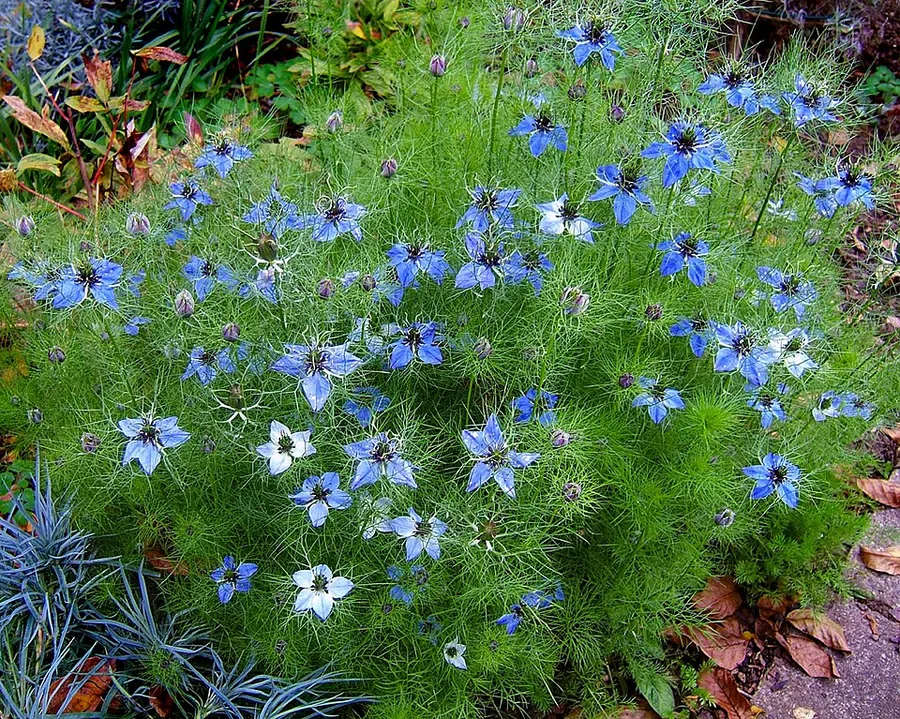
Nigella damascena is a hardy annual in the buttercup family, long valued in cottage gardens for the fine, feathery foliage that surrounds each bloom in a soft haze. Its flowers open in shades of blue, white, and pink and give way to inflated, horned seed capsules that account for much of its ornamental value. It germinates readily from seed and adapts to most ordinary garden soils.
The species is undemanding by nature. Sown at its final position and given sun, it advances from seed to flower within a couple of months. Its long taproot, however, does not tolerate disturbance, so the plant performs best when direct sown rather than raised as containerized transplants.
Its physiology is that of a cool-season grower. Flowering runs from late spring into summer, after which rising heat drives the plant into senescence and the capsules mature into papery pods. If a portion of those pods is left to split, the plant reseeds itself, re-establishing the following spring without further input.
Care
The short version: full sun and average, well-drained soil, direct sown in early spring. Maintain even moisture, feed minimally, and leave some pods to shed seed so the stand renews itself the following year.
Light
Site nigella in full sun, where it flowers most freely and develops the sturdiest habit. In part shade the internodes elongate and flowering diminishes, so exposure directly governs performance.
Water
Maintain evenly moist soil through the growing season and avoid letting it dry out completely while the plants are in active growth. Once established, the species handles ordinary garden conditions without special attention.
Soil
Average, well-drained soil suits it, whether loam, clay, or sand. It is indifferent to pH across the range 6.0 to 8.0, so most soils require no amendment before sowing.
Humidity
As an outdoor annual it requires no humidity management. Good airflow matters more, since it keeps the fine foliage dry and reduces the conditions that favor fungal problems.
Feeding
This is a light feeder adapted to average soil, so apply fertilizer sparingly if at all. Excess nitrogen promotes vegetative growth at the expense of flowering.
Pruning
Deadhead spent flowers to prolong the bloom period, or retain them to develop the horned seed pods for which the plant is grown. Retained pods also allow the self-seeding that renews the stand.
Size & spacing
Mature plants reach 18 to 30 inches (45 to 75 cm) in height with a narrow spread of 6 to 18 inches (15 to 45 cm). Thin or space them to maintain air movement between the feathery stems.
When to plant
Nigella operates on cool conditions and a compressed calendar. Sow it directly in early spring once the ground is workable, repeat the sowing at intervals into midsummer, and expect bloom from roughly June through August before heat terminates the cycle.
Northern hemisphere
Southern hemisphere
Typical months for a temperate climate: start earlier in warm zones, later where spring frosts linger.
- Sow: 6 to 8 weeks before the last spring frost in individual peat pots; transplanting is often disappointing due to a long taproot.
- Plant: Direct sow in the garden as soon as the ground can be worked in early spring; make successive sowings every 3 to 4 weeks until midsummer for continuous bloom.
- Harvest: Blooms late spring through summer (roughly June to August); each plant blooms for only a month or two and declines in summer heat.
Hardiness
USDA hardiness zones: 2–11
Temperature: down to -46°C
Troubleshooting
Nigella is a low-maintenance species with few genuine problems, and most disorders trace to its taproot or to summer heat. The early indicators below distinguish a situation that warrants action from one that reflects the plant's natural cycle.
Seedling collapse at the soil line or failure after transplanting
Two mechanisms account for most losses. The species forms a long taproot, and severing or disturbing it during transplanting checks growth, which is why lifted seedlings stall or die. Cool, waterlogged seed-starting media favor damping-off, soilborne fungi that girdle the stem at the soil line and topple the seedling. Sowing in situ or in peat pots that plant intact, in sterile media held on the dry side, addresses both.
Fix:
- Direct sow where plants are to grow, or start in individual peat pots and transplant with minimal root disturbance
- Use sterile potting media and clean containers, and avoid overwatering
Flowering ends and the plant browns as summer heat rises
This decline is physiological, not pathological. As a cool-weather annual, the species completes its flowering phase in the mild conditions of spring and early summer, then senesces once daytime temperatures climb. No intervention reverses it, since the plant has reached the end of its natural cycle. Staggered sowings maintain a supply of younger plants, while the earlier ones convert to seed pods.
Fix:
- Make successive sowings every 3 to 4 weeks so younger plants replace heat-spent ones
- Treat as a cool-season annual and enjoy the ornamental seed pods as bloom fades
A dense stand of weak volunteer seedlings the following season
Uncontrolled self-sowing drives this. The horned capsules split and shed seed in place, and the resulting crowded mats compete for light and root space, which produces thin, etiolated seedlings. Thinning restores spacing and airflow so remaining plants develop properly. Removing a share of capsules before dehiscence limits the seed load at the source.
Fix:
- Thin volunteer seedlings to allow proper spacing and airflow
- Remove some seed capsules before they shatter to limit self-seeding
Toxicity
This is a low-risk species rather than a hazardous one. The seed contains a mild alkaloid, damascenine, together with saponins, at levels sufficient that the ornamental seed should not be eaten freely and pets should not chew the capsules, though a small taste presents no cause for concern. Keep dried seed heads away from pets and small children inclined to chew them.
Toxic to
Cats · Dogs · Horses · Rabbits · Livestock · Birds · People
Cats Caution
The alkaloid and saponin content concentrates in the seed, so foliage nibbling rarely produces symptoms, whereas a cat that breaks into the capsules may drool or vomit. Storing dried pods out of reach removes the main exposure.
Dogs Caution
Ingestion of a mouthful of seeds typically produces no more than mild gastrointestinal upset, consistent with the low alkaloid concentration in the tissue. A casual taste of the plant carries negligible risk.
Horses Caution
Horses generally avoid the plant, and the trace amounts encountered in mixed pasture present little hazard. Removing it from paddocks is still prudent where a bored animal grazes flower beds indiscriminately.
Rabbits Caution
The saponins in the seed can irritate a rabbit's sensitive digestive tract, so the seed heads should not be offered as forage. A single leaf typically causes nothing worse than transient soft stool.
Livestock Caution
Goats, sheep, and cattle usually graze past it, and clinical signs arise only after an animal consumes a substantial quantity of the seed-bearing tops. Dullness or loose droppings would signal that uncommon exposure.
Birds Caution
Because the seed carries a measurable alkaloid load, it should not be deliberately fed to pet birds. Wild birds sampling a few seeds in the garden tolerate them without apparent effect.
People Caution
These are not the culinary black cumin seeds, so the ornamental seed should not be eaten freely, and a large quantity can produce gastrointestinal upset. A child who ingests a pod or two is generally fine, but dried heads are best kept out of reach.
Keep seeds and seed capsules away from pets and small children who might chew them, though significant poisoning is not well documented.
Helpline numbers

United States
ASPCA Animal Poison Control: (888) 426-4435 (fee applies)
Poison Control: (800) 222-1222



Canada
Poison Centres: 1-844-764-7669
Varieties
A handful of named selections recur in cultivation, differentiated chiefly by flower color and the size of the mature seed pods. These are the ones worth sourcing.
Miss Jekyll
The classic cottage-garden selection, bearing soft blue semi-double flowers that perform reliably as cut stems.
Miss Jekyll Alba
The proven Miss Jekyll form expressed in pure white rather than the standard blue.
Persian Jewels
A seed strain that produces double flowers spanning mauve, lavender, purple, rose, light blue, and white within a single planting.
Oxford Blue
A taller selection combining deep blue flowers with large dark seed pods valued for dried arrangements.
How to propagate
Nigella is propagated by seed alone, a straightforward method, sown directly at the intended flowering position.
SeedEasy
Direct sow in early spring as soon as soil is workable, with successive sowings every 3 to 4 weeks until midsummer. · Germinates and develops quickly; reaches flowering within roughly 2 to 3 months of sowing.
Seed is the sole means of propagation, and germination is straightforward. Sow directly at the final position, because the long taproot does not tolerate transplanting, and repeat sowings every 3 to 4 weeks from early spring through midsummer to extend the flowering window. Development is rapid: each cohort reaches bloom in roughly 2 to 3 months, sets seed, and reseeds the site for the following season.
Myths
Love-in-a-mist is the same plant as the black cumin you cook with.
The culinary spice is derived from Nigella sativa, a distinct species cultivated for its seed. Ornamental Nigella damascena is a different plant, grown for its flowers and horned capsules, and its seed is not intended for culinary use.
Love-in-a-mist transplants as easily as any bedding annual.
Its long taproot makes the species intolerant of root disturbance, so transplanted seedlings frequently check or die. Sow it straight into the garden instead, or raise it in peat pots that can be planted intact.