Ornamental · Ranunculaceae
Japanese Anemone
Anemone × hybrida
Plant it once for late-summer flowers on tall, swaying stems, and it returns with greater vigor each year.
Partial shade
Every 3–7 days
USDA 4–8
2–4 ft · 0.6–1.2 m
Overview
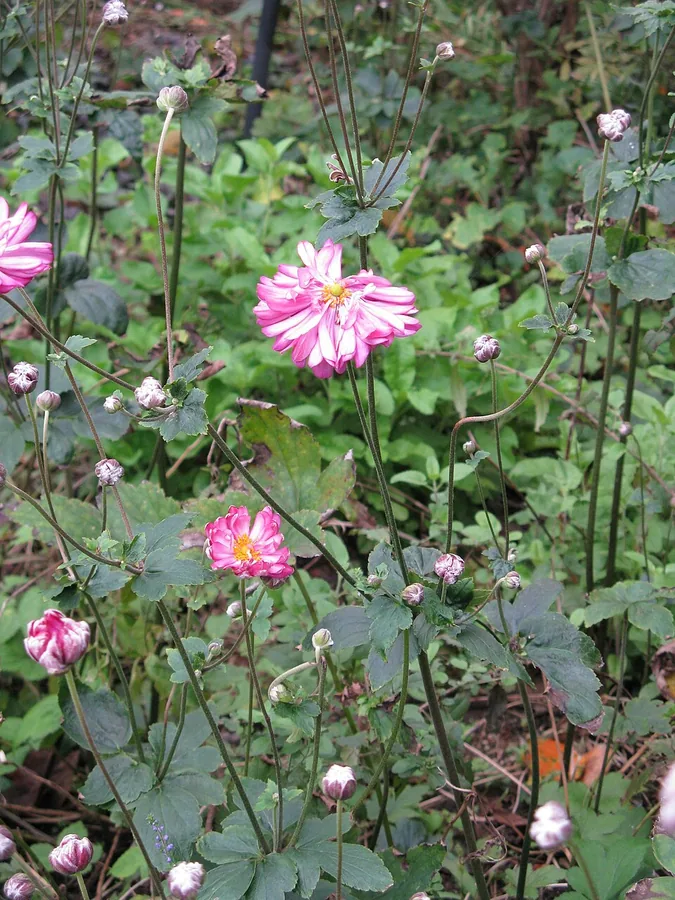
Japanese anemone comes into its own late in the season, raising soft pink and white flowers on tall, wiry stems as the surrounding border declines. A member of the buttercup family, it derives from the scrub and streamsides of central and southwestern China in spite of the common name. Because the flowers are held well clear of the foliage, they move with the least air current, and that trait gave rise to the older name windflower.
This is a perennial in which establishment governs everything. A newly set plant devotes its first year to root development and flowers little, then gains vigor and extends by fibrous suckering roots into wide, interwoven colonies. That colonizing habit suits a large shade planting and overreaches a confined one, so allocate space where it can spread.
Its requirements reduce to part shade and steady moisture. Establish it in fertile, humus-rich ground that never dries out, stake the tallest stems where the site is exposed to wind, and cut it down after frost. Meet those conditions and it sustains the border from late summer into fall.
Care
The short version: part shade, a fertile humus-rich soil held evenly moist, and patience through the first year while the root system establishes.
Light
Japanese anemone performs best in part shade, receiving morning sun with relief from the intensity of midday. It withstands full sun in cooler regions provided the soil remains moist and accepts part sun as well, but deep shade reduces flowering.
Water
Maintain the soil in a consistently moist state and never permit it to dry, particularly under summer heat. Irrigation every 3 to 7 days meets most sites, with more during drought, and a mulch layer conserves that moisture at the root zone.
Soil
Grow it in fertile, humus-rich, well-drained loam amended with ample organic matter. It favors a pH of 6.5 to 7.5, close to neutral, and waterlogged winter soil is among the few conditions that will kill it.
Humidity
Ambient garden humidity suffices, so no target figure applies. Air movement is the greater concern, since foliage that stays crowded and damp encourages the leaf diseases to which this plant is susceptible.
Feeding
Supply a balanced fertilizer across the growing season, or top-dress the crown with compost in spring. A rich, well-nourished soil sustains strong flowering with minimal further input.
Pruning
Cut spent flower stems to maintain the plant's appearance through the season. Once frost has knocked it back in late fall, cut the foliage to ground level to remove aged growth and the pathogens that overwinter within it.
Size & spacing
Mature specimens reach 2 to 4 feet (60 to 122 cm) in height and 1 to 3 feet (30 to 91 cm) in spread. Space each toward the upper limit of that range, both to promote airflow and to accommodate its continued outward creep over successive years.
When to plant
Japanese anemone flowers in fall but requires a full season of establishment beforehand. Set out container plants or divisions in spring once frost has passed, after which flowering runs from late summer into autumn and continues until the first hard frost.
Northern hemisphere
Southern hemisphere
Typical months for a temperate climate: start earlier in warm zones, later where spring frosts linger.
- Sow: Not commonly grown from seed; cultivars are propagated by division rather than sowing.
- Plant: Plant container-grown plants or divisions in spring after last frost.
- Harvest: Late summer to fall, roughly August to October until first frost.
Hardiness
USDA hardiness zones: 4–8
Temperature: down to -34°C
Troubleshooting
Japanese anemone presents few genuine problems, and most of what appears is either cosmetic or a normal consequence of slow establishment. Interpreting the early signs on leaves and stems allows intervention before a disorder advances. Match the symptom below, then act while the response is still effective.
Minimal first-year growth and bloom
In its first season the plant channels its energy into a fibrous suckering root system rather than top growth, which is why bloom stays sparse until the roots are laid down. Drought at this stage stalls that root development and prolongs the delay. Hold the soil evenly moist, mulch to buffer the crown, and leave it undisturbed, and vigor follows in the second and third seasons.
Fix:
- Keep soil consistently moist during the first growing season
- Mulch to conserve moisture and protect roots
- Be patient and avoid disturbing the developing crown
Foliar spotting, blotching, or powdery coating
Discolored or coated foliage typically indicates a fungal leaf disease such as leaf spot, downy mildew, powdery mildew, or rust, while foliar nematodes produce comparable banded discoloration. These pathogens establish where humidity is high and air is trapped among crowded stems. Remove the affected leaves, thin the clump so air can pass through, and irrigate at the base to keep the foliage dry.
Fix:
- Remove and discard affected leaves
- Improve air circulation by spacing or thinning plants
- Avoid overhead watering and water at the base
Ragged feeding holes in leaves and flowers
The bulk of this feeding damage traces to slugs, identifiable by the slime trails they deposit, with caterpillars, flea beetles, and other beetles accounting for the rest. Handpicking removes the visible offenders, and slug barriers or traps intercept the nocturnal feeders. Because these pests shelter in litter through the day, clearing debris around the plant limits their numbers.
Fix:
- Handpick slugs and caterpillars
- Use slug barriers or traps
- Remove plant debris where pests shelter
Tall flowering stems bending or lodging
The plant carries its flowers on tall, wiry stems, and wind, rain, or the soft growth of rich, shaded sites overload them until they lodge. Staking the taller cultivars ahead of flowering supports that load before the stems bend. Siting the plant in part shade with wind protection reduces the strain that causes leaning in the first place.
Fix:
- Stake or provide support for taller plants
- Site in part shade with protection from wind
Toxicity
Every part of this plant is toxic and irritant, which rules it out of any planting within reach of grazing animals or curious pets. Chewing the leaves or stems ruptures the tissue and releases protoanemonin, a compound that inflames the mouth and disturbs the stomach, while the sap can redden exposed skin. Exclude pets, livestock, and children from browsing it, and wear gloves before dividing or cutting it back.
Toxic to
Cats · Dogs · Horses · Rabbits · Livestock · Birds · People
Cats Mild
Chewing damages the tissue and liberates protoanemonin, the irritant that inflames a cat's mouth and produces drooling, vomiting, and diarrhea. Lethargy and reduced appetite commonly follow as the irritation settles.
Dogs Mild
A dog develops the same oral and gastrointestinal irritation, with drooling, vomiting, and loose stools appearing shortly after ingestion. The compound's bitter, burning taste usually limits intake before much is swallowed.
Horses Toxic
In horses the irritant sap blisters the lips and mouth and disturbs the gut, so the animal drools, refuses feed, and becomes liable to colic and diarrhea. Grazing access should be prevented.
Rabbits Toxic
The protoanemonin that affects other species renders the foliage an unsafe browse for rabbits, which should be excluded from it entirely. Ingestion leaves them drooling and refusing food.
Livestock Toxic
Cattle, goats, and sheep that graze the plant risk mouth blistering and digestive upset, though the acrid taste of the sap means they rarely consume it in quantity unaided.
Birds Toxic
The irritant principle renders every part unsafe for birds, so the plant should be kept beyond the reach of pet and backyard birds alike.
People Caution
No part of this species is intended for consumption, and chewing it irritates the mouth and the digestive tract. Skin contact with the sap can produce reddening, so gloves are warranted whenever the plant is divided or cut back.
Sap can irritate skin and cause contact dermatitis; wear gloves when handling, dividing, or cutting back plants.
Helpline numbers

United States
ASPCA Animal Poison Control: (888) 426-4435 (fee applies)
Poison Control: (800) 222-1222



Canada
Poison Centres: 1-844-764-7669
Varieties
The Japanese anemones in cultivation are largely named hybrids, distinguished mainly by flower color and form. The following selections merit knowing by name.
Honorine Jobert
An old French hybrid dating to 1858 that bears single white flowers formed from 6 to 9 overlapping petaloid sepals around a yellow eye, held on tall, wiry stems.
September Charm
A notable late-season cultivar whose silvery pink flowers are washed with deeper rose and centered on yellow stamens.
Pamina
A selection of Anemone hupehensis var. japonica valued for its deep rose, semi-double flowers.
How to propagate
Japanese anemone is propagated by division rather than from seed, which is the most reliable means of increasing a plant already in the garden.
DivisionEasy
Divide in spring as new growth emerges. · One to two growing seasons to reestablish vigor.
Divide an established clump in spring as the new growth emerges. The plant's reliance on fibrous suckering roots and rhizomes means the clumps and root fragments lift and replant readily, though each division requires one to two seasons to recover its full vigor.
Myths
Japanese anemone is a true Japanese native.
The species originates in the scrub, grassy slopes, and streamsides of central and southwestern China. Long cultivation and naturalization in Japan attached the name to the plant, yet its native range is Chinese, not Japanese.
Japanese anemone fills in fast and blooms well its first year.
A first-year plant is generally subdued, directing its resources into roots and producing few flowers while it establishes. After a season or two it becomes vigorous, expanding into broad colonies once established.