Bulb · Ranunculaceae
Poppy Anemone
Anemone coronaria
Soak the corms, supply sun and sharp drainage, and poppy anemones reward spring with jewel-toned bloom.
Full sun
Every 5–7 days
84–120 days
USDA 7–10
Overview
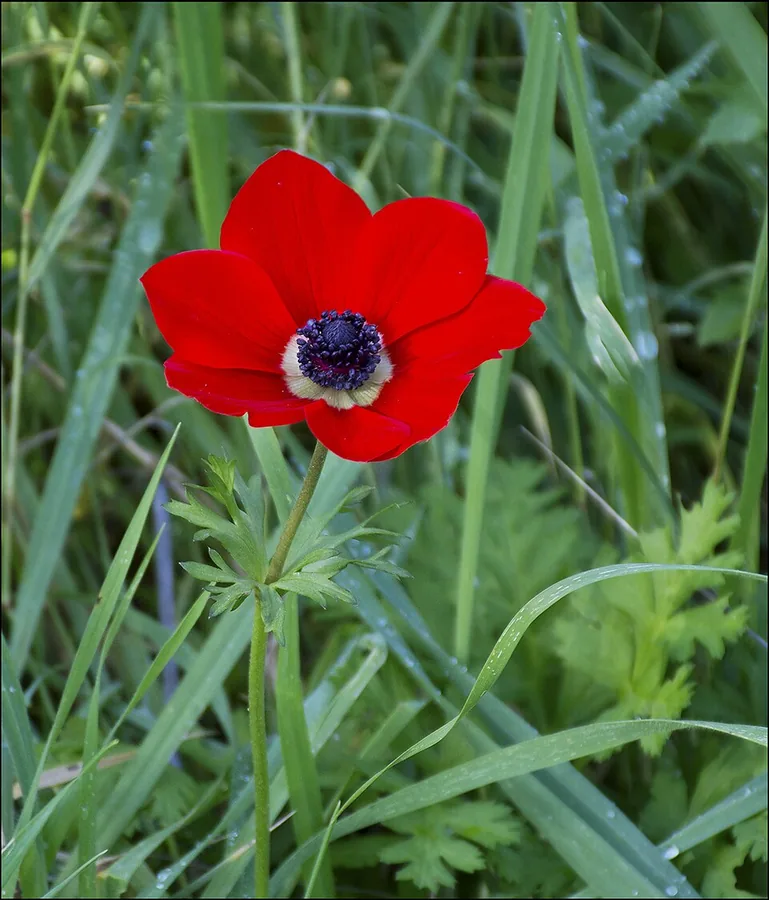
Among the most saturated colors in the spring border, poppy anemone opens cup-shaped flowers of red, blue, purple, pink, and white. It arises from small knobby corms rather than seed, and it sits in the buttercup family beside ranunculus, a placement that explains both its protoanemonin chemistry and its ferny dissected foliage. Each bloom is held on a slender scape above that ruff of leaves, the structure that makes it cut and hold so well in arrangement.
Its perennial habit is real but conditional, since hardiness runs only through zones 7 to 10, and even within that band the corms prove short-lived. Where winters fall below that range, the corm cannot persist, so growers either treat the plant as an annual or lift and store the corms. Planting time follows directly from this: fall in mild zones for early bloom, early spring where deep cold would destroy an autumn-set corm.
The plant pays back attention at planting. Soaking rehydrates the dried corm so it can break dormancy, and full sun with fast drainage supports the long flowering run from April into June. The decisive failure point is drainage, because the corm has no defense against waterlogged ground and rots when it sits wet.
Care
The short version: full sun to light shade, rich fast-draining soil, and even moisture through active growth. Soak the corms to break dormancy before planting, then withhold water as the foliage senesces so the corm can rest dry.
Light
Flowering is light-driven, so site anemones in full sun, although they tolerate partial sun or light shade. Aim for at least 6 hours of direct light daily, because insufficient light shifts the plant toward foliage at the expense of bloom.
Water
Hold the soil evenly moist through active growth from fall to spring, watering every 5 to 7 days as the surface dries. As flowers fade and the foliage dies back, taper the water and let the corm rest dry, since moisture during dormancy is the direct cause of rot.
Soil
Grow them in rich, sandy, well-drained loam amended with organic matter. The species is indifferent to pH across 6.0 to 8.0, but it has no tolerance for poor drainage, which remains the non-negotiable requirement.
Temperature
As a cool-season grower it endures a broad range, roughly 10°F to 75°F (-12°C to 24°C). It tolerates frost within its hardy band yet halts under genuine summer heat, the trigger that sends it into dormancy.
Humidity
Ambient outdoor humidity is sufficient, so no target applies. Good airflow does more for plant health than any humidity figure, reducing the leaf-surface moisture that fungal problems exploit.
Feeding
Incorporate a balanced fertilizer or compost at planting, then feed again during active spring growth. Rich, organic soil supplies most of the demand, so heavy feeding is unnecessary and offers no benefit.
Pruning
Deadhead spent flowers to keep the planting tidy and prolong bloom. After flowering, leave the foliage intact and let it yellow and senesce naturally, because that translocation of resources is how the corm recharges for the following season.
Repotting
Divide congested clumps every 2 to 3 years to maintain vigor, or grow the plant as an annual and replant fresh corms each fall or early spring. Reduced flowering and small, crowded corms are the diagnostic signs that a clump has outgrown its space.
Size & spacing
9–18 in (23–46 cm) tall
When to plant
Anemone coronaria follows a cool-season cycle, putting on vegetative growth through fall and winter and flowering in spring once warmth returns. Set corms in fall where winters stay mild, or in early spring where freezing would kill an autumn planting, and expect bloom from April into June.
Northern hemisphere
Southern hemisphere
Typical months for a temperate climate: start earlier in warm zones, later where spring frosts linger.
- Sow: Start corms in pots in fall for overwintering in a cool, frost-free space (e.g., cold frame or sunporch); set out in early spring
- Plant: Plant soaked corms 2-3 inches deep and 4-6 inches apart in fall in mild zones, or in early spring in colder zones
- Harvest: Spring bloom, April to June (or roughly 3 months after spring planting)
Hardiness
USDA hardiness zones: 7–10
Temperature: down to -18°C
Troubleshooting
The species carries few pests or diseases, so most failures are cultural and trace to water and light rather than a pathogen or insect. Reading the early signs in the corm, the flowers, or the senescing leaves lets you correct the underlying cause before it compounds. Match the symptom below, then act on its cause.
Corms turn soft and rot before they sprout
The mechanism here is anaerobic, since waterlogged soil starves the corm of oxygen and invites decay, so corm rot follows soggy ground or corms set too deep in heavy soil, and a lifted corm feels mushy or shows mold. Discard any soft tissue, amend the bed with sand and compost to restore drainage, and replant only firm corms at the correct 2 to 3 inch depth.
Fix:
- Improve drainage by amending soil with sand and organic matter
- Lift and discard rotted corms
- Replant healthy corms at the correct 2-3 inch depth in well-drained soil
Plenty of leaves but barely any flowers
Healthy foliage with no bloom points to a light or carbohydrate deficit, because flowering needs at least 6 hours of direct sun, and corms that have grown crowded and undersized lack the reserves to flower. Relocate the planting to brighter ground, divide the congested clumps to relieve competition, and feed the replanted corms in enriched soil.
Fix:
- Move or plant in a site with full sun to part shade
- Divide congested clumps and replant in enriched soil
- Feed with balanced fertilizer or compost at planting
Leaves yellow and brown off once summer arrives
Post-bloom yellowing is programmed dormancy, not pathology, the plant withdrawing photosynthate into the corm for next season. Allow the leaves to senesce undisturbed and reduce irrigation, since the only real risk is excess moisture through the rest period, which converts a normal die-back into rot.
Fix:
- Allow foliage to die back naturally and stop supplemental watering
- Reduce irrigation after flowering to give the corm a dry rest
Toxicity
Regard this as ornamental only. All tissue contains ranunculin, which converts to protoanemonin when cells are crushed or chewed, the buttercup-family irritant responsible for oral and gastrointestinal burning on ingestion and dermatitis or blistering on skin contact with fresh sap. Keep corms and cut stems away from pets, livestock, and children, and wear gloves when cutting or dividing.
Toxic to
Cats · Dogs · Horses · Rabbits · Livestock · Birds · People
Cats Mild
When a cat bites the leaves, crushed tissue releases the irritant sap into the mouth, producing drooling, pawing at the mouth, and vomiting. The reaction stays local to the mouth and gut and generally resolves without treatment.
Dogs Mild
Chewing the foliage gives a dog a sore, irritated mouth and gastric upset. Most dogs reject the bitter taste quickly, which limits the dose and keeps the reaction minor and brief.
Horses Toxic
In horses the same protoanemonin blisters the lips and mouth and triggers colic and drooling. Horses usually avoid the bitter foliage unless available grazing is sparse.
Rabbits Toxic
Anemone is unsuitable for rabbits in any amount. The irritant sap inflames the oral cavity and digestive tract, and a small body tolerates the exposure poorly.
Livestock Toxic
Grazing cattle, sheep, and goats can develop mouth blistering, drooling, and severe gastrointestinal irritation. Cases concentrate where pasture is short and animals turn to plants they would otherwise refuse.
Birds Toxic
Keep the plant and its cut stems away from pet birds, since the protoanemonin in the tissue irritates the mouth and crop. Treat it as off limits rather than accept the risk of a curious peck.
People Caution
No part of this plant is edible, and ingestion brings burning and a swollen, blistered mouth. Fresh sap can also redden and blister exposed skin, so wear gloves whenever you cut or divide it.
Wear gloves when cutting or dividing, as fresh sap can irritate skin. Keep corms and cut stems away from pets and children.
Helpline numbers

United States
ASPCA Animal Poison Control: (888) 426-4435 (fee applies)
Poison Control: (800) 222-1222



Canada
Poison Centres: 1-844-764-7669
Varieties
Garden material descends from a few established strains, with a couple of named clones worth sourcing for specific color. These are the selections you are most likely to encounter.
De Caen Group
A French-bred strain selected for cutting, producing large single poppy-like flowers across a wide color range.
St. Brigid Group
A Dutch and Irish strain bearing semi-double to double flowers that perform well as cut blooms.
Mr. Fokker
A De Caen-type clone that flowers in a single, deep violet-blue.
The Bride
A De Caen-type clone bearing pure white single flowers.
How to propagate
Three methods increase poppy anemone, and they differ sharply in speed and reliability. Corms are the fastest and easiest, division rejuvenates an aging clump, and seed is the slow option for the patient grower.
Bulbs & cormsEasy
Plant corms in fall in mild zones, or early spring in colder zones · Roughly 3 months to bloom after spring planting
Corms are the fastest and simplest route, yielding flowers in about 3 months from a spring planting. Soak the dried corms in lukewarm water for a few hours, no more than 4, to rehydrate and break dormancy, then plant them 2 to 3 inches deep and 4 to 6 inches apart in rich, well-drained soil.
DivisionModerate
Lift and divide dormant tuberous rhizomes after foliage dies back · One growing season
When a clump grows congested, wait for foliage senescence and full dormancy, then lift and split it. Dividing every 2 to 3 years relieves competition and sustains vigorous flowering, and the divisions reestablish over a single growing season.
SeedModerate
Sow fresh seed; germination can be slow and erratic · Often more than one season to reach flowering size
Seed is the slow and least reliable method, since germination is slow and erratic even from fresh seed, and the seedlings need more than one season to reach flowering size, which is why corms remain the standard choice.
Myths
Anemone flowers are safe to plant around pets and children.
The record contradicts this, because every part of the plant is poisonous. The tissue holds protoanemonin, which burns and irritates the mouth and gut on ingestion and can inflame or blister skin where fresh sap contacts it, so the plant belongs well away from pets and small children.
Poppy anemones live for years as reliable perennials everywhere.
Hardiness is limited to zones 7 to 10, and even within that band the corms are short-lived rather than durable. Many growers therefore treat them as annuals, lifting or replanting the corms each season, and outside that range the corm simply does not survive winter.