Shrub · Ranunculaceae
Clematis
Clematis
Set its head in sun and its feet in shade, and clematis builds a climbing wall of bloom.
Full sun
Every 5–7 days
USDA 4–9
8–12 ft · 2.4–3.7 m
Overview
Clematis is well named the queen of the climbers. A member of the buttercup family, Ranunculaceae, it spans everything from vigorous wild species to the large-flowered hybrids that hang saucer-sized blooms over a trellis or arbor. Throughout USDA zones 4 to 9 it persists as a hardy perennial vine, coming back each year.
Bloom timing varies by type and follows a long arc. A great many open in late spring to early summer, then return for a second display in late summer to early fall. The vine climbs by coiling its leaf stalks around slender supports, which is why it needs wires, netting, or a thin frame to grip rather than a solid post it cannot wrap.
Clematis asks for patience over fussing. Plant it deep, hold its roots cool and moist while the canopy takes full sun, and prune to suit its bloom group. Manage those few points and a young vine establishes itself for decades of bloom.
Care
The short version: full sun on the canopy with cool, shaded, evenly moist roots underneath, rich well-drained soil, and pruning timed to the plant's bloom group.
Light
Clematis blooms most freely in full sun, ideally 6 or more hours daily, while still tolerating partial sun or light shade. The classic rule earns its keep: head in the sun, feet in the shade, because hot, exposed roots suppress flowering.
Water
Supply at least 1 inch (2.5 cm) of water a week, more during dry stretches, and never allow the root zone to bake. A heavy mulch holds that moisture and keeps the roots cool while the canopy sits in sun. Even moisture on a rhythm of every 5 to 7 days sustains strong growth.
Soil
Set it in rich, fertile, well-drained loam, though clematis copes with clay or sandy ground once amended. It accepts a broad span from 6.0 to 8.0, so most garden soils serve well after compost is worked in.
Temperature
Clematis is genuinely cold-hardy, weathering winters to -29°F (-34°C) and summers to 95°F (35°C). That hardiness is exactly why it persists as a perennial across zones 4 to 9.
Humidity
Standard outdoor humidity suits it, so there is no target to meet. Air movement is the factor that counts, because still, crowded growth opens the door to powdery mildew and stem rot.
Feeding
Apply a balanced fertilizer in spring as growth resumes, then across the season. Stop while it is in flower, and keep nitrogen modest, since excess nitrogen drives the soft growth that wilt readily attacks.
Pruning
Prune to the bloom group, because cutting the wrong type at the wrong moment forfeits flowers. Group 1 old-wood bloomers need only a light trim straight after flowering, Group 2 large-flowered hybrids get a light prune down to the topmost plump buds in late winter, and Group 3 new-wood types are cut hard to 2 to 3 feet in late winter.
Repotting
Clematis seldom needs repotting and resents disturbance to its roots. Shift it only when roots circle or escape the pot, growth stalls, or the soil drains far too fast.
Size & spacing
A mature vine reaches 8 to 12 feet (2.4 to 3.7 m) in height and spreads 2 to 6 feet (61 to 183 cm) across. Allow that footprint and a support to twine through, so air can circulate around the leaves.
When to plant
Set clematis out in spring or early fall, when the soil works easily and conditions stay mild. Plant it deep, the crown an inch or two below the surface, so the roots establish ahead of summer heat or winter cold. The first flowers come in late spring to early summer, frequently followed by a second flush later on.
Northern hemisphere
Southern hemisphere
Typical months for a temperate climate: start earlier in warm zones, later where spring frosts linger.
- Plant: spring or early fall
- Harvest: late spring to early summer, often reblooming in late summer to early fall
Hardiness
USDA hardiness zones: 4–9
Temperature: down to -34°C
Troubleshooting
Nearly all clematis problems surface on the stems and leaves, from a shoot that folds overnight to a powdery film across the foliage. Spotting them early lets you remove the trouble before it advances. Find the match below, then treat while treatment still pays off.
A single shoot crumples and turns black as the buds open
When one shoot drops abruptly and darkens while the surrounding growth stays green, you are looking at clematis wilt, a fungal stem rot that times its strike to the flush of bud and flower formation. Inspect the lower stem near the soil line, where the telling dark lesions develop. The mechanism is a blocked, rotting stem, so the cure is removal: cut each diseased stem back to clean tissue or below the crown, sterilize the blades between cuts to avoid spreading spores, and keep up the watering. Because a plant set with its crown a couple inches deep holds dormant buds underground, it usually pushes fresh shoots the next season.
Fix:
- Cut out and destroy all affected stems back to healthy tissue or below soil level
- Disinfect pruners between cuts
- Keep the plant watered; plants set with the crown a couple inches deep usually resprout from below ground the following season
Torn holes in fresh shoots, with telltale slime trails
Chewed young growth and ragged holes on a recently planted vine point first to slugs and snails, which give themselves away with the silvery slime trails left as they feed. With no trails present, go out after dark to look for earwigs sheltering in the blooms and crevices. Iron phosphate bait scattered around young plants breaks the slug cycle, clearing debris removes the damp hiding spots they need, and rolled cardboard traps catch earwigs. Keep this up until the shoots toughen and become less appealing.
Fix:
- Apply iron phosphate slug bait around young plants
- Remove hiding places and garden debris
- Trap earwigs with rolled cardboard or shallow traps
A chalky white film over leaves that have curled and stayed small
A powdery white layer across the top of the leaf, alongside stunted and warped foliage, is the signature of powdery mildew, a fungus that establishes wherever air sits still and growth is crowded. To separate it from ordinary dust, wipe a leaf: the fungal coating adheres and the leaf itself is deformed. Pull the infected foliage, open up the vine to move air through it, and stop wetting the leaves, since the spores germinate in humid stagnant conditions. A labeled fungicide applied at the first sign holds back a spreading case.
Fix:
- Remove affected leaves
- Improve airflow by thinning and proper spacing
- Avoid overhead watering
- Apply a labeled fungicide early in infection if needed
Tender shoots turned sticky and packed with small soft insects
Massed soft-bodied insects, green or dark, on the shoot tips, together with sticky honeydew and possibly sooty mold or attending ants, tell you aphids are tapping the sap of the new growth they prefer. Turn over the young leaves to verify. A light colony washes away under a plain water spray, while a building one calls for insecticidal soap every 5 to 7 days for about 3 rounds, which works by contact and so needs repeating. Reserve a systemic insecticide for the heavy, entrenched infestations that resist the soap.
Fix:
- Spray with insecticidal soap, repeating every 5 to 7 days for about 3 applications
- Hose off light infestations with water
- Use a systemic insecticide only for heavy, persistent infestations
Toxicity
Clematis is neither edible nor a plant to keep within reach of pets. Every part contains protoanemonin, an irritant generated when leaves or stems are chewed or crushed, and the ASPCA classifies the vine as toxic to cats, dogs, and horses. The bitter flavor stops most animals from eating much, but the sap can still sting skin and mouths, so handle it deliberately.
Toxic to
Cats · Dogs · Horses · Rabbits · Livestock · Birds · People
Cats Mild
Once a cat chews the leaves or stems, the released irritant brings drooling, vomiting, and diarrhea along with a sore, inflamed mouth. That same sharp, bitter flavor tends to stop the cat before the dose climbs high enough to cause real harm.
Dogs Mild
A dog that mouths the foliage typically drools, gags, and ends up with a queasy stomach and an irritated mouth. The acrid taste discourages most from swallowing much, which is why serious poisoning rarely follows.
Horses Mild
A horse that grazes the vine may salivate heavily, refuse its feed, and show oral blistering with colicky discomfort. Given any decent forage alongside it, horses generally pass over the bitter foliage.
Rabbits Caution
The protoanemonin that bothers cats and dogs will inflame a rabbit's mouth and digestive tract just the same, so treat the vine as off-limits and fence it away from runs and hutches.
Livestock Caution
Cattle, goats, and sheep risk mouth and gut irritation from browsing clematis, although the acrid flavor turns most away unless the pasture thins out. Site the vine well beyond the reach of grazing stock.
Birds Caution
Because the sap is an irritant, clematis is a poor neighbor for pet birds and poultry, so keep inquisitive beaks off the foliage and stems.
People Caution
None of the plant is edible, and the sap can redden and blister skin or sting the mouth where it touches. Glove up before pruning and wash thoroughly after, and keep young children from chewing the leaves.
Sap can irritate skin; wear gloves when pruning and wash hands afterward.
Helpline numbers

United States
ASPCA Animal Poison Control: (888) 426-4435 (fee applies)
Poison Control: (800) 222-1222



Canada
Poison Centres: 1-844-764-7669
Varieties
Clematis numbers in the hundreds of species and cultivars, yet a handful appear in gardens over and over. These are the ones worth recognizing by name, together with the bloom group each belongs to.
Jackmanii
A classic hybrid prized for its large, deep velvety-purple flowers, it flowers on new wood as a Group 3 plant and so accepts the hard cutback each late winter.
Nelly Moser
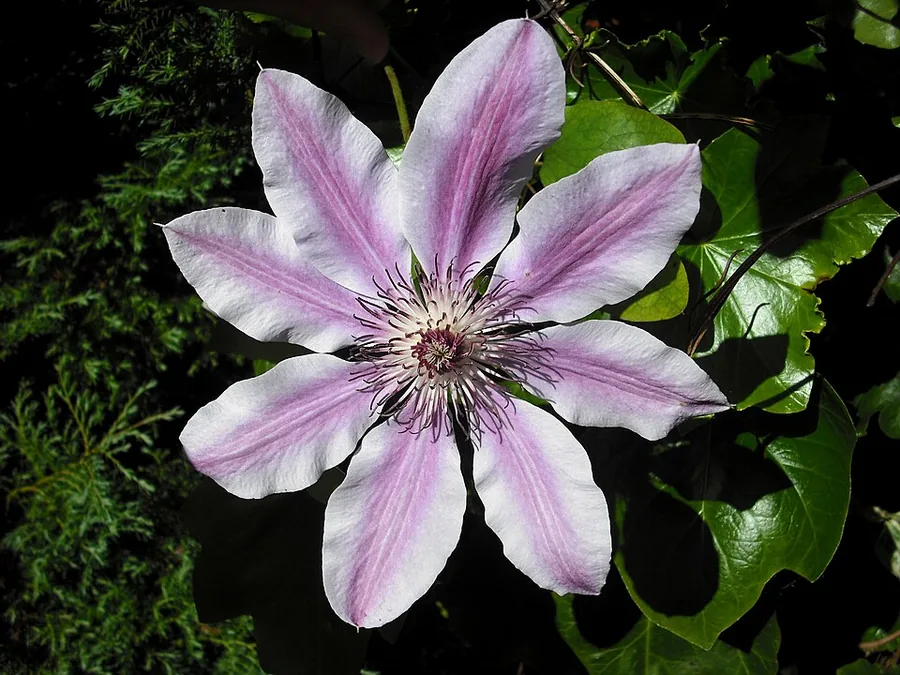
This Group 2 large-flowered hybrid bears pale pink petals each striped with a deeper carmine bar; because strong sun bleaches that coloring, position it where it gets some shade.
Henryi
A vigorous Group 2 large-flowered hybrid that produces big creamy-white blooms accented by dark anthers.
Sweet autumn clematis (Clematis terniflora)
Late in the season it covers itself in small fragrant white flowers, but its aggressive self-seeding has made it invasive across parts of the eastern US, so it is not a recommended garden choice.
Clematis montana
A vigorous early species that opens masses of small spring flowers, this Group 1 type needs only a light trim, and only once flowering has finished.
How to propagate
Clematis multiplies slowly but reliably, and the simplest methods clone a plant you already grow rather than raising it from seed.
LayeringEasy
Spring to summer · A few months to a year
Layering is the surest way to increase clematis. Anytime from spring through summer, pin a low, supple stem down against the soil and let it root at the point of contact, then separate the rooted plant once it has anchored itself over the next few months to a year.
Stem cuttingsModerate
Late spring to early summer · Several weeks to months
Between late spring and early summer, harvest semi-ripe internodal cuttings from the current season's growth. Rooting runs from several weeks to a few months, and the method demands more attention than layering does.
DivisionModerate
Early spring · A season
In early spring, lift and split an established crown, handling it gently since clematis dislikes heavy root disturbance. Allow each division a full season to root in and find its footing before you expect strong growth.
Myths
Clematis is harmless to pets because it is just a flowering garden vine.
As a buttercup-family member it holds protoanemonin, an irritant the ASPCA classes as toxic to cats, dogs, and horses. Chewing the plant can trigger drooling, vomiting, diarrhea, and a sore mouth. The bitter taste usually limits how much an animal eats, yet that does not make the vine harmless.
All clematis should be pruned hard every late winter.
The correct cut depends entirely on the bloom group. Group 1 flowers on old wood and asks only for a light trim after blooming, the Group 2 large-flowered hybrids get a light prune, and only the new-wood Group 3 takes the hard cutback. Cut an old-wood type to the ground and you remove that year's flowers.