Shrub · Ranunculaceae
Sweet Autumn Clematis
Clematis terniflora
A late-summer curtain of fragrant white bloom on a vigorous vine whose reseeding demands disciplined management.
Full sun
Every 5–10 days
USDA 4–9
15–30 ft · 4.6–9.1 m
Overview
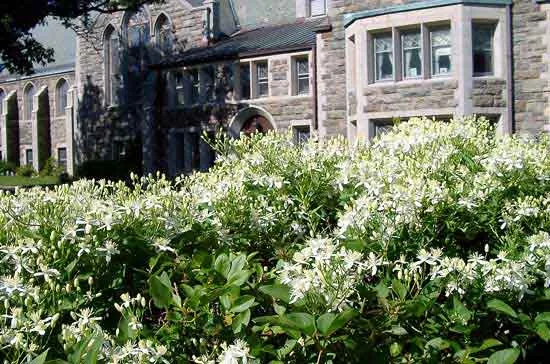
Clematis terniflora is a fast twining vine in the buttercup family, native to East Asia, that flowers on the current season's growth. Its cross-shaped white flowers open in profusion from August into September, a late window that gives it garden value once earlier bloomers finish. Given a support, it climbs 15 to 30 feet (4.5 to 9 m) within a season, the froth of bloom dense enough to obscure the foliage beneath.
Its cultural requirements are modest, which explains both its garden ease and its ecological problem. It performs best with the crown in full sun and the root zone kept cool and shaded, in ordinary well-drained soil, and it withstands winter lows near -29°F (-34°C). That same broad tolerance lets it self-seed prolifically and naturalize; across the eastern and central US it has escaped cultivation and displaced native vegetation, prompting invasive listings in many states.
Responsible cultivation hinges on interrupting the seed cycle. Removing spent flowers before seed matures, and siting the vine away from woodland edges, keeps it ornamental rather than invasive. Where that management is impractical, the native Clematis virginiana delivers comparable fragrance and white bloom without the naturalizing tendency.
Care
The short version: site it in full sun with the roots shaded and mulched, provide average well-drained soil and even moisture, prune it hard in late winter because it flowers on new wood, and deadhead before seed set to contain its spread.
Light
Flowering is heaviest in full sun, though the vine still blooms in partial shade. The familiar clematis principle applies for physiological reasons: the shoots want direct sun while the roots perform best kept cool, so shade the root zone with mulch or a low companion at the base.
Water
Maintain average, even moisture, roughly every 5 to 10 days during establishment. Once the root system develops the plant becomes notably drought-tolerant, but a cool, mulched root run sustains the best condition.
Soil
Almost any well-drained medium serves, whether loam, clay, or sand, since drainage matters more than texture. A pH from 5.5 to 7.5 is acceptable, so soil chemistry rarely limits performance.
Temperature
This is a cold-hardy species, tolerant of winter lows to -29°F (-34°C) and summer highs to 100°F (38°C). That thermal breadth is a principal reason for its wide adaptability and its capacity to naturalize.
Humidity
Ambient outdoor humidity is sufficient, so no target level applies. The relevant variable is air movement, because stagnant, humid air late in the season predisposes the foliage to mildew.
Feeding
A single application of balanced general-purpose fertilizer in spring meets its needs. The plant is already vigorous, so additional feeding offers no benefit and can encourage excess growth.
Pruning
Since bloom is borne on new wood, cut the entire vine back to about 1 foot (30 cm) in late winter or early spring before growth resumes. Equally important, deadhead spent flowers before seed set, which is the primary lever for limiting its heavy self-sowing.
Repotting
As a ground-grown vine it seldom requires potting on. In a container, repot only when roots circle the pot, water passes straight through, or growth slows, all indications of a rootbound plant.
Size & spacing
Allow for substantial dimensions, 15 to 30 feet (4.5 to 9 m) in both height and spread, and provide a correspondingly strong structure. Spacing plants for free air movement also reduces the late-season mildew this vigor invites.
When to plant
Because flowering occurs on new wood, the seasonal calendar is organized around a hard late-winter renewal cut. Plants go in during spring or fall, the whole vine is reduced to roughly a foot in late winter, and the resulting new shoots carry bloom from August into September. Deadheading before the seed ripens is what prevents the volunteer seedlings that otherwise follow for years.
Northern hemisphere
Southern hemisphere
Typical months for a temperate climate: start earlier in warm zones, later where spring frosts linger.
- Plant: spring or fall
- Harvest: August to September
Hardiness
USDA hardiness zones: 4–9
Temperature: down to -34°C
Troubleshooting
The disorders that affect this vine mostly stem from its vigor rather than any weakness. Anticipate prolific reseeding, occasional sudden stem collapse, and late-season foliar fungi. Identify the sign below, then intervene early, since each is easier to correct before it advances.
Volunteer seedlings across the bed and vines overrunning adjacent plants
This is the expression of its invasive habit. Following bloom the vine produces abundant plumed, wind-dispersed seed that germinates well beyond the planting, and its rapid twining growth overtops neighboring vegetation. The controls are mechanical: remove spent flowers before the seed heads mature, extract volunteer seedlings while young, and avoid siting near woodland. Where naturalizing is a concern, substitute the native Clematis virginiana.
Fix:
- Deadhead and remove seed heads before seeds mature and disperse
- Pull or dig out seedlings and unwanted runners promptly
- Cut back hard and bag spent flowering/seeding growth
- Do not plant near woodlands or natural areas; consider the native Clematis virginiana instead
Sudden wilt, blackening, and collapse of an individual stem
The likely agent is clematis wilt, a fungal infection that kills a stem from the top down while the root system remains viable. Mechanical injury to a stem or drought stress at the base can produce an identical collapse. Cut affected growth to healthy tissue or to ground level, dispose of the prunings, and keep the roots cool and mulched so the crown regenerates. This species is comparatively wilt-resistant relative to large-flowered clematis.
Fix:
- Cut affected stems back to healthy tissue or to ground level
- Remove and dispose of infected material
- Keep roots cool, moist and mulched to support regrowth from the base
Powdery white film or discrete spotting on the foliage
Late in the season the leaves may develop powdery mildew or leaf spot, both favored by stagnant air around congested growth. Correct the microclimate: thin and space the vine to restore air movement, remove the most affected leaves, and irrigate at the base rather than overhead. A full-sun position with reliable airflow discourages recurrence.
Fix:
- Improve air circulation by thinning and proper spacing
- Remove badly affected foliage
- Avoid overhead watering
Toxicity
Regard the entire plant as unsafe to ingest and irritating to handle. All tissues contain ranunculin, which is enzymatically converted to the irritant protoanemonin when a leaf or stem is chewed or crushed, and the ASPCA lists clematis as toxic to cats, dogs, and horses. The bitter, acrid taste generally limits intake, so serious poisoning is uncommon, yet the sap remains capable of blistering skin, so gloves are warranted during pruning.
Toxic to
Cats · Dogs · Horses · Rabbits · Livestock · Birds · People
Cats Mild
A cat that chews the leaves or stems responds with salivation, pawing at the mouth, and frequently vomiting or loose stools, all consistent with protoanemonin irritation. The pronounced bitter taste typically curtails intake before a harmful dose is consumed.
Dogs Mild
In dogs, gnawing the vine produces oral pain, drooling, and gastrointestinal upset with vomiting or diarrhea. Most reject it quickly once the acrid sap contacts the mouth, which limits exposure.
Horses Mild
A grazing horse develops salivation and a raw, irritated mouth, and the irritant can provoke colic-like abdominal discomfort with loose manure. The bitterness generally deters more than a cursory bite.
Rabbits Mild
The protoanemonin that irritates cats and dogs likewise inflames a rabbit's mouth and digestive tract, so exclude both the vine and its trimmings from reach. Offer only forage of known safety.
Livestock Mild
Cattle, goats, and sheep that browse the plant experience oral irritation and digestive disturbance, though the acrid sap ordinarily restricts consumption to a taste.
Birds Caution
Documentation of avian ingestion is scant, yet the irritant sap justifies keeping poultry and pet birds away from the foliage and fresh prunings.
People Caution
No part of the plant is edible, and contact with the sap can blister exposed skin. Wear gloves when pruning, wash afterward, and prevent children from chewing the stems.
Sap can irritate skin; wear gloves when pruning and wash hands after handling.
Helpline numbers

United States
ASPCA Animal Poison Control: (888) 426-4435 (fee applies)
Poison Control: (800) 222-1222



Canada
Poison Centres: 1-844-764-7669
Varieties
This vine offers no named garden cultivars to compare, only a persistent set of nomenclatural confusions worth resolving. Two points clarify what is actually being sold.
Clematis terniflora (species)
The introduced species bears compound leaves whose leaflets have entire, untoothed margins, and that smooth margin is the most reliable field character separating it from the toothed-margined native Clematis virginiana.
'Clematis paniculata' (name confusion)
In the trade it is frequently offered under the erroneous names C. paniculata, C. maximowicziana, or C. dioscoreifolia, although the legitimate C. paniculata is a distinct species native to New Zealand.
How to propagate
Given how readily this vine reproduces from seed, the practical objective is to increase it without dispersing further seedlings. Vegetative methods, cuttings and layering, reproduce a plant cleanly, whereas seed is best restrained.
SeedEasy
After seed ripens in fall · 1-2 seasons
Because the vine already self-sows to excess, deliberate seed propagation is rarely justified. Should seed be allowed to ripen in fall, a resulting plant requires roughly 1 to 2 seasons to establish, but restraining seed production remains the sounder practice.
Stem cuttingsModerate
Late spring to summer · 1-2 seasons
Cuttings are the clean means of increase, avoiding the dispersal that seed invites. Take softwood or semi-ripe stems from late spring through summer, after which a rooted cutting needs about 1 to 2 seasons to develop into a full plant.
LayeringEasy
Spring to summer · 1 season
Layering is the least demanding method, exploiting the stems' natural tendency to root wherever they contact soil. Pin a stem to the ground in spring or summer, and it commonly establishes within a single season.
Myths
Sweet autumn clematis is the same plant as the native virgin's bower.
The two are distinct species with a superficial resemblance. The native Clematis virginiana bears toothed leaflet margins and remains well-behaved, whereas the introduced Clematis terniflora bears entire margins and reseeds heavily enough to dominate. For the fragrance without the ecological cost, plant the native virgin's bower.