Tree · Salicaceae
Weeping Willow
Salix babylonica
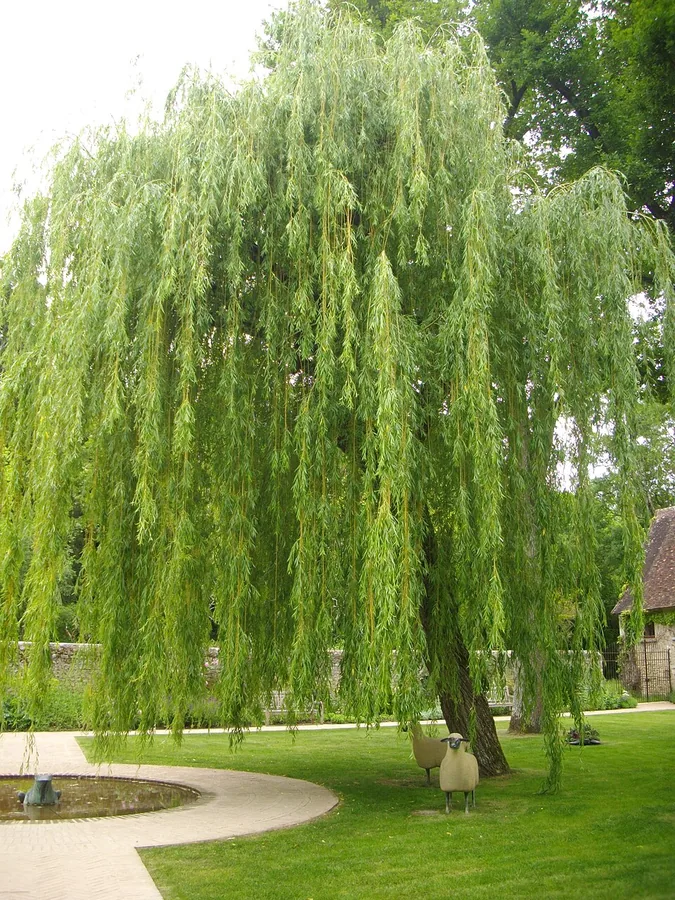
Sited by water with room to spread, the weeping willow drops its long branches to sweep the ground.
Full sun
Every 3–7 days
USDA 6–8
30–50 ft · 9.1–15.2 m
Overview
The weeping willow reads as water's own tree. Its long, pliant branches hang nearly to the ground and respond to the least air movement, which explains its natural association with pond and stream margins. It sits within the Salicaceae, and though named Salix babylonica, its origin traces to China rather than the ancient Near East.
Growth is fast by any measure, the tree reaching 30 to 50 feet (9 to 15 m) in both height and spread within a few seasons. That vigor has structural consequences. The wood is low in density and therefore brittle, and the root system is shallow and strongly water-seeking, so the tree demands open ground clear of drains, paving, and foundations.
Under full sun and reliably moist soil, establishment is nearly effortless. The cost is maintenance, since rapid growth produces abundant litter, storm breakage, and a comparatively short lifespan for so large a tree. Placed where root run and moisture are ample, few trees rival its pendulous, sweeping habit.
Care
The short version: give it full sun and consistently moist soil near water, allow generous room clear of pipes and pavement, and prune the brittle wood in late winter to limit storm breakage.
Light
Weeping willow performs best in full sun and tolerates partial shade. Greater light drives a denser, healthier canopy, and it also accelerates leaf drying after rain or dew, which suppresses the fungal infections that establish on persistently wet foliage.
Water
This is a wetland-adapted tree with a clear preference for consistently moist to wet soil. It thrives beside ponds and streams and withstands standing water and occasional flooding, conditions most trees cannot. Short drought is tolerated, but without irrigation in a prolonged dry spell it sheds leaves to reduce water loss.
Soil
Soil adaptability is broad. The tree grows in clay, loam, or sand and across acidic to alkaline ground, and unlike most species it tolerates poor drainage and saturated sites, a direct reflection of its riparian origins.
Temperature
Cold and heat hardiness is wide, the tree holding from -9°F to 100°F (-23°C to 38°C). That range accommodates most temperate gardens through both severe winters and hot summers.
Humidity
Ambient outdoor humidity is sufficient, so no target figure applies. Air movement matters more, because a stagnant, congested canopy holds leaf moisture and favors the foliar pathogens the tree is prone to.
Feeding
A balanced general-purpose tree fertilizer in early spring meets the needs of a young tree. Once established on a moist site, the tree rarely requires feeding, since ample soil moisture already sustains rapid growth.
Pruning
Prune in late winter to early spring before bud break, removing dead, weak, and storm-damaged wood. Because the low-density wood fails under ice and snow loads, reducing weak, narrow crotches now preempts more serious structural breakage later.
Repotting
This is a field-grown landscape tree rather than a container subject, so repotting does not apply. When planting nursery stock, establish it before roots circle within the pot or begin to lift and girdle at the trunk base.
Size & spacing
Allow for a large tree attaining 30 to 50 feet (9 to 15 m) in height and an equal spread. Provide the full 30 to 50 feet (9 to 15 m) of clearance so the extensive root run and pendulous crown remain well away from structures and pipes.
When to plant
Plant weeping willow in spring or fall, once the soil is workable and severe cold has passed, giving the roots a full growing season to establish. The catkins emerge early, in April and May, opening with or slightly ahead of the foliage as bud dormancy breaks.
Northern hemisphere
Southern hemisphere
Typical months for a temperate climate: start earlier in warm zones, later where spring frosts linger.
- Plant: Spring or fall, after the ground is workable
- Harvest: Catkins appear in early spring (April to May), before or with the leaves
Hardiness
USDA hardiness zones: 6–8
Temperature: down to -23°C
Troubleshooting
Willow disorders concentrate on the foliage, the current-season shoots, and the structurally weak limbs, and a tree growing this quickly can carry a developing problem some distance before symptoms are obvious. Reading the early signs below and intervening promptly limits the spread. Identify the symptom, then respond.
Woody crown galls accompanying tree decline
Tumor-like galls at the crown and roots identify crown gall, a bacterial infection for which no cure exists once it is established. In poorly aerated, saturated soil the roots may additionally rot and darken. Remove and destroy a severely galled tree, correct drainage where rot is implicated, and avoid any wounding of the roots or lower trunk, since injuries are the infection court.
Fix:
- Remove and destroy severely galled plants
- Avoid wounding roots and crown during cultivation
- Improve drainage where root rot is suspected
Blighted spring shoots with scabby foliar lesions
The concurrent infection of willow scab and black canker on one tree constitutes willow blight, which blackens and kills current-season shoots rapidly. Excise and burn the blighted, cankered wood, remove all fallen leaves that harbor inoculum, and thin the canopy to lower humidity around the foliage. A labeled fungicide is justified only in severe seasons and only in support of sanitation.
Fix:
- Prune out and destroy blighted and cankered shoots
- Rake and remove fallen infected leaves
- Improve air circulation and avoid overhead wetting
- Apply a labeled fungicide in severe cases following extension guidance
Honeydew-slicked, curled leaves or sawdust at the trunk
Curled foliage under a sticky honeydew film indicates sap-feeding aphids or scale, whereas sawdust and entry holes on the trunk indicate borers. Dislodge aphids with water or apply horticultural oil to scale, and sustain vigor through adequate moisture, since a stressed tree is far more susceptible to borer attack. Remove and destroy any wood the borers have already colonized.
Fix:
- Hose off or treat aphids; horticultural oil for scale
- Maintain vigor with adequate water to limit borer attack
- Remove and destroy borer-infested branches
- Use labeled insecticides only when infestations are severe
Limb failure at narrow crotches under load
The wood is inherently brittle, and limbs fail at narrow, poorly attached crotches whenever ice, snow, or wind loads them. Remove broken and weak limbs promptly, and reduce overextended branches to lessen the leverage a storm can apply. Structural pruning during the juvenile years develops stronger attachments that resist failure for years.
Fix:
- Prune out broken and weak limbs promptly
- Reduce overextended branches to lessen storm loading
- Remove deadwood regularly
Toxicity
For households with animals, weeping willow presents no toxic concern, as it does not appear on the ASPCA toxic lists. The foliage and twigs are safe for cats, dogs, horses, rabbits, livestock, and birds, and rabbits take willow readily as browse. The single caveat is that the bark contains salicylates, the natural precursor of aspirin, and should not be consumed in quantity.
Safe for
People · Cats · Dogs · Horses · Rabbits · Livestock · Birds
Cats None
A small quantity of willow foliage will not poison a cat. As with any novel plant material, an unaccustomed digestive tract may register transient upset, so redirect a persistent chewer to more appropriate forage.
Dogs None
Weeping willow is non-toxic to dogs, and an inquisitive mouthful of leaves causes no real harm. Limit sustained bark consumption, however, since bark carries the salicylates that underlie aspirin.
Horses None
Horses browse willow without adverse effect, and the foliage has a long record of being regarded as harmless to equines.
Rabbits Safe
Willow leaves and twigs constitute a well-established safe browse for rabbits and are frequently supplied as a gnawing material.
Livestock Safe
Cattle, goats, and sheep graze willow without ill effect, and the foliage presents no poisoning risk to a grazing herd.
Birds Safe
Birds nest and forage in willows freely, and neither the foliage nor the catkins pose any hazard to them.
People Safe
Weeping willow is not a poisonous tree, so the foliage poses no danger to people. The relevant caveat is that the bark carries salicylates, the natural source of aspirin, and should not be eaten in any quantity.
No special toxicity handling required; as with any plant, discourage pets from chewing large quantities of foliage or bark.
Varieties
Several named selections are distinguished by the form or color of their growth, and the following are the ones worth recognizing.
Tortuosa (Corkscrew / Contorted Willow, Dragon's Claw Willow)
Its branches, shoots, and foliage develop a pronounced spiral or corkscrew, most evident on current growth and most striking once the tree defoliates for winter.
Golden Weeping Willow (Salix × sepulcralis 'Chrysocoma')
A vigorous hybrid distinguished by bright golden-yellow pendulous branches that stand out against the bare winter landscape.
Aurea
A selection valued for the warm golden coloration of its young stems.
How to propagate
Willow ranks among the most readily propagated of trees, and a single parent will yield numerous young plants from cuttings or from a branch layered into the soil.
Stem cuttingsEasy
Late winter to early spring (hardwood) or summer (softwood) · Several weeks to root; rapid establishment thereafter
Few trees root as readily as willow, a consequence of the abundant rooting compounds in its tissue. Hardwood cuttings taken in late winter to early spring, or softwood cuttings in summer, root within a few weeks, and even an unrooted length inserted into moist soil will strike before establishing rapidly. This is the conventional method of increase.
LayeringEasy
Spring to summer · One season
A low branch layers itself with little intervention. Held against moist soil from spring through summer, it forms roots at the point of contact and yields an independent plant within a single season.
Myths
The weeping willow is poisonous to dogs and cats and must be kept from pets.
Willows are absent from the ASPCA toxic-plant lists, and the closely related purpleosier willow is listed as non-toxic to dogs, cats, and horses. The real liabilities are the aggressive root system and brittle wood, not toxicity. The bark does contain salicylates, the natural aspirin precursor, so it should not be ingested in quantity.
The weeping willow is a durable, long-lived shade tree suited to a small yard.
Its rapid growth is paired with a short life and continual maintenance. The wood is brittle and the roots forage aggressively for water, penetrating drains and sewers and heaving pavement, which disqualifies the tree from confined or built-up sites.