Tree · Rosaceae
Weeping Cherry
Prunus subhirtella
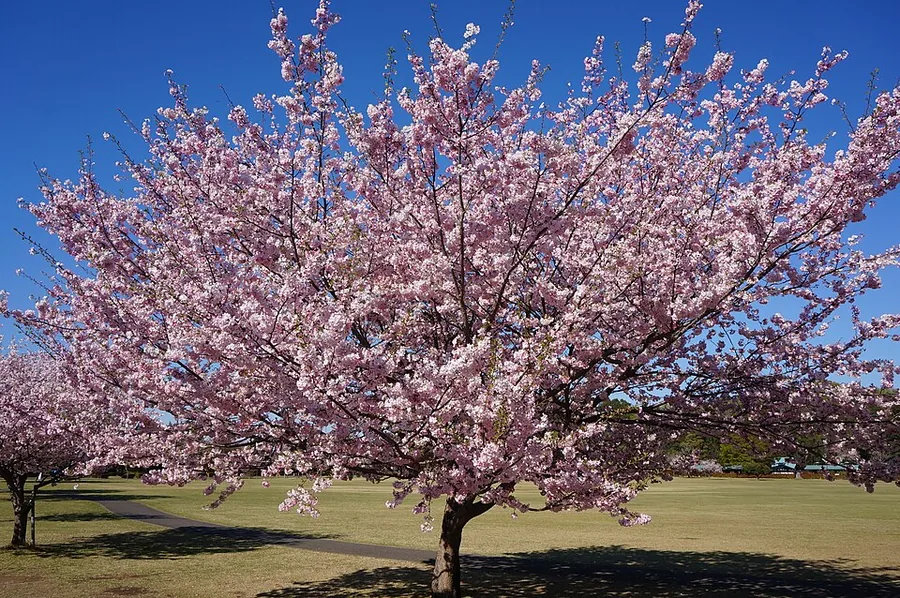
Grafted for form and grown for the moment, the weeping cherry drapes light pink to white blossom across the garden each April.
Full sun
Every 5–10 days
USDA 4–8
15–40 ft · 4.6–12.2 m
Overview
The weeping cherry is Prunus subhirtella, a small member of the rose family whose long branches rise from a grafted standard and arc back toward the ground. Its flowering biology drives the display: in early spring the light pink to white flowers open before the foliage emerges, so nothing masks the bloom on the trailing stems. The species descends from the Japanese Higan cherry, cultivated there for centuries.
Because the pendulous habit does not come true from seed, what reaches the market is nearly always a graft. Nurseries join a weeping scion to the top of an upright standard rootstock, commonly at 4 to 6 feet, which is why the branches cascade from that fixed height. That graft explains a key management point: any shoot arising below the union carries rootstock genetics and grows upright, so it must be removed to preserve the form.
Vigor is high, and given space the tree reaches 15 to 40 feet (4.6 to 12 m) with a comparable spread. It is broadly cold-hardy and undemanding once its root system is established. As a Prunus, though, its foliage accumulates cyanogenic glycosides, which makes siting relative to grazing animals a genuine horticultural consideration.
Care
The short version: full sun, moist well-drained soil, and consistent moisture through establishment. A single early-spring feeding, a light post-bloom pruning, and removal of below-graft suckers cover the essentials.
Light
Site it in full sun to maximize flower bud initiation and bloom density; partial shade is tolerated but reduces the display. The relationship is direct, since greater irradiance across the canopy translates into a heavier spring bloom.
Water
Maintain the soil moist and well drained, watering on roughly a 5 to 10 day interval while the tree is young or during drought, because a developing root system cannot yet buffer dry spells. An established specimen tolerates some dryness, but saturated ground restricts oxygen to the roots and should be avoided.
Soil
It performs best in moist, fertile, well-drained loam yet adapts readily to clay or sand, reflecting a wide edaphic tolerance. A soil pH between 5.5 to 7.5 keeps nutrients available, and that band spans most garden soils.
Temperature
Cold hardiness is substantial, spanning roughly -20°F to 100°F (-29°C to 38°C). The winter chilling supplied by a temperate climate satisfies the dormancy requirement that governs reliable spring flowering.
Humidity
Ambient outdoor humidity is sufficient, so no target applies. The more consequential factor is airflow through the canopy, since stagnant, humid conditions on crowded branches favor the leaf and bark pathogens to which cherries are susceptible.
Feeding
One application meets its needs. Supply a balanced slow-release tree fertilizer in early spring as growth resumes; excess nitrogen only stimulates soft, succulent tissue that is more readily colonized by pests and canker organisms.
Pruning
Prune immediately after flowering, removing dead, damaged, or crossing wood and refining the weeping outline. Suckers below the graft union must go, and large cuts are best avoided because sizable wounds create infection courts for borers and canker.
Repotting
Container culture does not suit this tree; treat it as a permanent in-ground planting. Establish it in its final position with allowance for the full spread, since it is not intended to be lifted and moved.
Size & spacing
A mature specimen attains 15 to 40 feet (4.6 to 12 m) in height with a spread of 15 to 25 feet (4.6 to 7.6 m). Allocate that footprint from planting, clear of structures and neighboring trees, because rapid growth quickly makes later relocation impractical.
When to plant
This tree operates on the cool phase of the season, and its timing follows its dormancy. Establish it while dormant in early spring or fall, expect flowering ahead of leaf-out in early to mid spring, and confine pruning to the window just after bloom so cuts heal into active growth.
Northern hemisphere
Southern hemisphere
Typical months for a temperate climate: start earlier in warm zones, later where spring frosts linger.
- Plant: Early spring or fall while dormant
- Harvest: Early to mid spring (light pink to white flowers before leaves)
Hardiness
USDA hardiness zones: 4–8
Temperature: down to -34°C
Troubleshooting
The recurring problems concentrate in the woody tissue rather than the flowers, because the bark and cambium are where the main pathogens and borers gain entry. Detecting a canker or a black knot gall early allows excision before the fungus advances through the vascular system. Match the sign below, then intervene while the surrounding wood remains sound.
Wilting shoot tips above sunken, exuding trunk cankers
The pattern indicates canker and dieback, in which fungi colonize through bark wounds and occlude the vascular tissue of entire limbs, frequently compounded by borers mining beneath the bark. Excise the cankered wood well below the lesion in dry weather and disinfect tools between cuts to prevent transfer. Sustained vigor from adequate water, combined with wound-free bark, remains the primary defense.
Fix:
- Prune out cankered wood well below the lesion during dry weather
- Sterilize tools between cuts
- Improve vigor with proper watering and avoid bark wounds
Rigid black galls encircling twigs and branches
The coal-black, corky swellings are black knot, caused by a fungus that colonizes twig tissue and is most conspicuous once the canopy is bare in winter. Excise each knot 10 to 15 cm below the gall in late winter and destroy the prunings, since the pathogen survives in the removed wood. Eliminating nearby wild cherry removes the reservoir that reinoculates the tree.
Fix:
- Prune out knots 10-15 cm below the gall in late winter
- Destroy or remove pruned material
- Repeat inspections annually
Foliage that is spotted, sticky, or skeletonized
Several agents converge on the leaves. Aphids and scale excrete honeydew and distort the foliage, Japanese beetles remove tissue between the veins, and leaf spot or leaf curl fungi produce discrete lesions. Dislodge or treat the sap-feeders with horticultural oil, hand-remove the beetles, and collect fallen leaves to break the fungal carryover between seasons.
Fix:
- Hose off or treat aphids/scale with horticultural oil or insecticidal soap
- Handpick Japanese beetles
- Rake and destroy fallen diseased leaves
Toxicity
The ornamental value carries a real toxicological caveat. As in every cherry, the leaves, twigs, bark, and seed pits contain cyanogenic glycosides that hydrolyze to release cyanide, and the concentration is functionally highest in wilted foliage. Keep prunings and fallen leaves away from horses and livestock, and prevent pets and children from chewing the twigs or pits.
Toxic to
Cats · Dogs · Horses · Rabbits · Livestock · Birds · People
Cats Mild
A cat that ingests wilted leaves, twigs, or a seed pit may present with brick-red mucous membranes, dilated pupils, and labored, panting respiration. Such cases are uncommon, but the rapid action of cyanide means any respiratory distress warrants emergency care.
Dogs Mild
A dog chewing bark, twigs, or fallen seeds can show salivation, respiratory effort, reddened gums, and pupillary dilation. The event is infrequent, yet an animal that has broken into the pits requires prompt veterinary assessment.
Horses Severe
Horses are at substantial risk. A quantity of wilted prunings placed within reach can produce staggering, gasping respiration, bright red membranes, and convulsions, with death possible within minutes of onset.
Rabbits Toxic
The same cyanogenic constituents render the leaves, twigs, and bark unsafe for rabbits. Exclude cuttings and prunings from their enclosure, since even a small intake of wilted foliage can precipitate weakness and respiratory distress.
Livestock Severe
Cattle, sheep, and goats are the classic subjects of wilted-leaf cyanide poisoning. Within 15 to 20 minutes of consuming fallen or pruned leaves they may salivate, breathe rapidly, display bright red membranes, and convulse, frequently with fatal outcome.
Birds Toxic
Cyanide within the foliage, bark, and seed pits is likewise hazardous to birds, so poultry and pet birds should be kept from prunings and cracked pits.
People Caution
This is an ornamental species, not a food plant. Its pits, leaves, twigs, and bark hold cyanogenic glycosides, so none should be consumed, and children should be prevented from chewing the seeds or foliage.
Keep pruned branches and fallen leaves away from horses and livestock, since wilting raises cyanide. Prevent pets from chewing twigs, bark, wilted leaves, or seeds.
Helpline numbers

United States
ASPCA Animal Poison Control: (888) 426-4435 (fee applies)
Poison Control: (800) 222-1222



Canada
Poison Centres: 1-844-764-7669
Varieties
The named weeping cherries diverge mainly in flower color, in whether the corolla is single or double, and in mature stature. The following cultivars are the ones most worth distinguishing.
'Pendula'
The classic pendulous form bears single light-pink flowers along long cascading branches worked onto a 4 to 6 foot standard.
'Pendula Plena Rosea'
This weeping selection replaces the single flowers with fuller, fully double pink blooms.
'Snofozam' (Snow Fountains)
A dwarf weeping cultivar, it presents white flowers on a low cascading framework suited to restricted spaces.
'Autumnalis'
It produces semi-double pink flowers in two flushes, one in fall and a second in early spring.
Yoshino cherry (Prunus × yedoensis)
A related flowering cherry of upright, spreading habit rather than pendulous, carrying white to pale-pink blooms.
How to propagate
Propagation is a specialist undertaking, driven by the fact that the pendulous form depends on grafting onto a tall standard. That structural requirement is why commercial nurseries produce almost all stock and why home-raised cuttings seldom reproduce the habit.
GraftingDemanding
Late winter to early spring (bench graft) or summer (budding) · 1-2 years to a saleable grafted tree
Grafting accounts for virtually all weeping cherry production. Propagators bench-graft in late winter or bud in summer, uniting the weeping scion with an upright standard rootstock, often Prunus avium, at 4 to 6 feet so the branches originate at that height. A saleable tree takes 1 to 2 years to develop, and the technical demands of the operation keep it largely outside the reach of home gardeners.
Stem cuttingsDemanding
Early summer (softwood) · Several weeks to root, 1-2 years to establish
Softwood cuttings taken in early summer can be rooted, though with low success, requiring several weeks to strike and 1 to 2 years to establish. The functional limitation is structural: a rooted cutting lacks the elevated standard, so it never expresses the raised cascading habit that grafting confers, which is why the method remains marginal.
Myths
Weeping cherries arise from seed or cuttings and grow upright like a typical tree.
The pendulous architecture originates from a scion grafted onto an upright standard rootstock, not from seed. Any sucker emerging below the graft union expresses the rootstock and grows straight, so removing it preserves the intended form.
Only the flowers and fruit pose a hazard to animals.
The petals are not the principal concern. The cyanogenic compounds are concentrated in the leaves, twigs, bark, and seeds, and their toxicity peaks in wilted foliage, the form most dangerous to grazing animals.