Ornamental · Nymphaeaceae
Water Lily
Nymphaea
A true aquatic, the water lily flowers from late spring to fall wherever it gets full sun and undisturbed water.
Full sun
USDA 3–11
3–10 in · 8–25 cm
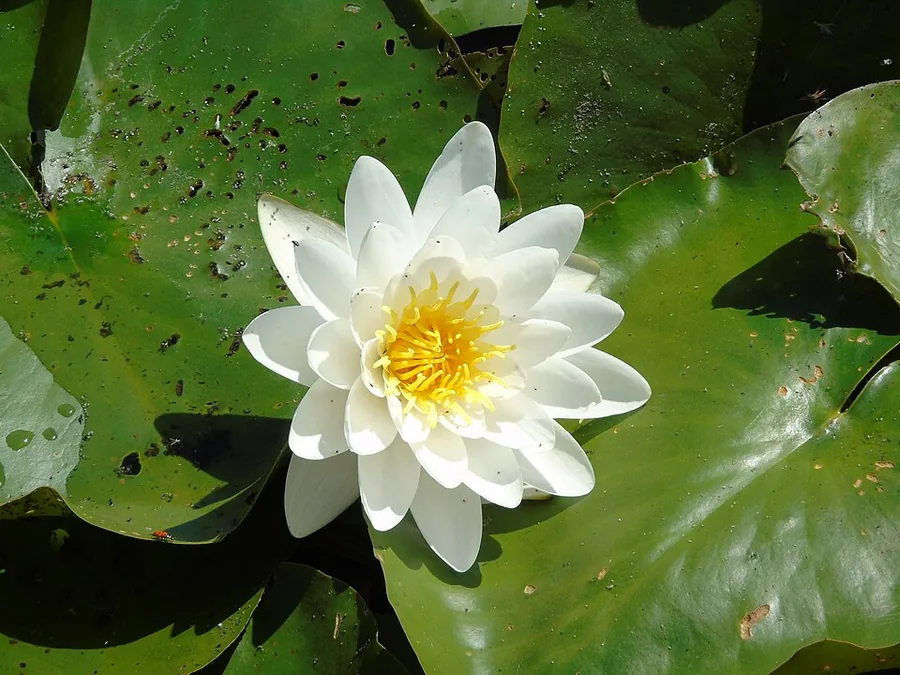
Overview
The water lily (Nymphaea) is an obligate aquatic: its crown roots in a submerged pot of heavy soil while the pads and cupped flowers develop at the water surface where they meet the light. The common name misleads, because it belongs to Nymphaeaceae and not to the true lilies, a distinction that carries real weight for cat owners.
Two broad groups serve different climates. The hardy lilies persist through zones 3 to 11 because the crown, held below the ice, escapes the freeze that would kill exposed tissue. The tropical lilies offer blues, purples, and night-opening flowers the hardy group cannot, but their tender crowns fail where the water freezes, so growers in cold regions treat them as annuals.
Its two demands follow from its biology: strong light to fuel bloom, and the still water it evolved in. A bright, calm site drives broad pad cover and months of flower, whereas shade starves bud formation and moving water disturbs the plant, both of which shift the balance toward leaf and away from flower.
Care
The short version: full sun and still water drive flowering, with the crown set in heavy soil under about 6 to 18 inches of water so the pads reach the surface. Feed monthly through the growing season to meet its heavy demand, and divide every few years before crowding suppresses bloom.
Light
Flowering is light-driven, so the plant needs at least 6 hours of direct sun daily, and full sun yields the heaviest bloom. In partial shade it survives but diverts its resources into foliage, leaving far fewer flowers.
Water
As a true aquatic, it holds its crown in a submerged pot while the pads float on standing water above. Maintain roughly 6 to 18 inches (15 to 46 cm) over the crown according to cultivar vigor, and keep the surface still, because fountains and pumps disturb a plant adapted to calm conditions.
Soil
Anchor the crown in heavy clay loam or aquatic media within a submerged container, capped with gravel that keeps the mix from clouding the water. The plant tolerates a wide pH of 6.0 to 8.0, so soil texture and weight matter more to establishment than acidity.
Temperature
Hardy types endure a broad span, roughly -40°F to 100°F (-40°C to 38°C), provided the crown overwinters below the ice line where liquid water buffers it from lethal freezing. Plant the pot deep enough that the crown never freezes solid.
Humidity
Growing on open water places the plant in high humidity at all times, so ambient moisture is never a limiting factor and requires no intervention.
Feeding
Water lilies are heavy feeders, and container culture in inert media leaves little native fertility. Insert an aquatic fertilizer tablet below the gravel about monthly through spring and summer, since sustained nutrition is what separates sparse bloom from a continuous one.
Pruning
Removing spent flowers and yellowing pads serves two ends: it redirects energy into repeat bloom and prevents decaying tissue from loading the water with nutrients. Deadhead through the season as the pads age.
Repotting
The plant is divided rather than potted on, because vigor declines as the rhizome fills its container. Lift and split it every few years when flowering falls, pads push above the water, or rhizomes pack the pot, all signs the clump has outgrown its root run.
Size & spacing
Vertical growth is minimal, only 3 to 10 inches (8 to 25 cm) above the surface, while horizontal spread runs 2 to 12 feet (61 cm to 3.7 m) by cultivar. Select a lily whose spread matches the pond so pad cover does not exceed the surface area and shade the water below.
When to plant
Bloom tracks water temperature rather than day length, so the plant breaks dormancy as the pond warms. Set the rhizomes into submerged pots in spring once frost has passed and the water is warming, and flowering follows across the surface from late spring through fall.
Northern hemisphere
Southern hemisphere
Typical months for a temperate climate: start earlier in warm zones, later where spring frosts linger.
- Plant: Set rhizomes or tubers in submerged containers in spring once water has warmed and frost danger has passed.
- Harvest: Late spring through fall (flowers rest on or just above the water).
Hardiness
USDA hardiness zones: 3–11
Temperature: down to -40°C
Troubleshooting
Most failures reduce to three controllable variables, insufficient light, excessive crown depth, and crowding, with a small pest complex accounting for the rest. The early signs below let you identify the limiting factor and correct it before flowering collapses. Read the symptom, then address the cause behind it.
Abundant foliage but few or no flowers
The dominant cause is inadequate light, below the roughly 6 hours of direct sun required for bud initiation. Excess depth over the crown, a container-bound clump, and fountain-driven water movement each suppress bloom by similar logic, diverting the plant away from flowering. Return it to full sun and still water, reset the crown to the correct depth, divide a crowded rhizome, and feed through the season.
Fix:
- Move the container so the plant gets at least 6 hours of direct sun
- Raise the container so the crown sits at the recommended depth for the cultivar
- Lift and divide the rhizome every few years
- Relocate away from fountains or pump outflow so the plant sits in still water
- Fertilize with aquatic plant tablets during the growing season
Colonies of soft insects on pads and buds
The insects are waterlily aphids, soft-bodied colonists of the upper pad surface and the buds. Displacing them into the water strands them, since they cannot reascend, and pond fish frequently consume them, so a firm spray or a brushing usually suffices. Remove any pad too heavily colonized to recover.
Fix:
- Hose or brush the aphids off the pads into the water, where they cannot climb back and fish may eat them
- Remove and discard heavily infested pads
Yellowing pads or foliage perforated by feeding
Uniform yellowing on older pads reflects normal senescence and needs no action. Perforations and ragged margins indicate waterlily beetle, leaf-mining midges, or china-mark moth, whereas discrete spots or soft brown lesions suggest leaf spot or crown rot. Excise the affected pads, remove beetles and larvae by hand or into the water, and supply a fertilizer tablet where deficiency is indicated.
Fix:
- Remove and discard yellow, spotted, or chewed pads
- Pick off beetles and larvae or knock them into the water
- Fertilize with aquatic plant tablets if a deficiency is suspected
Toxicity
For households with cats, the reassurance rests on taxonomy: Nymphaea is not a true lily and so poses none of the kidney danger that real lilies and daylilies do to cats. It does not appear on the ASPCA toxic list, and cats, dogs, and the wider household face no risk from it.
Safe for
People · Cats · Dogs · Horses · Rabbits · Livestock · Birds
Cats None
Safe for cats. As a member of Nymphaeaceae rather than a true lily, it lacks the kidney toxicity that renders Lilium and daylilies so dangerous to them.
Dogs None
No hazard to dogs. A dog that wades in and mouths a floating pad ingests nothing harmful.
Horses Safe
Not recorded as toxic to horses, and its aquatic habit keeps it outside their normal grazing range.
Rabbits Safe
Regarded as safe for rabbits, containing no compounds known to affect them.
Livestock Safe
Cattle, goats, and sheep may graze at the pond margin without exposure to any toxin in the leaves or flowers.
Birds Safe
Non-toxic to birds and waterfowl, which forage on the pads and seeds in natural settings.
People Safe
Presents no toxicity to people, children included, even when the floating flowers are handled at the water surface.
Grown in an outdoor pond, so casual contact by pets or children is uncommon; no special handling required.
Varieties
The genus runs to hundreds of selections, divided between hardy lilies that overwinter in place and tender tropicals bred for stronger color. The following are the cultivars and groups worth knowing.
'Attraction'
A hardy cultivar for zones 3 to 8 valued for its fragrant red flowers, and among the most extensively planted selections in cultivation.
'Marliacea Chromatella'
Hardy through zones 4 to 10, it carries canary-yellow cupped flowers above copper-mottled pads and blooms continuously from May until frost.
'Director George T. Moore'
A tropical day-blooming selection that presents violet-blue flowers above the water surface, cultivated as an annual wherever winters are severe.
Tropical day- and night-blooming water lilies
Tender Nymphaea suited to zones 9 to 11, or grown as annuals, contributing blue and purple pigmentation and night-opening habits absent from the hardy lilies.
Lotus (Nelumbo)
Taxonomically distinct from water lily, this is a separate genus in its own family whose leaves and flowers stand well above the water rather than resting on it.
How to propagate
Vegetative division is the practical route to more plants, and it dominates for a sound reason: it reproduces the parent exactly, which seed usually cannot.
DivisionEasy
Spring · One growing season
Spring division is the standard and least demanding method of increase. Lift the rhizome, section it so each division retains a growing point, and replant the pieces horizontally with the bud oriented upward in a submerged container of heavy soil. A division establishes within a single growing season, which is why the clump should be lifted and split every few years as crowding begins to depress flowering.
SeedModerate
Spring to summer · One or more seasons
Seed applies mainly to the wild species and requires a season or more to develop, sown across spring and summer. It has little practical value in the garden, because most named cultivars are sterile hybrids that will not reproduce true and are more reliably increased by division.
Myths
The water lily is a true lily and therefore as lethal to cats as the lilies that cause kidney failure.
Taxonomy settles this: Nymphaea belongs to Nymphaeaceae, not to the genus of true lilies, and sits outside the toxic group entirely. The agents of sudden, frequently fatal feline kidney failure are the true lilies (Lilium) and daylilies (Hemerocallis), which are unrelated to it. A pond water lily presents no comparable hazard, and it is absent from the ASPCA toxic list. Exclude genuine lilies and daylilies from cats, but do not conflate them with this aquatic species.