Ornamental · Araceae
Water Lettuce
Pistia stratiotes
A free-floating aroid rosette that doubles quickly in warm, nutrient-rich water, and one that belongs nowhere near a wild pond or stream.
Full sun
59–86°F · 15–30°C
USDA 9–11
3–6 in · 8–15 cm
Overview
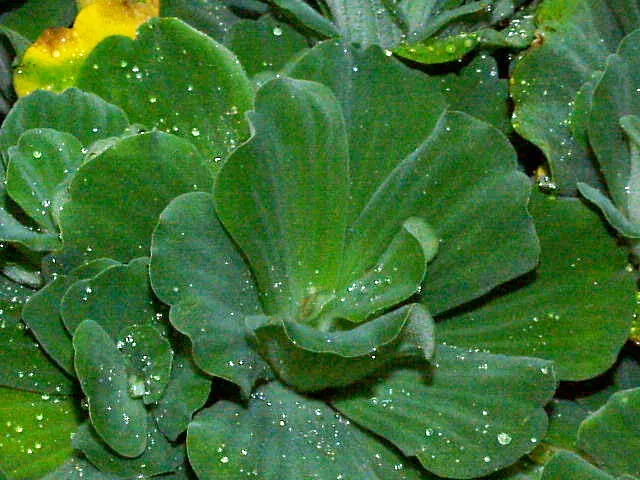
Water lettuce is a free-floating member of the arum family that rests on the surface as a ribbed, pale blue-green rosette. Because it anchors in no soil at all, it takes its nutrients straight from the water column, and its feathery submerged roots hang free to absorb them. Warm, still, nutrient-rich water under full sun supplies both the light and the dissolved nutrients it needs, which is why it colonizes a surface so quickly.
That efficiency is precisely the problem. Across the warm southern states the species has established as a serious invasive aquatic weed, and many states prohibit it outright. In open water it accumulates into a thick mat that intercepts light and blocks gas exchange, so the plants and fish beneath decline and the waterway clogs. For that reason it belongs only in a contained feature, isolated from any drain, stream, or pond outlet.
Care
The short version: float it on warm, still water in full sun, maintain the level and the nutrient supply, thin the daughter rosettes by hand, and never allow a fragment to reach natural water.
Light
Full sun drives the strongest growth, because photosynthesis sets the pace for an aquatic plant that already has unlimited water and nutrients, and partial sun or light shade is tolerated but slower. A rosette in strong light closes over the surface quickly, so frequent thinning matters more than any attempt to push it.
Water
The plant lives on the water and never in soil, so float the rosette on still or slow-moving water and let the feathery roots hang free to absorb nutrients below. Keep the level topped up, because a stranded rosette loses access to the water it feeds from. Warm, calm, nutrient-rich water in full sun gives the best results.
Soil
There is no rooting medium; the plant floats free and draws everything from the water. Hold the water within a 6.0 to 7.5 pH range, the neutral-to-slightly-acidic band it favors, and nutrient uptake proceeds normally.
Temperature
Growth tracks warmth, and the species does best between about 59°F to 86°F (15°C to 30°C). It carries no cold hardiness, so a frost or a spell of near-freezing water ruptures the tissue and the rosettes collapse to mush.
Humidity
Sitting at the air-water interface keeps it in high humidity as a matter of course. There is no figure to manage, because the open water surrounding it saturates the immediate air on its own.
Feeding
No fertilizer is warranted. The plant absorbs nutrients directly from the water column and grows fastest in rich, even polluted water, where added nutrients trigger explosive growth, so supplemental feeding only compounds the containment problem.
Pruning
Pruning here is population control. Thin and remove the surplus daughter rosettes by hand, rake, or net through the season to check the spread, and compost the removed material on dry land, never back in or near the water where fragments would re-establish.
Repotting
not applicable - free-floating, never potted
Size & spacing
Each rosette remains compact at 3 to 6 inches (8 to 15 cm) tall and 6 to 18 inches (15 to 46 cm) across, but the rosettes interlock edge to edge into a continuous mat. Leave open water between clusters and remove the excess, or the surface seals over.
When to plant
The species is tender and frost-killed, so it performs only as a warm-season plant. Introduce it in late spring once frost has passed and the water has warmed enough to drive growth. It grows and floats through the summer heat, then declines as temperatures fall at the season's end.
Northern hemisphere
Southern hemisphere
Typical months for a temperate climate: start earlier in warm zones, later where spring frosts linger.
- Plant: After all danger of frost has passed and water has warmed in late spring; the plant is tender and killed by frost, so in cold-winter areas it is grown as a warm-season annual.
- Harvest: Tiny, inconspicuous pale flowers hidden in the leaf center, summer to early winter (rarely noticed)
Hardiness
USDA hardiness zones: 9–11
Temperature: down to -7°C
Troubleshooting
Nearly every complaint traces back to vigor and containment rather than disease. The signs below describe a plant growing beyond its bounds, not a failing one. Recognize them early, because control is far easier before a mat establishes.
A floating mat spreading across the whole surface
Water lettuce reproduces vegetatively through daughter rosettes on stolons and also sets copious seed, so a few plants can blanket a pond within one warm season, and warm, sunny, nutrient-rich water accelerates the process. Remove the plants by rake or net repeatedly through the season, since a single pass rarely holds, and compost everything on dry land so no fragment returns to the water.
Fix:
- Physically remove plants by raking, seining, or netting them from the surface
- Remove repeatedly through the season to keep the mat from re-forming
- Dispose of all removed material by composting on dry land, well away from any water
- If using herbicide on large infestations, treat in sections to avoid oxygen crash from decaying plants killing fish
Dark, stagnant water with declining plants and fish below
A dense mat intercepts light from the submerged natives and seals the surface against gas exchange, so dissolved oxygen falls below the threshold fish require, and the decomposing biomass consumes still more oxygen while releasing nutrients. Clear the mat mechanically as early as possible, stage the removal so a mass die-off does not crash the oxygen further, and report any wild infestation to the state aquatic invasive species authority.
Fix:
- Remove the mat mechanically as early and completely as possible
- Stage removal or chemical treatment to avoid a sudden oxygen crash from mass plant die-off
- Report infestations of natural water bodies to state aquatic invasive species authorities
It may be illegal to own or move where you live
Many states classify Pistia stratiotes as a prohibited noxious aquatic weed, which makes sale, possession, and transport unlawful, among them Florida, Texas, California, Alabama, South Carolina, Connecticut, North Carolina, and Wisconsin. Verify your state's regulatory status before acquiring the plant; where it is prohibited, do not obtain it, destroy any existing stock by composting on dry land, and never move plants or fragments between water bodies or across state lines.
Fix:
- Confirm your state's regulatory status before obtaining or growing the plant
- If it is prohibited in your state, do not acquire it and remove and destroy any existing plants by composting on dry land
- Never transport plants or fragments between water bodies or across state lines
Rosettes collapse and rot after a cold snap
The species is tender and frost-sensitive, so freezing temperatures rupture the foliage and it browns and turns to mush. In cold-winter regions treat it as a warm-season annual and restart each spring, or, where legal, overwinter a few plants indoors in a bright, frost-free tub of warm water.
Fix:
- Treat as a warm-season annual in cold-winter regions
- Where legal, overwinter a few plants indoors in a bright, frost-free tub of warm water
Toxicity
The common name misleads: this is not an edible green. The foliage holds insoluble calcium oxalate raphides, needle-like crystals that mechanically irritate the mouth and gut, so a pet, grazing animal, or child that bites a leaf suffers a mild but genuine burn. The greater hazard, though, is ecological, since this banned invasive must never enter open water.
Toxic to
Cats · Dogs · Horses · Rabbits · Livestock · Birds · People
Cats Mild
A cat that chews the foliage takes in insoluble calcium oxalate crystals, whose needle-like form drives the irritation, so drooling, pawing at the mouth, and occasional vomiting follow. The reaction is generally mild and resolves once the plant is removed.
Dogs Mild
A dog biting the leaves encounters the same mechanical burning in the mouth and throat, with drooling and gastric upset possible but seldom serious. Most dogs are deterred by the bitter taste after a single attempt.
Horses Mild
Horses generally reject the gritty rosettes, and the oxalate crystals render a mouthful unpalatable rather than dangerous. A horse that does graze some may exhibit oral irritation or mild drooling, so exclude the plant from paddock water regardless.
Rabbits Mild
The crystals irritate a rabbit's oral tissues, so the foliage is not a suitable green to offer. A nibble can produce drooling or a brief loss of appetite, so omit it and rely on rabbit-safe forage.
Livestock Mild
Cattle, goats, and sheep typically avoid it, and the bitter, oxalate-laden foliage discourages more than an exploratory taste. An animal that does consume some may drool or go off feed temporarily, so fence stock away from infested water as a precaution.
Birds Mild
Pet and backyard birds sustain the same oral irritation when they peck the foliage. The effect is mild, but the plant is not one to leave where birds forage, so provide species-appropriate feed instead.
People Mild
Despite the name it is no salad green. Chewing the leaves produces burning and swelling in the mouth from the oxalate crystals, and the sap can leave skin or eyes itchy, so wash after handling and keep it away from small children.
Wash hands after handling and keep plants and trimmings away from pets and small children; sap and crushed leaves can irritate skin, mouth, and eyes.
Helpline numbers

United States
ASPCA Animal Poison Control: (888) 426-4435 (fee applies)
Poison Control: (800) 222-1222



Canada
Poison Centres: 1-844-764-7669
Varieties
In practice there is a single species to know, alongside a floating look-alike that is easily confused with it. Both share the same invasive tendency, so distinguishing them before purchase matters.
Pistia stratiotes (species)
The species itself is the form encountered, a velvety, ribbed, pale blue-green rosette trailing feathery roots, and the dwarf ornamental selections offered in trade retain the identical invasive habit and legal restrictions.
Water hyacinth (Pontederia / Eichhornia crassipes) - look-alike, not a variety
Frequently sold alongside water lettuce and mistaken for it, water hyacinth is a distinct floating species set apart by glossy rounded leaves on inflated bulb-like petioles and showy lavender flowers, and it is an equally notorious mat-forming, regulated weed.
How to propagate
The plant is almost self-propagating, which is the root of its invasiveness. It reproduces by two routes, and both proceed far faster than is desirable in any pond plant.
Offsets & pupsEasy
Warm growing season (late spring through summer) · Days to a few weeks
Through the warm months from late spring into summer the plant generates daughter rosettes on stolons, and a detached pup roots and establishes independently within days to a few weeks. That same effortless vegetative spread is the mechanism behind its invasiveness, so propagate it only where legal and hold every plant well clear of natural water.
SeedModerate
Warm season; seed germinates in warm water (above about 68 degrees F) · Weeks
It also produces copious water-dispersed seed that germinates in warm water above about 68°F (20°C) and takes a few weeks to establish. Because those seeds drift, they found new infestations well away from the parent, which is a principal reason the species is so difficult to eradicate once released.
Myths
Water lettuce is a harmless, pretty floating plant you can drop into any pond.
The record shows otherwise: it is a banned or regulated noxious aquatic weed in many states, including Florida, Texas, and California. Left in open water it multiplies into dense mats that smother light and oxygen, kill native plants and fish, and choke waterways. Keep it out of natural water entirely, and compost what you remove on dry land.