Bulb · Araceae
Calla Lily
Zantedeschia aethiopica
Supplied with rich, moist ground and ample sun, the calla produces tall, sculptural blooms.
Full sun
Every 2–4 days
USDA 8–10
2–3 ft · 0.6–1 m
Overview
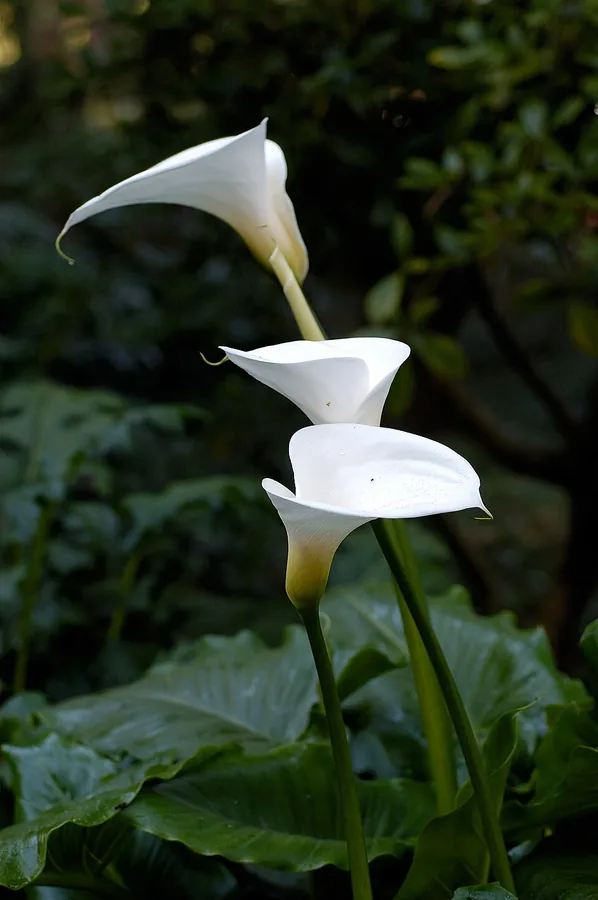
The calla lily presents one of the cleanest forms in cultivation: a single curled spathe enclosing a slender golden spadix. Botanically it sits not among the true lilies but within the arum family, native to southern Africa and grown worldwide for cut flowers and summer bedding. The familiar form is pure white, while the broader genus extends into cream, yellow, and deep wine tones.
Growth proceeds from a stout underground rhizome, and the plant behaves as a returning perennial in mild regions. Its tolerance of saturated soil is the trait that sets it apart from most bulbs: the rhizome will sit in boggy ground or at a pond margin and even withstand standing water up to about a foot deep. Because the species evolved in wet habitats, the conventional fear of overwatering carries little weight during active growth.
Ornamental value aside, the entire plant is toxic to people and animals. Each part contains insoluble calcium oxalate crystals, which inflict mechanical and chemical irritation on any tissue that bites them, so the calla is a flower for display rather than consumption. Position it where pets and small children cannot access the foliage or the sap.
Care
The short version: full sun to partial shade, soil held rich and reliably moist, a balanced fertilizer through the growing months, and division of the rhizomes every year or two as the clump becomes crowded.
Light
Flowering is strongest in full sun, since higher light supports the energy demand of bloom production, yet the plant accepts partial shade, which proves useful where summers run hot. Greater light also yields sturdier, more upright flower stems.
Water
This species is adapted to saturated ground, so hold the soil consistently moist to boggy and irrigate every 2 to 4 days during active growth, never allowing it to dry. It tolerates standing water up to about a foot deep, which is why erring toward damp carries no penalty.
Soil
Use rich, humusy clay or loam high in organic matter, the medium that best retains the moisture the rhizome demands. Unlike most bulbs it withstands poor drainage and occasional flooding, and it performs across a broad pH range of 6.0 to 8.0.
Temperature
It functions across roughly 10°F to 86°F (-12°C to 30°C) but performs best in mild summer warmth. Hard freezing induces dormancy, so where winters are severe the rhizomes require lifting or a heavy mulch to survive.
Humidity
The plant favors humid air, consistent with its origin in wet ground and along pond margins. Dry air alone does little damage provided soil moisture is maintained, since the roots, not the leaves, govern its water status.
Feeding
Apply a balanced general-purpose fertilizer monthly through spring and summer while growth is vigorous and nutrient uptake is high. Reduce feeding as the foliage senesces and the plant transitions toward dormancy.
Pruning
Remove spent flower stalks and any yellowing or dead foliage to maintain the clump and redirect resources. After the foliage dies down for the season, cut it back as the plant enters dormancy.
Repotting
Divide and repot every 1 to 2 years, or sooner once the clump becomes congested. Rhizomes filling the container, declining flower output, and roots emerging from the drainage holes all indicate the rhizomes have outgrown their space.
Size & spacing
A mature specimen reaches 2 to 3 feet (61 to 99 cm) in height and spreads 12 to 24 inches (30 to 61 cm). Space rhizomes about 12 to 18 inches (30 to 46 cm) apart so each clump has adequate room to develop.
When to plant
Calla growth is temperature-driven and resumes as soil warms. In cold-winter regions, start rhizomes indoors in late winter so they are established before transplanting outdoors after frost. Flowering follows in early summer, with the peak display through June and July.
Northern hemisphere
Southern hemisphere
Typical months for a temperate climate: start earlier in warm zones, later where spring frosts linger.
- Sow: Start rhizomes indoors in late winter to early spring in cold-winter areas.
- Plant: Plant rhizomes outdoors in spring after frost, 3-4 inches deep and 12-18 inches apart.
- Harvest: Blooms June to July.
Hardiness
USDA hardiness zones: 8–10
Temperature: down to -12°C
Troubleshooting
Calla problems concentrate either at the rhizome or on the foliage. The serious one is rot, which traces directly to waterlogged, oxygen-poor soil, whereas beetles and thrips remain largely cosmetic. Match the symptom below to its cause and intervene early.
Soft, mushy rhizome and collapsing leaves
A soft, mushy rhizome with collapsing foliage indicates rhizome rot, which develops when soil remains waterlogged and oxygen-deprived, allowing fungal and bacterial pathogens to take hold. Lift the rhizome and inspect it, discarding any brown, foul-smelling tissue. On rhizomes still worth saving, excise the soft tissue, allow the cuts to cure, then replant in better-drained, aerated soil.
Fix:
- Lift affected rhizomes and discard rotted ones
- Cut away soft tissue from salvageable rhizomes and let cure
- Replant healthy rhizomes in better-drained, aerated soil
Leaves chewed to lace and flowers torn up
Foliage chewed to lace and damaged blooms point to Japanese beetles, metallic green-bronze insects that congregate on leaves and flowers through summer. Hand-pick them into soapy water as the most direct control. Sustained removal matters on heavily infested plants, because reducing the early population limits the number that follows to feed.
Fix:
- Handpick beetles into soapy water
- Reduce populations on heavily infested plants
Silvery, stippled patches on the leaves
A silvered, stippled leaf surface, often accompanied by black frass specks beneath, results from banded greenhouse thrips rasping the tissue and feeding on the released cell contents. Remove and dispose of the most heavily infested foliage to lower the population. Maintaining vigor through adequate water and feeding then allows a healthy calla to outgrow the light damage thrips cause.
Fix:
- Remove and dispose of heavily infested foliage
- Improve growing conditions to support plant vigor
Toxicity
Regard every calla as inedible without exception. All parts contain insoluble calcium oxalate crystals, needle-shaped raphides that penetrate soft tissue on contact and produce immediate burning, salivation, and swelling. The hazard extends to cats, dogs, horses, livestock, rabbits, birds, and people, and the sap irritates exposed skin as well, so wash hands after handling and keep the plant beyond the reach of pets and children.
Toxic to
Cats · Dogs · Horses · Rabbits · Livestock · Birds · People
Cats Toxic
A cat that bites any part experiences the irritation immediately, manifesting as pawing at the mouth, profuse drooling, and vomiting. Swelling of the lips and tongue follows, and swallowing becomes painful as the crystals act on the soft tissue.
Dogs Toxic
A dog that chews the leaves or sap drools heavily and gags, frequently with a swollen, sore mouth. The acute sting of the crystals causes most dogs to retreat quickly, so ingestion rarely reaches a level that produces lasting harm.
Horses Toxic
In horses the crystals scald the mouth and tongue, producing swelling, drooling, and a marked reluctance to feed. Because horses cannot vomit, the clinical picture centers on oral soreness and the refusal of feed rather than gastric signs.
Rabbits Toxic
The insoluble calcium oxalate that affects cats and dogs irritates a rabbit's mouth and gut in the same manner. Keep callas, cuttings, and dropped leaves well clear of any rabbit grazing in the vicinity.
Livestock Toxic
Cattle, sheep, and goats grazing the foliage develop mouth and throat irritation, drooling, and gastrointestinal upset. The acrid taste normally deters them, though hungry animals on poor pasture may consume it despite the deterrent.
Birds Toxic
The same irritant crystals are present in the leaves and sap for birds, so a parrot or chicken that pecks the plant can develop a sore, swollen mouth. Excluding birds from the plant entirely is the prudent course.
People Caution
No part of the calla is edible, and ingestion produces immediate burning of the lips, tongue, and throat together with drooling and swelling. The sap alone can leave skin itchy and raw, so wash after handling and keep children well away from the plant.
Keep plant, cut flowers, and sap away from pets and children; wash hands after handling as the sap can cause skin and mouth irritation.
Helpline numbers

United States
ASPCA Animal Poison Control: (888) 426-4435 (fee applies)
Poison Control: (800) 222-1222



Canada
Poison Centres: 1-844-764-7669
Varieties
Most callas in trade are selections of the white arum lily, distinguished chiefly by spathe size or coloration. The two below are the most widely encountered.
White Giant
White Giant is a large-flowered selection valued for its oversized pure white spathes, the most conspicuous of the classic callas.
Green Goddess
Green Goddess carries spathes that are white at the base and grade to green toward the tips, producing a distinctly two-tone bloom.
How to propagate
Callas propagate readily, and division of an established clump is the most efficient method for producing additional flowering plants.
DivisionEasy
Early spring or late summer to early fall · One growing season
Division of a crowded clump is the simplest method of increase. Carry it out in early spring or during the cooler period from late summer into fall, lifting the rhizomes and separating them by hand. Each healthy division establishes and reaches full size within a single growing season.
SeedModerate
When ripe seed is available · Multiple seasons to flowering
Seed propagation requires patience, since seedlings need several seasons of vegetative growth before they reach flowering size. Sow ripe seed when it is available, but recognize the long lead time. For producing flowering plants quickly, division remains the more efficient option.
Bulbs & cormsEasy
Spring · One growing season
Purchased rhizomes are the standard starting point. Plant them in spring at 3 to 4 inches deep and 12 to 18 inches apart, and they will develop and flower within their first season.
Myths
The calla lily is a true lily and causes fatal kidney failure in cats like Easter and tiger lilies do.
The common name misleads, because the calla is not a true lily but a member of the arum family. It does not produce the acute kidney failure that genuine lilies cause in cats. Its toxin is instead a load of insoluble calcium oxalate crystals, which irritate the mouth and provoke drooling and vomiting in cats and dogs, an outcome that is painful but seldom life-threatening.