Bulb · Araceae
Elephant Ear
Colocasia esculenta
Built for wet ground and warmth, elephant ear converts rich soil and constant moisture into huge tropical leaves across the season.
Full sun
45–86°F · 7–30°C
USDA 8–11
3–6 ft · 0.9–1.8 m
Overview
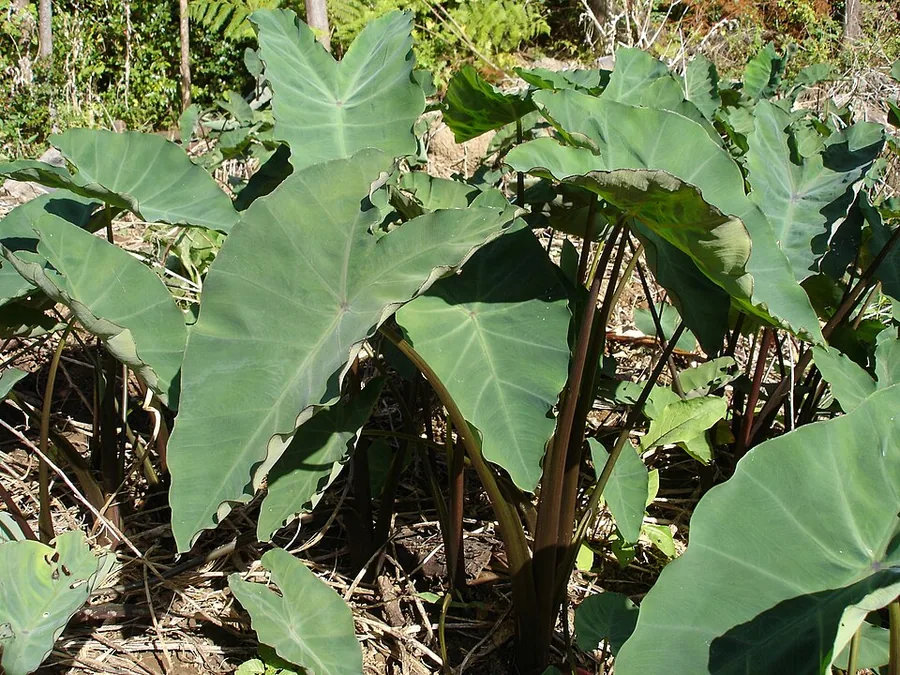
Elephant ear, a tender herbaceous member of the arum family, reads as pure tropical foliage. Its heart-shaped blades extend past 3 feet (91 cm) on upright petioles, an arrangement suited to lifting that large leaf area above wet ground at a pond edge or damp bed. It grows from a starchy corm, the storage organ known in cultivation and the kitchen as taro.
Its native warm, wet habitat explains its hardiness limits. Across zones 8 to 11 the corm survives in the ground and the plant returns each year, while colder regions force annual culture or indoor storage of the dormant corm. Because it evolved in saturated soils, it tolerates shallow standing water at a pond margin where most ornamentals would suffer root rot.
Vigor here follows water and feeding. Saturated soil keeps the wide leaf surfaces supplied against high transpiration, sustained feeding fuels the rapid leaf expansion, and wind shelter protects the thin, oversized blades from tearing. The result is a fast, bold clump, though every raw tissue is toxic, so placement should account for pets and children.
Care
The short version: rich, constantly saturated soil that never dries, full sun to part shade, sustained warmth, and a monthly feed through spring and summer, with the corms lifted before frost wherever the plant is not hardy.
Light
Elephant ear performs best in full sun, which drives the largest leaves, and it accepts part sun to part shade with reduced size. In hot climates the high light that fuels growth also raises transpiration beyond what the roots can replace, so afternoon shade prevents the marginal scorch that follows.
Water
Water is the limiting factor for this bog species. It requires constantly wet, boggy soil and must never dry, and it grows readily as a pond marginal in up to 6 inches of standing water. Demand rises with sun and heat, because the broad leaves transpire heavily and the roots must keep pace.
Soil
It needs fertile, humus-rich clay or loam that retains moisture, a medium most plants would find too saturated. Its tolerance of occasional flooding reflects the wetland origin and is precisely what allows it to hold at a pond edge.
Temperature
Growth proceeds from about 45°F to 86°F (7°C to 30°C) and slows as temperatures fall toward the lower end. The plant carries no frost tolerance, so the first freeze kills the top growth and ends the above-ground season.
Humidity
Its tropical origin gives it a preference for high humidity. Moist air lowers the vapor pressure deficit across the large leaves and limits marginal drying, which is part of why it succeeds in waterside settings.
Feeding
During the spring and summer growth flush, apply a balanced fertilizer once a month. The combination of rich soil and regular nutrients supports the rapid expansion of the oversized foliage that defines the plant.
Pruning
Maintenance is limited to removal of spent tissue. Cut away tattered, yellowing, or frost-damaged leaves as they decline, and provide wind shelter, since gusts tear the large, soft blades.
Repotting
Divide and repot the corms in spring as clumps enlarge. Crowded corms, reduced leaf size, or a clump pushing up out of the pot indicate that competition has set in and the planting should be split.
Size & spacing
A mature clump reaches 3 to 6 feet (91 to 183 cm) in both height and spread. Space plants accordingly so the large leaves can expand fully without overlapping and shading one another.
When to plant
Elephant ear is governed by heat and has no frost tolerance, which sets its calendar. Plant the corms in mid-spring once soil temperatures have risen and frost has passed, allow foliage to develop through the warm months, then lift the corms before the first fall frost in regions where the plant is not hardy.
Northern hemisphere
Southern hemisphere
Typical months for a temperate climate: start earlier in warm zones, later where spring frosts linger.
- Plant: Plant corms in mid-spring after the soil warms and frost danger has passed
- Harvest: Rarely flowers in cultivation (yellowish-white spathe); grown as a foliage plant
Hardiness
USDA hardiness zones: 8–11
Temperature: down to -12°C
Troubleshooting
With few serious pests, elephant ear's problems almost always reduce to two stresses, water shortage and cold. The large, thin leaves register both quickly, so the foliage itself is the diagnostic. Match the symptom below and correct the underlying condition before further leaf area is lost.
Browning, scorched leaf margins with wilting foliage
These are the signs of water stress in a bog plant. Held in full hot sun, the wide leaves transpire faster than dry soil can supply, and the thin margins desiccate and brown first. Water deeply to restore saturation, mulch to buffer the soil moisture, and add afternoon shade where summers are severe.
Fix:
- Water deeply and keep soil consistently wet
- Mulch to retain moisture
- Provide afternoon shade in hot climates
Foliage collapses and blackens after a cold night
This is frost damage to a frost-tender tropical, appearing the moment freezing air reaches the tissue. The first fall frost blackens the foliage overnight as the cells rupture. Remove the killed leaves, then lift and store the corms in a cool, dry place above 45°F (7°C) until spring.
Fix:
- Cut back damaged foliage
- Dig corms after first frost and overwinter in a cool, dry place above 45°F
Toxicity
The hazard here is mechanical and chemical at once. Leaves, stems, and corm hold insoluble calcium oxalate crystals in needle-shaped bundles called raphides, which on chewing drive into the mucous membranes and cause immediate local burning and swelling of the mouth and throat rather than systemic poisoning. This affects cats, dogs, horses, and people alike; only thorough cooking of the corm breaks down the hazard to yield edible taro, so the raw plant must stay away from pets, livestock, and children.
Toxic to
Cats · Dogs · Horses · Rabbits · Livestock · Birds · People
Cats Moderate
When a cat bites a leaf the raphides drive into the oral lining and cause an immediate, painful sting, followed by heavy drooling, pawing at the face, a swollen mouth and tongue, vomiting, and difficulty swallowing.
Dogs Moderate
Contact burns a dog's mouth at once, so most release the plant quickly, with drooling, retching, a swollen tongue, and difficulty swallowing developing afterward.
Horses Moderate
A grazing horse sustains the same oral and labial burning, accompanied by drooling and a reluctance to eat as the tissue swells.
Rabbits Toxic
The same raphides irritate the mouth and gastrointestinal tract of a rabbit, and the small body size leaves little margin, so the plant should be kept entirely out of reach.
Livestock Toxic
Cattle, goats, and sheep that browse the raw foliage develop painful mouth swelling and digestive upset and may refuse feed while the oral tissue recovers.
Birds Toxic
A bird that nibbles the leaves takes the same caustic injury to the mouth and crop, so the entire raw plant should be considered unsafe for them.
People Caution
Raw, every part irritates the mouth and throat and can swell the airway, which rules it out as a fresh green. The corm becomes the edible taro only after thorough cooking in salted water; properly cooked it is safe, raw it is not.
Wear gloves when dividing corms; plant sap and raphides can irritate skin and mucous membranes.
Helpline numbers

United States
ASPCA Animal Poison Control: (888) 426-4435 (fee applies)
Poison Control: (800) 222-1222



Canada
Poison Centres: 1-844-764-7669
Varieties
The cultivars in cultivation are selected chiefly for dark leaf pigmentation rather than form. The selections below are the most frequently grown and the easiest to tell apart.
'Black Magic'
It bears dusky purple-black leaf blades on stems of matching dark color, reading as near-charcoal overall.
'Illustris'
It shows dark, near-black blades laced with bright green veins that contrast sharply against the deep pigment.
'Black Coral'
It holds glossy, ruffled foliage in a deep blue-black that reflects light off the leaf surface.
'Mojito'
It carries green leaves marked at random with flecks and splashes of dark purple-black, so individual leaves differ.
How to propagate
Propagation mirrors the plant's natural spread through its corms, so vegetative division of an existing clump is the standard and most reliable route to new plants.
DivisionEasy
Spring, as new growth begins · A few weeks to establish in warm, moist conditions
Divide a clump in spring as new growth begins, which is the most dependable method. Separate the corms, pot them into a rich, peaty mix, and hold them constantly moist. Under warm conditions they establish within a few weeks.
Bulbs & cormsEasy
Plant corms in mid-spring after frost · Sprouts and establishes over several weeks once soil is warm
Stored corms can also be planted in mid-spring once frost has passed and the soil has warmed, after which they sprout and root over several weeks. In zones colder than the hardy range, lift the corms each fall and overwinter them above 45°F (7°C).
Myths
Elephant ear and taro are poisonous, so they can never be eaten.
In raw form the plant is indeed toxic, because insoluble calcium oxalate raphides irritate the mouth on contact. The corm, however, is a tropical staple and the taro behind Hawaiian poi once it has been cooked through in salted water, which breaks down the irritant. Cooking renders it edible; raw, it remains poisonous.