Houseplant · Orchidaceae
Vanda Orchid
Vanda
A monopodial epiphyte that thrives on bright light and high humidity, soaked bare-root at the aerial roots and rewarded with large, lasting blooms.
Full sun
Every 1–2 days
59–95°F · 15–35°C
USDA 10–12
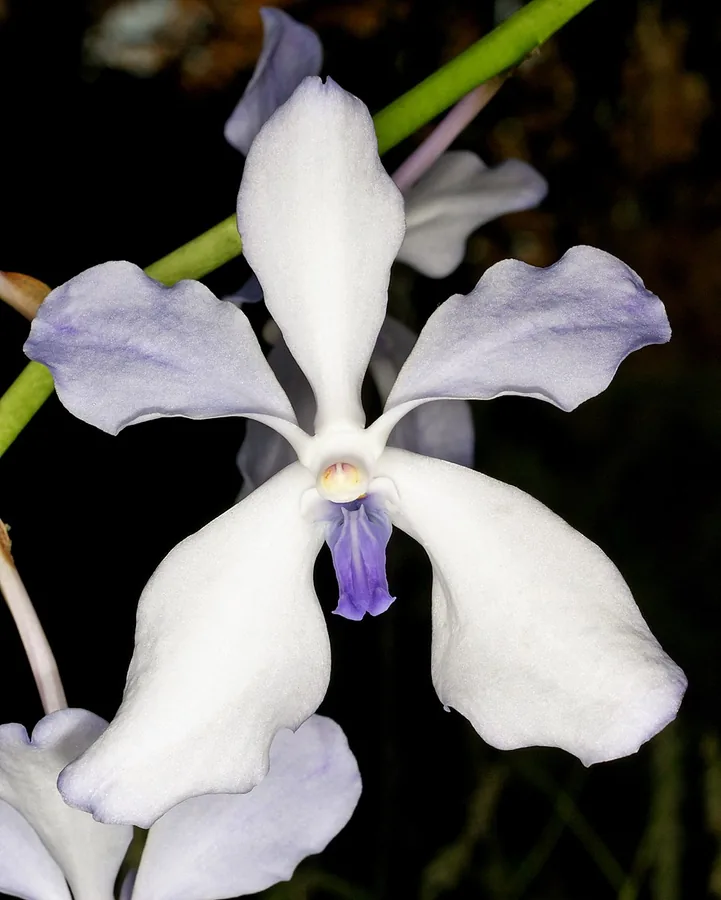
Overview
The Vanda is a monopodial epiphyte native to tropical Asia, which means it extends from a single apical growing point rather than branching or spreading laterally. In habitat it anchors to tree bark by thick aerial roots and takes up water and nutrients directly from rainfall and atmospheric moisture, never from a substrate. That epiphytic biology dictates its entire culture, which is why the plant is grown bare-root in an open slatted basket with the roots exposed to free air.
This is a demanding orchid because its light requirement approaches full sun, and that demand is coupled with warmth and humidity at greenhouse levels. When those thresholds are met the genus produces large, flat, long-lived flowers spanning colors from the rare true blue of Vanda coerulea to deep pinks and golds. When light in particular falls short, the plant continues vegetative growth but withholds flowering, which is the usual reason a healthy-looking Vanda fails to bloom.
Flowering in Vanda is not bound to a season under indoor conditions. Given adequate light, warmth, and humidity, a vigorous plant can flower more than once in a year, cycling on its own physiological schedule rather than a fixed seasonal trigger.
Care
The short version: supply the highest light intensity you can provide, hold temperatures between 59°F and 95°F (15°C to 35°C), and maintain relative humidity of 70% to 90%. Drench the bare roots daily until the velamen flushes green, allow it to silver between soakings, and keep air circulating to prevent rot.
Light
Vanda sit at the high end of orchid light demand and require near-full sun to initiate flowering; bright indirect or partial sun sustains the plant but rarely triggers blooms. Use leaf color as the diagnostic, since foliage held at a firm yellow-green indicates sufficient light while dark green signals a deficit. Raise the exposure across several weeks so the tissue acclimates and does not scorch.
Water
The thick aerial roots are drenched daily, and often twice daily under heat, until the velamen turns from silver to green and is fully hydrated. They are then allowed to dry back to silver before the next soaking, a wet-then-dry cycle that denies pathogens the standing moisture rot requires. Because the plant is grown bare-root in moving air, it tolerates this frequency without the medium staying saturated.
Soil
Most Vanda are cultivated bare-root with no medium, the roots suspended in an open slatted basket so air reaches them freely. Where potting is preferred, only very coarse bark or charcoal in an open basket is suitable, because instant drainage and aeration are what keep the roots alive. The genus favors slightly acidic conditions in the range of a pH of 5.5 to 6.5.
Temperature
Maintain warmth in the range of 59°F to 95°F (15°C to 35°C). Cold is the limiting stress for this genus, since low temperatures can blacken the leaf bases and precipitate rot, so exclude cold drafts and prevent nighttime lows from falling below tolerance.
Humidity
Vanda require high atmospheric moisture, on the order of 70% to 90%, which exceeds typical indoor levels. That humidity must be paired with continuous air movement, because stagnant saturated air is the specific condition under which root and crown rot develop.
Feeding
Apply a balanced water-soluble orchid fertilizer weekly, at low concentration, delivered together with the frequent watering so the dilute feed reaches the roots at every soaking. Continue year-round through active growth, concentrating the heaviest feeding in spring and summer when growth peaks.
Pruning
Pruning needs are minimal. Remove spent flower spikes after flowering and excise dead or rotted aerial roots, but retain every healthy green or silver root, since those are functional water-absorbing organs. Never cut the single growing stem, because a monopodial orchid has one apical meristem and cannot regenerate it.
Repotting
Because Vanda resent root disturbance, repot only every 2 to 3 years or when the basket itself deteriorates. The indications are roots overflowing and circling outside the basket, slats rotting or breaking, and a stem grown top-heavy enough to become unstable.
Size & spacing
On its single erect stem a mature Vanda reaches 1 to 3 feet (30 to 100 cm) in height, with a leaf span of 8 to 16 inches (20 to 40 cm). Position each plant so the pendant aerial roots have unobstructed air on all sides.
Troubleshooting
Most disorders in Vanda originate at the roots or trace to the light regime, so those are the first two things to assess. Root health reads quickly, since sound roots flush green within minutes of watering as the tissue rehydrates. Identify the symptom below and intervene early, because both rot and scorch progress rapidly once established.
Aerial roots browning and turning mushy rather than green
The disorder is root rot, and it follows from moisture held against the root surface with insufficient drying. The primary driver is stagnant water or a trapped, packed medium that excludes air, whereas the inverse fault, prolonged dryness in low humidity, produces shriveling rather than mush. Excise the dead tissue with a sterile blade, transfer the plant to a more open basket with strong circulation, and reinstate daily drenching that silvers off between waterings.
Fix:
- Remove dead rotted root sections with a sterile blade
- Move plant to a more open basket with strong air circulation
- Resume daily drenching but ensure roots dry to silver between waterings
Lower-leaf yellowing or blackening tissue at the leaf bases
Soft black crown and base rot develops after cold nights or when water is left standing in the leaf axils overnight. A single aged lower leaf yellowing is a normal senescence event, but blackened bases are pathological, so the location of onset is diagnostic. Move the plant to reliably warm conditions above 15°C (59°F), water early enough that the foliage dries before nightfall, and cut out the rotted tissue with a sterile blade.
Fix:
- Move plant to consistently warm conditions above 15°C
- Water early in the day so foliage dries before night
- Cut away blackened rotted tissue with a sterile blade
Bleached tan lesions scorched into the leaf surface
The damage is sunburn, produced when the plant is moved into intense direct sun without prior acclimation, and heat combined with dry air intensifies it. The lesions form on the upper leaf surfaces oriented toward the light and deepen through the peak-sun hours, which confirms the cause. Return the plant to bright light with light midday shade, raise humidity and airflow to cool the tissue, then increase exposure incrementally over several weeks.
Fix:
- Shift to bright light with light shade during the hottest midday hours
- Increase humidity and airflow to cool the foliage
- Acclimate gradually to higher light over several weeks
Vigorous foliage and roots but a persistent failure to flower
When vegetative growth is strong but flowering never occurs, the cause is almost always insufficient light. Leaf color confirms it, since dark green, soft foliage indicates a light deficit while firm, faintly yellow-green foliage indicates an adequate supply. Increase light toward full sun with proper acclimation, hold warm and humid conditions, and feed consistently with a balanced orchid fertilizer.
Fix:
- Increase light to near-full-sun levels with adequate acclimation
- Maintain warm temperatures and high humidity
- Feed regularly with a balanced orchid fertilizer
Toxicity
For a household with animals, the Vanda presents no toxic risk and is classed as non-toxic to pets and people. The ASPCA records orchids as safe for cats and dogs, and no toxic constituent has been documented in Vanda. The practical hazard runs in the opposite direction, since a chewing animal can destroy a specimen that took years to develop.
Safe for
People · Cats · Dogs · Horses · Rabbits · Livestock · Birds
Cats None
Non-toxic to cats. Ingestion of leaf tissue will not poison a cat, though a large volume of any plant material can provoke transient drooling or mild gastrointestinal upset.
Dogs None
Non-toxic to dogs. The orchid contains no toxic principle, so the only plausible effect is the mild digestive upset that accompanies overconsumption of plant matter.
Horses Safe
No toxicity is documented in horses. A horse that mouths the foliage during grazing is exposed to no harmful compound from the plant.
Rabbits Safe
Non-toxic to rabbits. The foliage holds no recognized poison, so incidental chewing is harmless, although a stem is best positioned out of reach to preserve the specimen.
Livestock Safe
Regarded as non-toxic to livestock including goats, sheep, and cattle, with no toxic compounds recorded in the tissue.
Birds Safe
Non-toxic to birds. A pet bird that pecks foliage or flowers is exposed to no toxin from this orchid.
People Safe
Non-toxic to people. The plant is not cultivated for consumption, but accidental tasting by a child carries no risk of poisoning.
Considered safe around pets; mild stomach upset is still possible if a curious animal eats large amounts of any plant material.
Varieties
A small set of Vanda recur in cultivation, valued either as species in their own right or as the breeding parents behind current hybrids. The names below are the ones worth recognizing.
Vanda coerulea
Valued for its uncommon blue-to-violet tessellated flowers, this species underlies a large proportion of the blue-toned hybrids in commerce.
Vanda Miss Joaquim
A historic natural hybrid that was designated the national flower of Singapore.
Vanda sanderiana
A large-flowered species sometimes classified in Euanthe and used extensively as a parent in breeding the showy modern Vanda hybrids.
How to propagate
Vegetative increase in Vanda is slow and unreliable, so most growers acquire plants rather than propagate them. The methods that do work require a mature specimen and considerable time before an independent plant results.
Stem cuttingsDemanding
Spring to early summer during active growth · Several months to over a year to establish as an independent plant
Only a mature, tall specimen bearing several aerial roots is a candidate for top-cutting, and the optimal window is spring to early summer during active growth. Sever the upper portion of the stem so the cutting retains several healthy aerial roots, then pot or basket it, after which the remaining rooted base may produce new growths. Establishment is slow, spanning several months to more than a year before the cutting functions as an independent plant, and the operation stresses the parent orchid.
Offsets & pupsModerate
When a keiki has formed several of its own roots, typically in the growing season · Several months once the keiki has rooted
Vanda occasionally produce a keiki, a small plantlet arising at the base or along the stem, most often during the growing season. Leave it attached until it has developed 2 to 3 roots several centimeters long, then separate it and mount it independently. After rooting, the keiki requires several months to establish as a plant in its own right.
Myths
Vanda orchids require potting soil in the manner of ordinary houseplants.
As epiphytes, their roots depend on air exchange and cannot function packed in substrate. Cultivate them bare-root in a slatted basket or in very coarse, open material. Enclosed in soil, the roots are deprived of air and rot.
Orchids are toxic and dangerous to cats and dogs.
The ASPCA classifies orchids as non-toxic to cats and dogs, and no toxic compound has been documented in Vanda. The plant is safe to keep in a household with pets, allowing that a large quantity of any foliage can upset a sensitive digestive system.