Houseplant · Orchidaceae
Cymbidium Orchid
Cymbidium
Supply bright light and cool fall nights, and the cymbidium responds with long, arching sprays of bloom.
Bright indirect
Every 5–7 days
50–86°F · 10–30°C
USDA 10–12
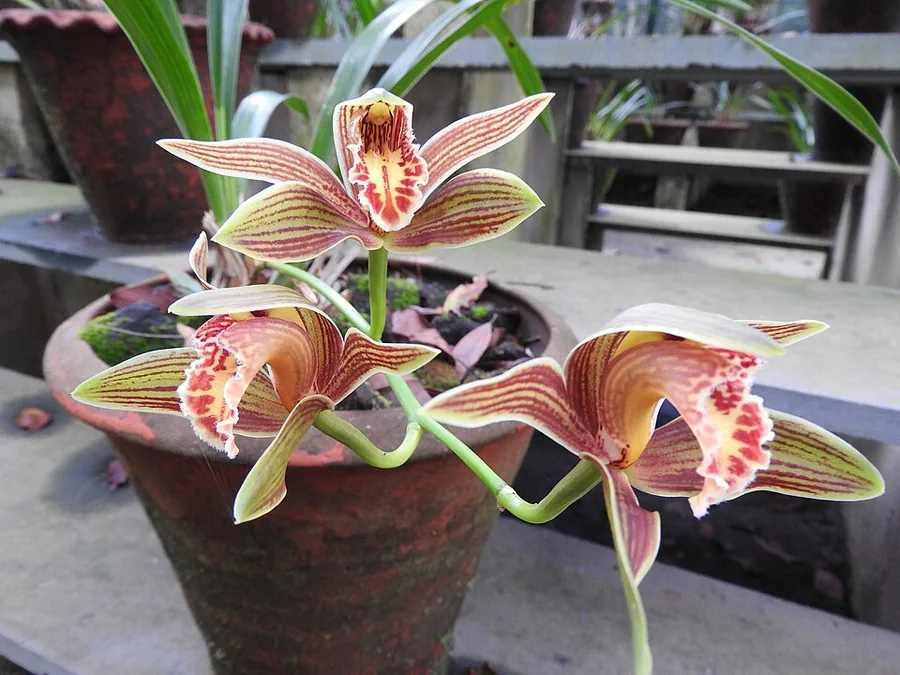
Overview
The cymbidium, botanically the boat orchid, sits among the more tractable orchids for indoor culture. Growth proceeds from swollen storage stems known as pseudobulbs, each carrying long strap-shaped leaves and arching inflorescences that remain in flower for weeks through late winter and spring. The genus is terrestrial to semi-terrestrial, which is why cultivation uses a loose bark medium rather than the mounted, epiphytic approach suited to tree-dwelling orchids.
Its defining requirement is a cold cue. The plant depends on a run of cool fall nights to initiate flower spikes, so a specimen held at uniform warmth through the year invests its resources in vegetative growth and produces no inflorescence. Reproduce the natural seasonal pattern, bright light across the year paired with that autumn drop in night temperature, and flowering follows as a matter of physiology.
Cultural tolerance is wide once two preferences are respected: the bark medium should stay evenly moist yet never saturated, and the root mass performs best when slightly confined within its container. Under sound management a single clump persists for many years, broadening in girth and flowering more freely with each successive season.
Care
The short version: bright indirect light year round, a bark medium kept evenly moist but never saturated, and a sustained run of cool fall nights to initiate the blooms. Feed weekly during active growth at a dilute rate, and repot only at intervals of a couple of years.
Light
Cymbidiums require bright indirect light, full and strong through winter but filtered in summer so the foliage is not scorched. A light deficit is the second most frequent reason a plant withholds flowers, after the absence of cool nights.
Water
Water thoroughly with tepid water every 5 to 7 days, holding the bark evenly moist but never saturated, and allow all surplus to drain. The medium should retain moisture without remaining wet, because standing water around the roots is the most direct cause of rot.
Soil
Use a bark-based orchid mix with free drainage rather than ordinary potting soil, which excludes air and suffocates the roots. A slightly acidic pH of 5.5 to 6.5 is appropriate, and the coarse bark maintains the gas exchange the roots depend on.
Temperature
The plant accepts a broad span from roughly 50°F to 86°F (10°C to 30°C). The operative factor is the seasonal amplitude, since the run of cool fall nights is the physiological signal that triggers spike initiation.
Humidity
Provide 50% to 70% relative humidity, a level above what most heated rooms hold in winter. A pebble tray or a nearby humidifier raises it, while steady air movement prevents the damp foliage from favoring pests and fungal rot.
Feeding
Apply a balanced fertilizer at quarter or half strength weekly from spring through fall, always after watering so the dilute solution never contacts dry roots. Reduce feeding through winter as metabolic activity slows.
Pruning
No structural pruning is warranted. Once flowering ends, cut the spent spike back to the base and remove any yellowed or dead leaves to limit decaying tissue and preserve airflow through the clump.
Repotting
Repot only every 2 to 3 years, in spring after flowering, because a degree of root confinement actually promotes flowering. Move up only when the leading pseudobulb meets the pot wall, the roots crowd or escape, or the bark has decomposed and holds water.
Size & spacing
A mature clump attains 1 to 4 feet (30 to 120 cm) in height and 9 to 35 inches (23 to 90 cm) in spread, the foliage and arching inflorescences accounting for most of the vertical dimension. Allow lateral room so the spikes can arch outward without contacting adjacent surfaces.
Troubleshooting
The bulk of cymbidium failures resolve to three mechanisms: a light or temperature deficit at the wrong point in the seasonal cycle, infestation by common houseplant pests, or chronic saturation of the root zone. Identify the pattern below and intervene early, before a recoverable setback escalates into root loss.
Blackened, mushy roots and a soggy crown
These symptoms describe root rot, the result of a medium held too wet, usually once decomposed bark has lost its open structure and ceased to drain. Lift the plant and assess the roots, since living tissue stays firm and pale while rotted tissue turns brown and collapses under pressure. Excise the dead roots, repot into fresh open bark, and lengthen the interval between waterings.
Fix:
- Remove rotted roots and repot into fresh well-draining bark medium
- Reduce watering frequency and ensure free drainage
Vigorous foliage with no flower spikes
A well-grown cymbidium that refuses to bloom has almost always been denied its cool fall nights, because spike initiation depends on the day-to-night temperature differential of autumn. Insufficient winter light compounds the problem by limiting the energy available for flowering. Supply strong seasonal light and a sustained run of cold autumn nights, and spike formation resumes.
Fix:
- Expose to cool fall nights with a marked day-night temperature drop
- Increase light to full winter light and bright filtered summer light
Stippled, yellowing leaves with webbing or sticky film
Fine stippling with delicate webbing indicates spider mites feeding on cell contents, whereas soft clustered insects leaving a sticky honeydew point to aphids. Both colonize leaf undersides and tender new growth, where the cuticle is thinnest. Rinse the foliage to dislodge them, wipe the survivors away, then apply insecticidal soap or horticultural oil and repeat until the population collapses.
Fix:
- Rinse foliage and wipe off pests
- Treat with insecticidal soap or horticultural oil, repeating as needed
Toxicity
For households with pets or children the verdict is clear: the cymbidium is non-toxic. The ASPCA records orchids as safe for cats, dogs, and horses, and that assessment extends to the other animals likely to share a home. A pet that ingests a leaf may experience brief gastrointestinal upset from the indigestible roughage, but no poisonous principle is present.
Safe for
People · Cats · Dogs · Horses · Rabbits · Livestock · Birds
Cats None
Cats face no toxic risk. Ingested foliage acts only as indigestible roughage, so a brief stomach upset is the limit of any reaction.
Dogs None
Dogs are equally unaffected. The most a chewing dog encounters is transient, self-resolving gastrointestinal upset.
Horses Safe
Horses are not at risk. The foliage contains no compound capable of poisoning them.
Rabbits Safe
Rabbits tolerate it without harm, though it offers no nutritional value and should never displace their normal forage.
Livestock Safe
Cattle, goats, and sheep are in no danger of poisoning from this orchid.
Birds Safe
Pet birds may perch alongside it safely, as the plant produces no toxic compounds.
People Safe
People, children included, are unharmed by it. The plant is simply not cultivated for consumption.
Although non-toxic, eating large amounts of any plant material may cause mild, temporary stomach upset.
Varieties
The genus encompasses hundreds of species and hybrids, ranging from cool-growing wild forms to award-winning crosses selected for color and flower form. The following are a representative few worth knowing.
Cymbidium erythraeum
A cool-growing species whose consistent garden performance has secured it the RHS Award of Garden Merit.
Cymbidium lowianum
A large species producing long arching sprays of green flowers, each lip marked with red, and another holder of the Award of Garden Merit.
Cymbidium Sarah Jean gx 'Ice Cascade'
A white-flowered hybrid of cascading habit best displayed where it can spill over the rim of a raised pot or shelf.
Cymbidium Tiger Tail gx
An Award of Garden Merit hybrid valued for the consistency of its patterned blooms.
How to propagate
Home propagation of cymbidiums proceeds by division rather than seed, separating one mature clump into several independent plants.
DivisionModerate
Spring, after flowering and at repotting · 1-2 years to re-establish and flower again
Propagate by dividing a crowded clump in spring, immediately after flowering and during the repotting cycle. Each division should retain at least three healthy pseudobulbs together with a leading growth, since that reserve of stored carbohydrate is what carries the piece through recovery. Anticipate a slow return to bloom, because a fresh division generally needs one to two years to re-establish and flower.
Myths
All orchids are poisonous to cats and dogs.
The ASPCA classes orchids as non-toxic to cats, dogs, and horses, and cymbidiums share that status. The worst outcome from a chewed leaf is a mild, short-lived stomach upset.
Orchids are parasites that live off other plants.
Botanically this is wrong. Cymbidiums are terrestrial to semi-terrestrial orchids rooted in their own bark medium that photosynthesize their own food in their leaves. They derive nothing from a host and never have.