Houseplant · Orchidaceae
Jewel Orchid
Ludisia discolor
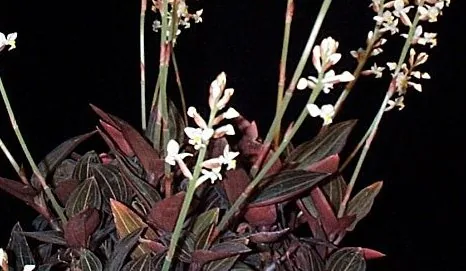
Prized for its velvet, vein-streaked leaves, the jewel orchid is the terrestrial orchid grown for foliage rather than flowers.
Medium indirect
Every 4–9 days
61–84°F · 16–29°C
USDA 10–12
Overview
The jewel orchid sits apart from the family's usual reputation. Where most orchids are epiphytes that colonize tree branches and are valued for their blooms, Ludisia discolor is a ground-dwelling terrestrial grown for its dark, velvety leaves and their tracery of bright veins. The modest white flowers it raises on upright spikes in late autumn are secondary to that foliage.
Its origins on the warm, shaded forest floors of Southeast Asia explain nearly every cultural preference. Reproduce the dappled, indirect light of that understory, hold steady warmth, and maintain humid air, and the plant advances slowly across the pot on a creeping rhizome. The undemanding nature of that regime is what makes it a sound introductory orchid for growers deterred by more exacting species.
The one intolerance to respect is saturation at the roots. The creeping rhizome that drives its spread will rot rapidly in a waterlogged medium, so the entire task reduces to holding even moisture while never allowing the plant to sit in standing water.
Care
The short version: medium indirect light, sustained warmth between 61°F and 84°F (16°C to 29°C), and high humidity. Hold the mix evenly moist but never soggy, irrigate in the morning, and feed lightly through the growing season.
Light
Site it in medium indirect light that reproduces the bright, filtered shade of a forest floor. It accommodates low light and brighter indirect exposures as well, but direct sun scorches the soft leaf surface and degrades its pigment.
Water
Maintain the medium evenly moist but never soggy, irrigating every 4 to 9 days as the surface dries. Apply tepid water in the morning so the foliage dries before dark, because persistent moisture on the leaves and at the base is what initiates rot.
Soil
Grow it in a well-drained, moisture-retentive mix formulated for houseplants or terrestrial orchids, such as potting mix or fine fir bark blended with sphagnum. Reserve coarse bark for epiphytic orchids, and target a slightly acidic pH of 5.5 to 6.5.
Temperature
It performs best in standard interior warmth between 61°F and 84°F (16°C to 29°C). Shield it from cold drafts and chilled window glass through the winter.
Humidity
This species demands humid air in the 50% to 80% range. A pebble tray, a grouping of plants, or a humidifier in a dry room supplies it, and pairing that moisture with active airflow suppresses leaf spotting.
Feeding
During the growing season from spring to autumn, apply a balanced or orchid fertilizer weekly at a quarter to half strength. Withdraw feeding through the low-light months as growth decelerates.
Pruning
Intervention is minimal. Remove spent flower spikes once flowering concludes, and strip any damaged or spotted leaves to preserve appearance and keep air moving around the crown.
Repotting
Repot every 1 to 2 years, or once the creeping rhizome begins overrunning the pot rim and the medium degrades into a soggy state. A shallow, wide pot accommodates the spreading rhizome far better than a deep container.
Size & spacing
Mature dimensions stay compact at 6 to 12 inches (15 to 30 cm) in height with a spread of 8 to 12 inches (20 to 30 cm). That slow lateral habit suits a desk, shelf, or terrarium.
Troubleshooting
Nearly every jewel orchid disorder resolves back to water, whether excess in the medium or persistence on the foliage. Identify the early indications and the correction is straightforward. Match the presentation below and intervene before rot advances.
Soft, blackened stems and structural collapse
Soft, blackened tissue is rot, driven by a medium that stays saturated and starves the rhizome of oxygen at the root zone. Once the creeping rhizome turns mushy and sour, excise every affected section back to firm tissue with a sterile blade and reset the plant into fresh, free-draining mix. Lower the watering frequency afterward and confirm the pot drains without pooling, because standing moisture is the underlying driver.
Fix:
- Remove the plant and cut away all rotted tissue with a clean blade
- Repot into fresh, well-drained mix
- Reduce watering frequency and ensure the pot drains freely
Spotting and blemishes on the velvety foliage
Leaf spotting develops where a film of water lingers on the foliage overnight or where the air around the plant stalls, both of which let pathogens settle on a wet surface. Watering at daybreak with tepid water lets the leaves dry well before nightfall, and steady air movement carries that moisture off. The cleanest safeguard is to avoid wetting the foliage during irrigation at all.
Fix:
- Water in the morning with tepid water so leaves dry before night
- Improve air circulation around the plant
- Avoid wetting the foliage when watering
Toxicity
For a household with animals, the assessment is favorable: the jewel orchid is non-toxic to cats, dogs, and the wider household menagerie. The ASPCA classifies it as safe, so a sampled leaf carries no toxic consequence. The outer limit is mild digestive upset should a pet consume a large quantity.
Safe for
People · Cats · Dogs · Horses · Rabbits · Livestock · Birds
Cats None
The ASPCA classifies this orchid as non-toxic to cats, so no toxic constituent is at work. A leaf sampled by a cat poses no real risk, and only a substantial mouthful of plant fiber is likely to trigger transient drooling or a mild digestive upset.
Dogs None
The same non-toxic status holds for dogs. With no poisonous compound present, a persistent chewer would at most experience brief gastrointestinal upset driven by the indigestible fiber rather than any toxin.
Horses Safe
Horses can graze in its vicinity without consequence, as the species carries no toxins documented to affect equines.
Rabbits Safe
The leaves and stems present no hazard to rabbits, and the plant remains safe should a rabbit sample it.
Livestock Safe
Cattle, goats, and sheep tolerate its presence, since no part of the tissue holds a compound harmful to grazing animals.
Birds Safe
Pet birds share space with this orchid safely. It presents no toxic threat, even to a bird that samples the foliage.
People Safe
The plant is safe in a household with children. It is not a culinary species, yet a leaf reaching a toddler's mouth warrants no alarm.
No special handling hazards; ingestion of large amounts of plant material may still cause mild stomach upset in pets.
Varieties
Ludisia most often reaches the trade simply as the jewel orchid, though a few named selections circulate, distinguished by the pigmentation of their leaves and veins.
'Nigrescens'
Selected for pigmentation, its velvety leaves run so dark as to appear near black, overlaid with bright red-pink veins that stand out sharply against the ground color.
'Alba'
A milder selection, it carries lighter green foliage veined in silvery-white rather than the typical red.
How to propagate
Among orchids, few propagate this readily. The creeping rhizome that carries the plant across its pot doubles as propagation stock, whether you excise a cutting or separate an established clump.
Stem cuttingsEasy
Spring to summer during active growth · 4-8 weeks to root
Stem cuttings root most readily during active growth in spring or summer, when the plant is putting energy into new tissue. Sever a segment of the creeping rhizome bearing a few nodes, set it on moist mix so those nodes contact the medium, and it initiates roots on its own across the following 4 to 8 weeks.
DivisionEasy
Spring, at repotting · 4-8 weeks
Division pairs naturally with a spring repot, since the plant is already unpotted. Separate the rhizome into sections, ensuring each piece keeps its own roots and growing stems so every division can support itself, then pot them individually to re-establish over the next 4 to 8 weeks.
Myths
Jewel orchids need coarse bark like every other orchid.
Unlike the epiphytic orchids that anchor to tree branches, Ludisia discolor is terrestrial and roots in the ground. Its physiology calls for a moisture-retentive, well-drained mix, either a soil-based blend or fine bark cut with sphagnum, rather than the chunky bark suited to a moth orchid's aerial roots.
Orchids are poisonous to cats and dogs.
The ASPCA classifies the jewel orchid, and orchids as a group, as non-toxic to cats and dogs. A pet that samples a leaf faces no toxic risk, though ingesting a large volume of any plant fiber can provoke short-lived gastric upset.